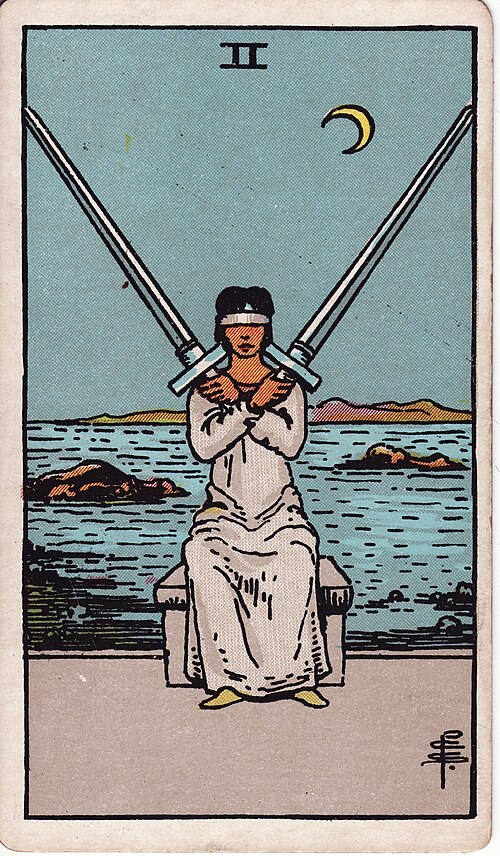
Two of Swords at a glance
The Two of Swords is the second card of the Swords suit in the Minor Arcana and position 52 in this 78-card RWS sequence. It organizes a moment of suspended judgment: two options, two claims, two boundaries, or two kinds of information held in tension. The card can describe deliberate neutrality, emotional protection, avoidance, or the time needed before a choice. It is not a fixed prediction and does not reveal an absent person's private thoughts.
What the RWS image shows
A seated figure faces forward on a stone seat near a body of water. A pale blindfold covers the eyes. The figure holds two swords crossed over the chest, with the blades rising diagonally toward opposite sides. A crescent moon appears in the dark sky, and small rocky forms or islands sit across the water. The clothing is light, while the surrounding water and sky are darker. The figure's posture is still and symmetrical, but the crossed arms and turned-away gaze suggest that stillness may be both protection and constraint.
The visible image does not tell us which option is correct or what the figure secretly knows. It supplies a structure of balance, guarded access, and incomplete visual information. In this article, RWS means the pictorial tradition associated with A. E. Waite and Pamela Colman Smith. Waite's Pictorial Key to the Tarot can be read as a historical source, while modern psychological, intuitive, and coaching interpretations should be identified as later approaches rather than treated as one universal rule.
Keywords grounded in image and tradition
Pause follows from the seated posture and lack of outward movement. Choice and stalemate follow from the two raised swords, which create a balanced but closed position. Protection follows from the crossed blades over the body. Limited information follows from the blindfold and night setting, while emotional reserve is suggested by the figure's contained expression and covered eyes. The moon and water add changing, less controllable conditions, but they do not prove deception. As a Two, the card develops a relationship between alternatives; the spread position decides whether that relationship is useful balance or costly avoidance.
Upright meaning: holding tension while preparing to choose
Upright, the Two of Swords can show a conscious pause, a boundary around overwhelming input, a fair attempt to hear both sides, or a decision that needs one more relevant fact. Its strength is restraint: the person does not rush simply to end discomfort. It can support negotiation, a cooling-off period, private reflection, or a temporary agreement not to act until terms are clearer.
- Potential strengths include impartial listening, emotional self-protection, careful comparison, patience, and the ability to keep a difficult question contained. Risks of excess include denial, false equivalence, refusing useful evidence, treating silence as neutrality, and protecting yourself so completely that no decision can be tested. Practical actions include naming the two options, writing each option's requirements and costs, identifying the missing fact, setting a decision date, and asking for clarification without demanding that another person prove a private feeling.
Reversed meaning: the stalemate shifts, but not always cleanly
Reversed does not automatically mean a negative outcome. It may indicate that a blockage is loosening, that a choice can no longer be postponed, or that hidden discomfort is entering awareness. It can also show internalized conflict, information that is being processed privately, an excess of avoidance, or a delay caused by fear of consequences. In some readings the crossed swords no longer maintain a workable balance; in others, the reversal suggests that the reader is ready to lower a defense and look again.
- For blockage, ask whether the problem is missing information, competing obligations, fear, or a boundary that has become rigid. For internalization, allow a private draft, journal entry, or quiet conversation before making a public commitment. For excess, challenge the habit of keeping every option open when the costs are already visible. For delay, choose a review point and define what new evidence would change the decision. For direction adjustment, replace the demand for perfect certainty with a reversible experiment, a clearer question, or a smaller next step.
Applications in everyday areas
- Relationships and emotions: Upright, the card may suggest a need for calm conversation, negotiated space, or time to identify your own feelings before responding. Reversed, it can show suppressed emotion, a defensive silence, or a decision about the relationship that needs to be acknowledged. Read the other person's position as observable communication and agreements, never as proof of hidden motives.
- Work and study: Upright it favors comparing methods, waiting for a missing instruction, or protecting concentration from competing demands. Reversed it may show procrastination, conflicting priorities, unclear feedback, or a choice forced by an approaching deadline. Make a decision matrix, ask the supervisor or instructor one precise question, and test the smallest workable plan.
- Money and resources: The card supports a pause before signing, spending, lending, or switching plans. Upright can mean a balanced comparison
- reversed can mean avoidance of records, delayed budgeting, or pressure that makes options look more equal than they are. Use actual numbers and qualified financial advice rather than treating the card as a market signal.
- Personal growth: The lesson is not to eliminate uncertainty but to relate to it honestly. Upright supports boundaries and measured reflection
- reversed asks whether self-protection is preventing new information, emotional acknowledgment, or a timely adjustment.
Two of Swords in spreads and positions
In a one-card reading, ask: What am I balancing, what information is missing, and what decision can I prepare without forcing it today? Upright may favor a defined pause; reversed may ask you to notice where delay has become the decision. Either way, write down what would count as useful evidence rather than asking the card to choose for you.
- In a three-card past, present, future spread, the Two in the past can describe an earlier compromise, withheld response, or unresolved fork that still shapes the present
- in the present it highlights the need to hold competing claims carefully
- in the future it suggests a possible choice point whose outcome depends on evidence and action. In a situation, action, outcome spread, it can show the current stalemate, an action of clarifying criteria or taking protected time, and an outcome of negotiated balance, a decision, or continued delay depending on the surrounding cards.
- In relationship positions, self asks where you are guarding, comparing, or postponing your own honest response
- other person should describe only their visible level of participation, stated boundary, or lack of response, not their inner certainty
- interaction shows the pattern created between you, such as mutual quiet, careful negotiation, or a conversation neither side is initiating. Reversed shifts emphasis toward a defense being lowered, a conflict surfacing, or pressure requiring a new agreement.
- In decision positions, opportunity may be a chance to gather a missing fact, preserve neutrality, or design a reversible test
- risk may be indecision, false balance, or allowing discomfort to make the choice by default
- advice is to define the standard, deadline, and evidence that matter. The Two changes from resource to risk or advice according to its position, so it cannot be reduced to a simple yes-or-no answer.
- In obstacle, advice, and outcome positions, the obstacle may be a blind spot, fear of loss, or too many unranked priorities
- advice may be to protect a short period for reflection and then ask a concrete question
- outcome may be a workable compromise or a clearly acknowledged choice. Reversed in the outcome position can indicate that the stalemate breaks, but it can also show a rushed decision made because the pressure became intolerable.
Instructional combination example
This is an instructional example, not a real case. Place the adjacent Ace of Swords before the Two of Swords in a situation and action reading. The Ace introduces a distinction, fact, or question; the Two shows that recognizing the distinction does not remove the emotional or practical cost of choosing. The pair therefore modifies simple clarity into a process: define the issue, identify the missing evidence, and set a time to decide. If the Ace is reversed, the pair may describe a confused premise feeding the stalemate, so the first action is to revise the question rather than force a choice.
Common misreadings and school differences
The blindfold is not proof that the figure is foolish, lying, or spiritually unable to see. The crossed swords are not automatically a breakup or war. The moon does not establish deception, and a pause does not guarantee that both options are equally good. Avoid using the card to read a third party's mind, diagnose anxiety, predict an accident, settle a lawsuit, guarantee an investment, or decide whether someone is safe. Those conclusions require consent, evidence, and appropriate professional help.
RWS scenic imagery makes the Two a story of a seated figure, water, moon, blindfold, and crossed swords. Marseille-style pip cards may place more weight on number, suit, symmetry, and the arrangement of swords; other decks may change the figure, setting, or emotional tone. RWS and Marseille traditions also differ in the numbering of Strength and Justice: RWS uses Strength VIII and Justice XI, while Marseille commonly uses Justice VIII and Strength XI, with some imagery differing. This knowledge base uses RWS order and primary image analysis.
Responsible use and journal prompts
Use the Two of Swords for cultural study, symbolic reflection, and better questions, not as an authority that removes responsibility. If the issue concerns health, legal exposure, debt, investment, employment rights, violence, or immediate safety, consult qualified professionals and direct records. In relationship work, write from your own experience and ask for direct communication where appropriate. Do not keep drawing cards until an uncomfortable decision disappears.
- Which two claims, needs, or options am I actually trying to balance?
- What information is missing, and how can I obtain it without violating anyone's privacy?
- What is the cost of waiting, and what small decision or experiment can I make before the final choice?
- Where would a clear boundary create more honesty than continued neutrality?
Suggested learning links
The previous card in sequence is the Ace of Swords at /articles/tarot-card-ace-of-swords; the next is the Three of Swords at /articles/tarot-card-three-of-swords. For foundations, see Tarot for Beginners at /articles/tarot-for-beginners, the Swords suit guide at /articles/tarot-swords, and the upright and reversed guide at /articles/tarot-upright-and-reversed. Use /articles/tarot-how-to-ask for clear, self-directed questions, /articles/three-card-tarot-spreads for position design, and /articles/tarot-journal-review for recording the difference between observation, interpretation, action, and later feedback.