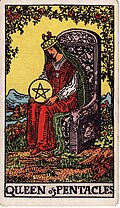
Queen of Pentacles at a glance
The Queen of Pentacles is the Queen court card of the Pentacles suit, a Minor Arcana card, and position 77 of 78 in this RWS series. Her subject is practical care: turning attention into nourishment, skill, stability, and a livable environment. A court card can describe a person, a role, a stage of learning, or a way of responding; it does not assign a fixed gender, age, or personality to anyone.
This series follows Rider-Waite-Smith numbering and primary image analysis. RWS places Strength at VIII and Justice at XI, while many Marseille traditions reverse those numbers and use different imagery and ordering conventions. The difference matters when comparing decks, but it does not change the question being asked in a reading.
What the RWS image shows
A crowned woman sits on a substantial throne and holds a large pentacle with both hands. Her gaze turns downward toward the coin rather than outward toward the viewer, making attention itself part of the scene. Green foliage and red flowers surround the throne; a small rabbit is visible near the lower right, while the ground and distant landscape create a cultivated, open setting. The image uses earthy greens, reds, golds, and stone colors to place a human figure inside a fertile material world.
The main visual movement is inward and downward: the Queen studies what she is holding. The throne gives her a stable seat, while the garden suggests that stability is maintained through continuing care rather than passive possession. These are observations of the printed RWS scene. Traditional meanings and modern reflective applications build on them, but neither turns the picture into a guaranteed prediction.
Keywords derived from the image
- Nurturing and stewardship follow from the Queen's protective posture and cultivated garden
- grounded attention follows from her seated body and downward gaze
- practical abundance follows from the prominent pentacle held close to her
- resourcefulness follows from the contrast between a human caretaker and a living landscape
- embodied comfort follows from the throne, earth tones, and domestic sense of place
- boundaries and sustainable care are useful counterweights because tending resources also requires limits.
Upright Queen of Pentacles meaning
Upright, this card points to care that becomes tangible. It can describe making a home workable, managing time and money carefully, learning a useful craft, supporting someone without taking over, or giving a project the conditions it needs to grow. Its potential strength is reliable attention: the willingness to notice practical details and follow through. In relationships, the card may favor warmth expressed through consistent actions rather than dramatic declarations.
The risk of excess is over-functioning. A person may become the only organizer, provider, fixer, or emotional container in a group. Comfort can turn into stagnation, and generosity can become control when care is used to make others dependent. The upright position is not automatically positive; it asks whether support is reciprocal, affordable, and welcome. A practical action is to identify one essential responsibility, define its limit, and create a repeatable routine rather than promising unlimited availability.
Reversed Queen of Pentacles meaning
Reversed does not simply mean bad luck. It can show blockage around receiving or giving care, internalization of worry about safety or worth, excess concern with appearance or control, delay caused by depleted energy, or a needed adjustment in direction. The Queen's inward gaze may become withdrawal into private burdens; her garden may represent neglected maintenance; the pentacle may feel heavy when resources are being held too tightly.
Read the reversal as a diagnostic prompt. Ask what practical support is missing, which obligation has outgrown its budget, and whether care is being offered without consent or rest. The direction adjustment may be to simplify, delegate, ask for help, restore sleep and ordinary routines, or separate self-worth from productivity. In a delay position, it can advise preparation rather than forced acceleration. In an internal position, it may describe private competence that has not yet been shared. Reversal can therefore be protective, clarifying, or transitional as well as difficult.
Applications in ordinary life
Relationships and emotions: The upright Queen can emphasize dependable affection, hospitality, sensory comfort, and a wish to make a bond feel safe. Notice whether care is exchanged or merely performed by one person. Reversed, explore resentment from unequal labor, fear of vulnerability, possessiveness, or the need to receive support. In a relationship reading, describe observable patterns and your choices; do not claim to know another person's private thoughts.
Work and study: Upright, she supports patient skill-building, careful administration, mentoring, and a workspace that helps concentration. Choose quality and continuity over frantic visibility. Reversed, check for burnout, perfectionism, disorganized materials, or a delay created by trying to manage every detail alone. A useful action is to set a realistic work block, document a process, and identify one resource or person that can share the load.
Money and resources: This card can prompt a clear inventory of income, costs, tools, time, food, housing, and other real supports. It favors conservation and long-term planning, not a promise of wealth. Reversed, examine leakage, scarcity anxiety, status spending, or reluctance to seek qualified help. Tarot is not a substitute for professional financial, legal, or investment advice; use the card to frame questions and verify decisions with reliable information.
Personal growth: The Queen invites a form of spirituality that includes the body, the calendar, the home, and the natural world. Practice noticing what helps you function and maintain it without making productivity your identity. Reversed, growth may mean accepting limits, distinguishing care from self-erasure, and allowing others to contribute. Small repeated actions are more informative here than grand resolutions.
Queen of Pentacles in spreads and positions
One-card prompt: ask, “What practical form can care take today?” Upright, focus on a concrete act of stewardship or support; reversed, look for the blocked resource, hidden worry, excess, delay, or direction that needs adjustment rather than forcing a yes-or-no answer.
Three cards: in a past, present, future spread, the Queen in the past may show a learned caregiving pattern or foundation; in the present, it highlights the resource currently requiring attention; in the future, it suggests a possible way of cultivating stability, not a guaranteed outcome. In a situation, action, outcome spread, she first describes the material conditions, then a practical response, then the kind of result that follows from consistent care.
Relationship positions: in “self,” she emphasizes your needs, habits, and way of offering support. In “other person,” use her as a symbolic description of the role or behavior you can responsibly observe, not a reading of private intent. In “interaction,” she shifts attention to reciprocity, shared routines, boundaries, and whether comfort helps both people remain capable.
Decision positions: in “opportunity,” the card may identify a chance to build something durable or make conditions more humane. In “risk,” it may warn of overwork, attachment to comfort, or carrying costs that belong to others. In “advice,” it recommends a budget, a routine, a boundary, or a request for qualified assistance. In “obstacle,” ask what is being neglected or overprotected. In “outcome,” read the likely pattern produced by present choices, not a fixed fate.
Instructional combination example
Instructional example, not a real case: Queen of Pentacles beside King of Pentacles creates a dialogue between attentive cultivation and established management. The Queen can ask how resources are cared for day by day; the King can ask how those resources are governed, protected, and used responsibly. Together they may support a household or project, but they can also expose a provider-manager imbalance. The neighboring card modifies the emphasis; neither card supplies a guaranteed prediction.
Common misreadings, traditions, and responsible use
- Do not reduce the Queen to “a rich woman,” a mother, or a literal spouse. Do not assume a pentacle promises money, pregnancy, or material success. Do not confuse comfort with avoidance or generosity with unlimited self-sacrifice. Different decks may alter clothing, plants, animals, throne details, color emphasis, or court-card theory
- compare the actual image before importing a keyword. Some readers treat court cards as people, others as roles, elements, stages, or behaviors. Tarot is best used here as cultural symbolism and structured self-reflection, not as a scientifically validated predictive system. It should not replace medical, legal, financial, or other professional guidance.
Tarot journal prompts
- Where is my care becoming visible and sustainable rather than merely well-intended?
- What resource, boundary, or routine needs attention before I take on more?
- Which forms of support do I give easily, and which forms do I need to learn to receive?
Suggested learning links and source note
For sequence context, continue from Knight of Pentacles (`tarot-card-knight-of-pentacles`) and compare this card with King of Pentacles (`tarot-card-king-of-pentacles`). Foundational links include Pentacles (`tarot-pentacles`), Court Cards (`tarot-court-cards`), Upright and Reversed (`tarot-upright-and-reversed`), How to Ask Tarot Questions (`tarot-how-to-ask`), and Tarot Journal Review (`tarot-journal-review`). A historical reference is A. E. Waite's The Pictorial Key to the Tarot, identified in the retrieved 1911 index as written by Arthur Edward Waite and illustrated by Pamela Colman Smith. This article keeps historical reference, visible imagery, traditional interpretation, and editorial synthesis distinct.