Card identity and sequence
The Page of Pentacles is a Minor Arcana court card: the Page rank in the Pentacles suit, and position 75 of 78 in the Rider-Waite-Smith sequence. Pentacles organize questions about material conditions, skills, work, bodies, time, and resources; the Page brings an early, observant, teachable mode of engaging with them. This is a symbolic reading tool, not a guarantee of a job, payment, qualification, or other event.
What the RWS image shows
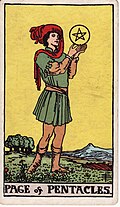
In the common RWS image, a youthful figure stands alone in a green field and holds one large pentacle in both hands at about chest or face level. The figure's attention is directed toward the coin rather than toward the viewer. The body is shown in profile, with the face turned toward the pentacle; the exact direction and costume details can vary across reproductions. Green ground, cultivated-looking earth, a low distant ridge or mountain, and an open sky place the figure in a spacious rural setting. Green and warm earth colors reinforce growth and physical immediacy, while the single, carefully held coin creates a strong visual focus. Nothing in the scene suggests haste: the action is examination, attention, and consideration.
The image observation is distinct from later keyword systems. The RWS tradition is associated with A. E. Waite's text and Pamela Colman Smith's illustrations, but the history of the deck, book, publisher, and later correspondences should not be collapsed into one certain origin story. Waite's public-domain Pictorial Key offers a historical interpretive reference; the practical guidance here is an editorial synthesis from the image, suit structure, traditional meanings, and reflective use.
Keywords derived from the image
- Study and apprenticeship follow from the Page's concentrated gaze and teachable court rank. A tangible opportunity follows from the single pentacle held as an object worthy of care. Patience follows from the still posture and quiet landscape. Practical curiosity follows from looking closely before acting. Grounded beginnings follow from the young figure standing on earth, while inexperience is the shadow of having a promising object without yet having tested the method.
Upright meaning
Upright, the Page of Pentacles points to learning that can become useful in the material world. It may describe a beginner taking a course, practicing a craft, examining a job or financial option, or making a modest but concrete start. Its strength is disciplined attention: notice the details, ask good questions, and turn interest into a repeatable skill. It can also suggest a message or offer involving work, study, resources, or a practical commitment, but the card does not promise that the offer is sound.
The risk of excess is staying in preparation forever, treating research as a substitute for a small test, or valuing credentials and objects more than understanding. Upright does not mean easy success. A useful action is to define the next verifiable step: compare requirements, make a budget, schedule practice, inspect the terms, or submit a realistic first version. Let the coin represent a resource to investigate, not a prize already won.
Reversed meaning
Reversed, the Page of Pentacles can show a blocked beginning, scattered attention, or a useful idea that has not found a workable routine. The theme may be internalized when someone is quietly learning but has not shown the work; excessive when preparation becomes perfectionism, hoarding, or status-seeking; delayed when paperwork, training, money, or confidence needs more time; or redirected when the original course is not the right practical fit. Reversed is not automatically negative: it can be permission to pause, simplify, or revise the plan.
Ask what is actually missing. Is the obstacle information, time, support, money, confidence, or a realistic scope? Direction adjustment might mean choosing one skill instead of five, testing an inexpensive version, seeking feedback, or abandoning an attractive but unsuitable option. Do not turn the reversed card into a judgment about intelligence or worth. It describes a relationship with a beginning that needs clarification.
Applications by life area
- Relationships and emotions: Look for a sincere but developing form of care, such as learning how someone communicates or building trust through consistent small acts. Reversed, emotional reserve, awkward effort, or practical concerns may delay expression. Do not use the card to claim what another person secretly feels
- ask what behavior and conversation can be observed.
- Work and study: Upright favors training, internships, research, careful applications, and a first portfolio piece. Reversed may flag procrastination, weak preparation, unclear instructions, or a course that no longer serves the goal. Set a measurable study or work task.
- Money and resources: Treat the card as a prompt for budgeting, comparing terms, building an emergency buffer, or learning a financial skill, not as an investment-return prediction. Reversed can indicate an overlooked cost, delayed payment, or a plan too ambitious for current resources.
- Personal growth: Practice being a beginner without confusing beginner status with permanent limitation. Upright asks for patient embodiment of a value
- reversed asks whether fear of imperfect results is preventing a useful experiment.
Reading the card in spreads
- One-card prompt: “What practical skill, resource, or first step deserves my full attention today?” The emphasis is on a question and an action, not a fixed prediction.
- Three cards, situation, action, outcome: In Situation, the Page describes the learning curve or concrete seed already present. In Action, it recommends study, checking details, or a small test. In Outcome, it suggests a developing result whose quality depends on follow-through. In a past, present, future layout, it can show an earlier lesson, current re-engagement, or a future opening that still requires preparation.
- Relationship spread: In Self, read the querent's willingness to learn and show care in practical ways. In Other Person, read the role or behavior visible in the relationship, not a private mental state. In Interaction, focus on how small efforts, expectations, and material circumstances combine.
- Decision spread: In Opportunity, the card highlights a learnable opening or modest resource. In Risk, it warns of inexperience, overplanning, or an offer not yet verified. In Advice, it says to inspect the details and take the smallest responsible step.
- Obstacle, advice, outcome: As Obstacle, it can be scattered focus or fear of beginning. As Advice, create a routine and gather evidence. As Outcome, it points to progress in an early stage rather than a guaranteed finished achievement.
Instructional combination example
Instructional example, not a real case: Page of Pentacles beside Ten of Pentacles can shift a broad family or long-term resource theme toward learning how to maintain and contribute to an existing structure. Beside Knight of Pentacles, the Page's curiosity becomes a repeatable routine: the adjacent Knight modifies “learn” into “practice steadily.” If reversed, the pair may ask whether the learner is delaying a necessary first test while waiting to feel fully qualified.
Misreadings, traditions, and responsible use
Do not reduce the Page to a literal child, a guaranteed student, or a definite message about money. Court cards can describe a person, a role, a stage, or a way of acting, and deck traditions differ in imagery, elemental correspondences, and whether Pages are treated as messengers, learners, or both. This series uses RWS imagery and sequence. RWS and Marseille traditions also differ in some imagery and in the numbering of Strength and Justice; that difference does not change the Pentacles court-card position used here. Tarot offers cultural symbolism and a self-reflection framework, not scientifically validated prediction. Do not use this card as medical, legal, or investment advice, or to read a third party's mind. Verify real offers, contracts, qualifications, and budgets through ordinary evidence and appropriate professionals.
Journal prompts
- What detail am I willing to study instead of assuming?
- What is the smallest useful experiment I can complete this week?
- Where has preparation become avoidance, and what evidence would help me adjust direction?
Suggested learning links
For sequence context, continue from the Ten of Pentacles (tarot-card-ten-of-pentacles) to the Knight of Pentacles (tarot-card-knight-of-pentacles). For foundations, use the site's Tarot for Beginners guide (tarot-for-beginners), Pentacles suit guide (tarot-pentacles), Court Cards glossary (glossary-court-cards), and Upright and Reversed guide (tarot-upright-and-reversed). These resources provide structure without replacing this card's image-specific reading.