King of Pentacles at a glance
The King of Pentacles is the King court card of the Pentacles suit, a Minor Arcana card, and position 78 of 78 in this RWS series. He represents material mastery as a practice of stewardship: organizing resources, making durable decisions, and turning experience into responsible provision. A court card can signify a person, a role, a method, or a stage of development. It is not a rule that a male figure must describe a man.
This knowledge base uses the Rider-Waite-Smith sequence and primary image analysis. In RWS, Strength is VIII and Justice is XI; many Marseille traditions place Justice at VIII and Strength at XI, and their imagery can differ as well. Use the system named by the deck rather than blending numbering or symbols without notice.
What the RWS image shows
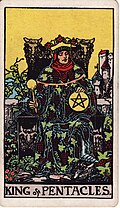
A crowned figure sits on a decorated throne and holds a large pentacle in one hand and a scepter in the other. He faces slightly toward the viewer while his head and attention angle down toward the coin. Vines, leaves, and grapes surround his robe and throne. A castle or fortified building appears in the background, and the palette brings together green foliage, red fabric, gold, brown earth, and gray stone. The scene places authority inside a cultivated landscape rather than in an empty abstract space.
The image combines stillness with possession: the King is seated, the symbols are held close, and the surrounding growth suggests a domain built over time. The throne and crown point to responsibility and status, while the coin and vineyard keep the card connected to tangible resources. These are visual observations. Traditional associations can be useful interpretive lenses, but the card does not guarantee wealth, success, or a particular external event.
Keywords derived from the image
- Stewardship follows from the ruler seated among cultivated growth
- stability follows from the throne, castle, and grounded composition
- competence follows from the deliberate handling of coin and scepter
- sustainable prosperity follows from vines and grapes that imply ongoing cultivation rather than instant reward
- authority follows from crown and seat, but accountability must accompany it
- generosity and protection are constructive possibilities, while possession and rigidity are the shadow risks of holding resources too tightly.
Upright King of Pentacles meaning
Upright, the King of Pentacles favors capable management and long-term reliability. He can describe a person who understands systems, a project that has reached operational maturity, or an invitation to make decisions based on evidence, maintenance, and realistic capacity. His potential strengths include patience, sound judgment, protection of what has been built, fair provision, and the ability to convert experience into repeatable results. In a work or household question, he asks what structure will remain useful after the excitement has passed.
The risk of excess is domination through resources. Authority may become status-seeking, possessiveness, inflexibility, or the assumption that paying for something grants control over everyone involved. Security can harden into fear of change. The upright position is not automatically positive: a stable arrangement can still be unequal or ethically compromised. A practical action is to define the purpose of a resource, record who benefits and who carries the cost, and make one decision that protects long-term trust rather than short-term image.
Reversed King of Pentacles meaning
Reversed does not automatically mean ruin. It may indicate blockage in leadership or resource management, internalization of fear about loss or status, excess attachment to control, delay caused by weak foundations or unrealistic promises, or a direction adjustment from accumulation toward responsible use. The crowned figure can become isolated behind position; the coin can become a possession used as leverage; the vineyard can show neglected maintenance beneath an impressive surface.
Use the reversal to test the structure. Which figures, agreements, skills, or safeguards are missing? Is the delay asking for due diligence, repair, training, or a smaller commitment? In an internal position, the card may describe competence that is hidden by self-doubt or a private fear of not having enough. In an excess position, it may point to workaholism, hoarding, luxury as proof of worth, or authority without listening. Direction adjustment can mean delegating, disclosing terms, checking figures, seeking qualified advice, or sharing control. Reversal can reveal a needed correction rather than pronounce a negative fate.
Applications in ordinary life
Relationships and emotions: Upright, the King can emphasize steadiness, protection, commitment shown through dependable behavior, and the creation of shared practical security. It can also ask whether care has become a transaction or a hierarchy. Reversed, examine possessiveness, emotional withholding behind provision, status concerns, or a partner who uses resources to set the terms of the bond. In relationship positions, discuss observable agreements and interaction patterns rather than claiming access to another person's thoughts or intentions.
Work and study: The upright King supports project ownership, administration, leadership, technical mastery, and study that compounds through practice. Build systems that can be audited and taught to others. Reversed, look for micromanagement, shortcuts hidden by confidence, stale methods, or delays caused by refusing feedback. A useful action is to write a clear standard, review the evidence, and give responsibility to the person best placed to carry it.
Money and resources: This card is a prompt to inspect assets, costs, obligations, skills, time, tools, and the maintenance behind any apparent security. It may support long-range planning and careful risk awareness, but it is not a promise of investment returns or financial success. Reversed, consider concentration of risk, status spending, opaque agreements, or fear-based hoarding. Use qualified financial and legal advice for actual decisions; tarot can help clarify questions, not replace verification.
Personal growth: The King asks how values become institutions, habits, and ethical use of power. Mature self-reliance includes knowing when to consult others and when to distribute authority. Reversed, growth may require loosening an identity built entirely on productivity, income, expertise, or control. Measure success by resilience, fairness, and usefulness as well as accumulation.
King of Pentacles in spreads and positions
One-card prompt: ask, “What deserves responsible long-term management?” Upright, identify the structure, skill, or resource that can be strengthened; reversed, locate the blockage, internalized fear, excess, delay, or change of direction that must be addressed before expansion.
Three cards: in a past, present, future spread, the King in the past may show inherited standards, a prior authority, or a foundation already built; in the present, he highlights the resources and responsibilities currently being managed; in the future, he suggests a possible mature pattern if present choices are maintained, not a guaranteed outcome. In a situation, action, outcome spread, he first names the governing conditions, then the responsible use of power, then the likely consequence of that management.
Relationship positions: in “self,” the King describes how you handle commitment, security, resources, and authority. In “other person,” read him as a symbolic role or behavior that can be observed, not as proof of private motives. In “interaction,” examine who sets terms, who provides labor or money, how decisions are made, and whether stability leaves room for mutual agency.
Decision positions: in “opportunity,” the card may show a chance to formalize a durable system or apply hard-won expertise. In “risk,” it warns of rigidity, overcommitment, status pressure, or dependence on one provider. In “advice,” it favors due diligence, clear contracts, maintenance, and accountable leadership. In “obstacle,” ask whether control is preventing adaptation or whether foundations are weaker than they look. In “outcome,” read the pattern most supported by current actions, not a fixed verdict.
Instructional combination example
Instructional example, not a real case: King of Pentacles beside Queen of Pentacles brings established stewardship into contact with attentive daily cultivation. The King emphasizes governance, reserves, and durable standards; the Queen emphasizes lived conditions, maintenance, and whether support is actually nourishing. Together they can describe a balanced household or project, but they can also reveal a hierarchy in which one person controls resources while the other performs invisible care. The adjacent card changes the emphasis; neither card proves an event.
Common misreadings, traditions, and responsible use
- Do not reduce the King to “a wealthy older man,” a husband, or a guaranteed benefactor. Do not treat the pentacle as automatic financial success or read the castle as proof of social rank. Do not confuse stability with stagnation, authority with wisdom, or provision with permission to control. Other decks may change the animals, plants, throne, clothing, landscape, and court-card logic
- inspect the deck in front of you. Some schools read court cards as people, others as roles, processes, elements, or behaviors. Tarot is a cultural and symbolic self-reflection practice, not a scientifically validated predictive method. It cannot replace medical, legal, financial, or other professional advice.
Tarot journal prompts
- What am I building that should remain useful to people beyond the present moment?
- Where does authority need transparency, shared responsibility, or a clear boundary?
- Which form of security am I protecting, and what evidence would show that it is genuinely sustainable?
Suggested learning links and source note
The previous card is Queen of Pentacles (`tarot-card-queen-of-pentacles`). There is no next card in the fixed 78-card series; for a cyclical comparison, revisit The Fool (`tarot-card-the-fool`) as the sequence's opening card. Foundational links include Pentacles (`tarot-pentacles`), Court Cards (`tarot-court-cards`), Upright and Reversed (`tarot-upright-and-reversed`), How to Ask Tarot Questions (`tarot-how-to-ask`), and Tarot Journal Review (`tarot-journal-review`). A historical reference is A. E. Waite's The Pictorial Key to the Tarot, whose retrieved 1911 index identifies Arthur Edward Waite as author and Pamela Colman Smith as illustrator. This article distinguishes historical reference, visible RWS imagery, traditional interpretation, and modern editorial synthesis.