Card identity and sequence
The Knight of Pentacles is a Minor Arcana court card: the Knight rank in the Pentacles suit, and position 76 of 78 in the Rider-Waite-Smith sequence. Pentacles bring attention to material conditions, work, skills, bodies, time, and resources. The Knight expresses those themes through sustained movement and responsibility rather than speed. This is a symbolic framework for reflection and planning, not a promise of a job, payment, health result, or inevitable future.
What the RWS image shows
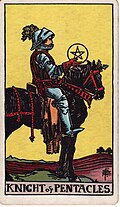
In the common RWS image, an armored knight sits on a dark or earthy-colored horse that has stopped in a cultivated landscape. The horse faces left in the familiar rendering, while the rider holds a single pentacle in front of him and directs attention toward it. The knight's posture is upright and controlled; unlike the more visibly charging Knights in the deck, this scene is marked by stillness. Plowed or patterned earth, green fields, distant trees or hills, and an open sky create a setting where effort can be measured over time. The coin is a concrete object, the horse is capable of carrying the work forward, and the pause makes inspection part of the action.
Visible imagery should be kept separate from later systems of correspondence. The RWS tradition is associated with A. E. Waite's interpretive text and Pamela Colman Smith's illustrations, but the publication history of the deck and the book, as well as later occult additions, should be described cautiously. Waite's public-domain Pictorial Key is a useful historical reference point; this article combines that tradition with direct image observation, the Pentacles sequence, and practical self-reflection rather than presenting one fixed definition.
Keywords derived from the image
- Steadiness follows from the halted horse and balanced rider. Reliability follows from the knight's controlled posture and single object of attention. Method follows from the cultivated ground and deliberate inspection. Endurance follows from the suit's material, time-based concerns. Slow progress follows from movement being possible but not rushed. The shadow keywords, rigidity and stagnation, arise when steadiness loses its connection to purpose and becomes refusal to adapt.
Upright meaning
Upright, the Knight of Pentacles describes dependable effort, careful execution, and progress built through repetition. It is favorable for maintenance, long projects, training, routine, saving, quality control, and work that rewards patience. The card's strength is follow-through: make a promise proportionate to your capacity, then keep showing up. It can describe a practical person or a methodical phase, but it does not guarantee that persistence alone will produce the desired result.
The risk of excess is caution without movement, loyalty to a failing plan, or treating routine as proof that no review is needed. Upright does not mean “never change.” A practical action is to establish a schedule, define a standard, check progress at set intervals, and revise when evidence calls for it. The knight asks for sustainable pace, not needless slowness.
Reversed meaning
Reversed, the Knight of Pentacles can indicate blocked progress, internalized pressure, excessive routine, delay, or a direction that needs adjustment. Blockage may appear as missed steps, fatigue, poor systems, or waiting for perfect certainty. Internalization may mean carrying responsibility silently until the work becomes isolating. Excess may look like stubborn repetition, workaholism, hoarding, or defensive conservatism. Delay can be useful when an inspection reveals a real problem, but it can also be avoidance disguised as caution.
Direction adjustment means preserving the useful commitment while changing the route: reduce the workload, ask for help, update the method, renegotiate an unrealistic deadline, or stop investing in a goal that no longer matches the evidence. Reversed is not automatically negative. It may signal that a routine has done its job and now needs a deliberate redesign.
Applications by life area
- Relationships and emotions: Upright emphasizes consistency, dependable presence, and affection shown through practical care. It may feel quiet rather than dramatic. Reversed can show emotional withholding, routine replacing conversation, or one person carrying too much. Discuss expectations instead of inferring a partner's private thoughts.
- Work and study: Upright supports project management, deliberate practice, apprenticeships, testing, editing, and long-term coursework. Reversed may flag burnout, repetitive work without learning, missed deadlines, or excessive caution. Use milestones and feedback rather than relying on willpower alone.
- Money and resources: Upright favors cash-flow awareness, realistic saving, maintenance, and checking terms before committing. It is not a promise of profit or a substitute for regulated financial advice. Reversed can point to stalled funds, inflexible budgeting, neglected maintenance, or a plan that must be resized.
- Personal growth: Build trust in yourself through evidence of kept commitments, while allowing new information to change the plan. Reversed asks whether discipline has become self-punishment or whether fear of disruption is preventing needed growth.
Reading the card in spreads
- One-card prompt: “What can I make more reliable through one measured action today?” The card shifts the question from speed to sustainable follow-through.
- Three cards, situation, action, outcome: In Situation, the Knight describes the current workload, routine, or slow-building condition. In Action, it recommends a schedule, quality check, or carefully bounded commitment. In Outcome, it suggests a result that develops through repeated effort, not a guaranteed deadline. In a past, present, future layout, it can show an established habit, a current maintenance phase, or a future period of patient building.
- Relationship spread: In Self, examine how you demonstrate dependability and where you may be withholding emotion. In Other Person, read observable conduct or the role they occupy in the connection, not their hidden intentions. In Interaction, ask whether the relationship's shared rhythm supports both people or has become static.
- Decision spread: In Opportunity, the Knight highlights a durable option that rewards preparation. In Risk, it warns of inertia, sunk-cost attachment, or a schedule too slow for the situation. In Advice, verify assumptions, set milestones, and keep the pace sustainable.
- Obstacle, advice, outcome: As Obstacle, it can be rigid routine, fatigue, or refusal to review. As Advice, preserve consistency while introducing a feedback point. As Outcome, it emphasizes a stable process or incremental gain rather than a dramatic transformation.
Instructional combination example
Instructional example, not a real case: Page of Pentacles beside Knight of Pentacles changes a new idea into a practice plan. The Page supplies curiosity and a learning edge; the Knight supplies repetition, standards, and delivery. If Queen of Pentacles follows, the pair may widen from personal skill-building to sustainable care for a home, body, or resource system. Reversed, the combination asks whether methodical effort is supporting growth or merely postponing a necessary choice.
Misreadings, traditions, and responsible use
The Knight is not automatically a literal man, a guaranteed message, or proof that an outcome will be slow. Court cards can represent a person, role, phase, or operating style, and different tarot schools vary in elemental attributions, personality language, and the balance between traditional divination and psychological reflection. This series follows RWS imagery and sequence. RWS and Marseille traditions differ in some imagery and in the numbering of Strength and Justice; those differences should be named rather than silently blended. Tarot is a cultural and symbolic self-reflection practice, not scientifically validated predictive power. Do not use this card for medical, legal, or investment-return decisions, and do not claim to know a third party's mind. Pair reflection with evidence, consent, professional advice, and the freedom to change course.
Journal prompts
- Which routine is genuinely moving my goal forward, and what evidence shows that?
- Where has patience become rigidity or fear of change?
- What milestone, review date, or support would make my next commitment sustainable?
Suggested learning links
For sequence context, read the Page of Pentacles (tarot-card-page-of-pentacles) before this card and continue to the Queen of Pentacles (tarot-card-queen-of-pentacles). For foundations, use the site's Tarot for Beginners guide (tarot-for-beginners), Pentacles suit guide (tarot-pentacles), Court Cards glossary (glossary-court-cards), and Upright and Reversed guide (tarot-upright-and-reversed). These links support structured reading without replacing the Knight's specific image and spread position.