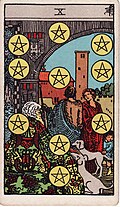
Ten of Pentacles at a Glance
The Ten of Pentacles is Minor Arcana, Pentacles suit, rank ten, and position 74 in the 78-card Rider-Waite-Smith sequence. It follows the Nine of Pentacles and comes before the Page of Pentacles. The card broadens the suit's material language from one person's cultivated security to a network of family, community, memory, inheritance, and shared infrastructure. Its question is not simply “What do I have?” but “What does this arrangement preserve, support, or pass onward?”
This article separates visible RWS details from traditional interpretation and practical synthesis. The elder, younger figures, dogs, arch, coins, and built environment are visual observations. Ideas about legacy, continuity, and belonging are interpretive traditions. The actions and prompts are editorial tools for reflection, not predictions. Waite's The Pictorial Key to the Tarot can be consulted as a period reference for traditional descriptions; this article does not reproduce its wording. RWS is the series standard. Marseille traditions commonly place Justice at VIII and Strength at XI, while RWS uses Justice XI and Strength VIII, and their numbered-card imagery differs.
RWS Visual Details and Keywords
The RWS scene places ten gold pentacles within an arching pattern that resembles a family tree or architectural frame. An older, richly dressed figure sits in the lower foreground, accompanied by two pale dogs. Near the center, a younger couple stands beneath the arch, with a child visible close by. Behind them are a gateway or estate, pale walls, towers, and a city-like setting. The elder looks into the shared scene while the younger figures face one another and the child; the image therefore contains both generations and several directions of attention. Gold coins, patterned clothing, stone structures, animals, and human connection combine private resources with public and inherited context.
The keyword set is legacy, belonging, continuity, stewardship, family systems, and durable security. Legacy follows the elder, child, and repeated coin pattern; belonging follows the group gathered within one setting; continuity follows the arch and built environment; stewardship follows the need to care for resources across time; family systems follows the multiple figures and roles; durable security follows the established home and material structure. These keywords describe a field of relationships and obligations, not an automatic promise of wealth or harmony.
Upright Meaning
Upright, the Ten of Pentacles points to what can endure beyond a single moment or individual. It may describe family support, a stable institution, inherited knowledge, shared property, or a community whose rules and resources have accumulated over time. Its strength is continuity with practical substance: people can rely on one another because roles, resources, and expectations are visible enough to discuss. It can also invite gratitude for nonfinancial inheritance such as skills, stories, care, and access.
- Strengths: long-term planning, intergenerational support, reliable systems, shared prosperity, belonging, and stewardship of what others may inherit.
- Risks of excess: rigidity, gatekeeping, entitlement, family pressure, status maintenance, or protecting tradition at the cost of living people.
- Practical actions: document agreements, clarify responsibilities, preserve useful knowledge, review shared resources, and include affected people in decisions about the future.
The card is not a guarantee that a family, relationship, job, or investment will last. It asks what evidence supports durability and who benefits from the structure. In a planning question, it favors a system that can be maintained by more than one person, with explicit contingencies rather than hopeful assumptions.
Reversed Meaning
Reversed, the Ten of Pentacles can show a blocked inheritance, unstable support, conflict over shared resources, or a system that looks established but no longer serves its members. It can be internalized when belonging is experienced as a private question of identity, security, or family history rather than openly negotiated. It can also indicate excess: materialism, controlling elders, inherited prejudice, or a demand to preserve appearances. Reversal may describe delay while documents, trust, finances, or roles are clarified, and it may advise changing direction toward a smaller or more equitable structure.
- Blockage: a gatekeeper, unclear agreement, fragmented resources, or an unresolved family or institutional pattern prevents continuity.
- Internalization: belonging, inheritance, or fear of exclusion is shaping choices quietly and needs honest naming before action.
- Excess: status obsession, entitlement, hoarding, tradition used as control, or loyalty that requires self-abandonment.
- Delay: a transfer, commitment, household plan, or long-term project needs verification, repair, or legal and practical paperwork.
- Direction adjustment: define fair participation, separate care from control, diversify support, and build a future that includes present needs.
Applications by Life Area
- Relationships and emotions: Upright, this can emphasize shared values, family context, durable commitment, and care expressed through practical reliability. Reversed, it may point to inherited expectations, conflict between generations, or security used as leverage. Do not treat the card as evidence of a third party's feelings
- use it to examine observable patterns and spoken agreements.
- Work and study: Upright, it favors institutions, mentorship, durable credentials, documented processes, and work that serves a community. Reversed, inspect nepotism, stale hierarchy, unclear succession, or a course or job chosen only to satisfy inherited expectations. Ask which skills remain useful when the setting changes.
- Money and resources: Upright, review shared budgets, long-term reserves, property responsibilities, and the noncash value of mutual support. Reversed, be cautious with pressure around debt, inheritance, contracts, or concentrated assets. Tarot cannot give investment-return, tax, estate, or legal advice
- obtain qualified guidance and read the actual documents.
- Personal growth: Upright, explore what you want to preserve and what you want to revise. Reversed, distinguish genuine belonging from compliance and decide which inherited story can end with you rather than being passed forward.
Spread Positions and Changing Emphasis
In a one-card reading, ask, “What structure or relationship can support the future I am building?” The emphasis is on systems and stewardship, not a fixed forecast. In a three-card past, present, future spread, the card may show inherited patterns in the past, current family or community resources, and a future responsibility to preserve or redesign them. In a situation, action, outcome spread, it frames the situation as a network of obligations, the action as clarifying roles and resources, and the outcome as continuity that depends on fair participation.
- Relationship positions: In self, it shows your place in a shared system and the values you bring into commitment. In the other person, it describes the role or behavior to observe, not an inside report of their thoughts. In interaction, it highlights the agreements, histories, relatives, routines, and material conditions that shape the bond.
- Decision positions: In opportunity, it suggests access to a durable network, mentorship, institution, or long-term foundation. In risk, it warns of obligation, gatekeeping, inherited conflict, or a structure too rigid to adapt. In advice, verify the terms, include the people affected, and plan for maintenance and succession.
- Obstacle, advice, and outcome positions: As obstacle, old rules or unequal access may be blocking a healthy future. As advice, preserve what is genuinely supportive while revising what harms participation. As outcome, it can indicate a durable arrangement, shared resource, or clearer place within a community, with surrounding cards showing whether continuity is generous or restrictive.
Instructional Combination Reading
Instructional example, not a real case: Nine of Pentacles followed by the Ten of Pentacles moves from personal competence and self-held security toward shared continuity. The Ten beside the Page of Pentacles emphasizes teaching, apprenticeship, or a new learner receiving a practical foundation. These adjacent cards modify the Ten's focus; they do not prove an inheritance, marriage, or financial result.
Common Misreadings, Differences, and Responsible Use
A common misreading is “wealthy family and guaranteed happy ending.” The RWS image supports a conversation about continuity, resources, and belonging, but it also visibly includes hierarchy, age, animals, and multiple roles that can create obligation. Some decks replace the family scene with community, ancestry, or institutional imagery. Marseille-style Ten of Pentacles cards may rely on a repeated suit pattern rather than the RWS narrative tableau. Numerological, elemental, psychological, and historical schools may therefore emphasize different layers. Name the deck and method before comparing interpretations.
Use the card for cultural study, symbolic reading, and self-reflection. Do not use it to make guaranteed claims about inheritance, family loyalty, employment, property, investing, health, law, or another person's mind. Important decisions should be based on documents, direct conversations, qualified professionals, and safety planning. A tarot spread can help identify questions; it cannot replace evidence or consent.
Tarot Journal Prompts
- Which resources, skills, or values do I want to preserve, and why?
- Where does belonging feel mutual, and where does it depend on unequal obligation?
- What practical agreement would make my long-term plan more durable and fair?
- What inherited pattern can I consciously revise before passing it forward?
Suggested Learning Links
Continue backward to Nine of Pentacles (`tarot-card-nine-of-pentacles`) to study personal security and cultivated independence, then forward to Page of Pentacles (`tarot-card-page-of-pentacles`) to study the learner who receives a practical beginning. For foundations, see Tarot for Beginners (`tarot-for-beginners`), Tarot Upright and Reversed (`tarot-upright-and-reversed`), Tarot Pentacles (`tarot-pentacles`), and Tarot Journal Review (`tarot-journal-review`).