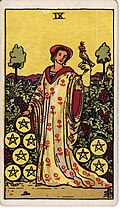
Nine of Pentacles at a Glance
The Nine of Pentacles is Minor Arcana, Pentacles suit, rank nine, and position 73 in the 78-card Rider-Waite-Smith sequence. It follows the Eight of Pentacles and comes before the Ten of Pentacles. Its central movement is from repeated effort toward a visible, personally held result: skill becomes competence, resources become room to choose, and solitude can become deliberate self-possession rather than isolation.
This article separates four layers. The garden, figure, bird, coins, and landscape are observable RWS details. Associations such as independence and earned comfort belong to tarot tradition. The practical actions and journal questions are editorial applications for reflection, not predictions. Waite's The Pictorial Key to the Tarot is a useful period reference for traditional descriptions; the wording here is original. RWS is the working deck for this series. Marseille traditions commonly place Strength at XI and Justice at VIII, while RWS places Strength at VIII and Justice at XI; pip-card imagery also differs.
RWS Visual Details and Keywords
A richly dressed woman stands in a cultivated garden or vineyard. Nine gold pentacles are arranged among the foliage around her. A gloved bird rests on one raised hand, and a small snail may be seen near the lower foreground in common RWS reproductions. The figure is turned toward the garden and the viewer's field rather than shown in a group exchange. Behind her are a yellow sky, distant hills, and a walled estate or building. The warm yellow and red clothing, ripe greenery, orderly coins, trained bird, and quiet distance create a scene of cultivated abundance with boundaries.
The keyword set is earned independence, refinement, stewardship, self-respect, and measured enjoyment. Earned independence follows the single figure and the completed garden; refinement follows the careful clothing and controlled setting; stewardship follows the coins embedded in living growth rather than scattered money; self-respect follows her upright composure; measured enjoyment follows abundance that is present but still maintained. The bird adds a second layer: desire or instinct is not absent, but is handled through training and choice.
Upright Meaning
Upright, the Nine of Pentacles points to a result that can be enjoyed because something real has been practiced, protected, or built. It favors competence over display and sustainable comfort over a sudden windfall. Its strength is the ability to stand on one's own resources while recognizing the labor that made them possible. It can describe a quiet success, a healthy boundary, a private pleasure, or the confidence to choose quality without asking for constant approval.
- Strengths: self-reliance, skill made visible, discernment, patience, healthy privacy, and appreciation of tangible progress.
- Risks of excess: perfectionism, status anxiety, guardedness, over-identifying with possessions, or using independence to avoid mutuality.
- Practical actions: review what is working, protect time for skilled work, make a realistic resource plan, enjoy one earned pleasure, and ask which comforts genuinely support your values.
The card does not guarantee wealth or a favorable outcome. It asks whether the foundations are sound and whether enjoyment is allowed to coexist with responsibility. In a process question, it may suggest finishing the current cycle, maintaining standards, and letting evidence speak before expanding.
Reversed Meaning
Reversed, the same image can show a blocked harvest, private doubt, dependence hidden behind a polished surface, or a need to change direction. Reversal is not automatically negative. The theme may be internalized: the person has resources but cannot feel entitled to use them, or needs privacy and recovery before sharing results. It may also expose excess, such as luxury used to compensate for insecurity, rigid control of every detail, or a work pattern that delays rest indefinitely.
- Blockage: effort is not reaching a usable result, access to resources is restricted, or self-trust is weakened by comparison.
- Internalization: confidence, desire, or the wish for independence is being processed privately rather than expressed openly.
- Excess: isolation, perfectionism, hoarding, performative status, or treating productivity as the only proof of worth.
- Delay: the harvest needs more time, maintenance, training, or a clearer measure of completion than the question has allowed.
- Direction adjustment: simplify, share a task, revise the budget or timeline, and define success by durable function rather than appearance.
Applications by Life Area
- Relationships and emotions: Upright, this can describe secure individuality, standards, and affection that does not require possession. Reversed, ask whether distance protects healthy boundaries or prevents vulnerability. Do not use the card to infer another person's private feelings
- discuss observable behavior and mutual expectations instead.
- Work and study: Upright, it favors mastery, independent concentration, portfolio-building, and recognition earned through reliable work. Reversed, check for perfectionist delay, underpricing, burnout, or studying alone when useful feedback is available. A concrete review schedule is more helpful than waiting to feel fully ready.
- Money and resources: Upright, review savings, sustainable income, quality purchases, and the difference between security and display. Reversed, inspect dependence, avoidable leakage, status spending, or fear-based hoarding. Tarot cannot provide investment-return, debt, tax, or financial-planning advice
- use qualified information for those decisions.
- Personal growth: Upright, practice receiving the benefits of your own effort without apology. Reversed, separate self-worth from output and experiment with interdependence, rest, or a less performative standard of success.
Spread Positions and Changing Emphasis
In a one-card reading, ask, “What resource, skill, or boundary can I tend today?” The card emphasizes a measurable act of stewardship rather than a fixed event. In a three-card past, present, future spread, it may show past training, present enjoyment or assessment, and a future choice about preserving or sharing results. In a situation, action, outcome spread, it frames the situation as existing resources, the action as careful maintenance or selective investment, and the outcome as a result whose quality depends on follow-through.
- Relationship positions: In self, it emphasizes your standards, autonomy, and capacity to contribute without self-erasure. In the other person, it describes the role or behavior that the position invites you to observe, not a verdict about their inner state. In interaction, it asks whether independence and closeness are being negotiated with respect.
- Decision positions: In opportunity, it highlights a chance to use established skill or secure a sound foundation. In risk, it warns of isolation, vanity, or an attractive option that costs too much maintenance. In advice, choose the durable option, verify the resources, and leave room for enjoyment.
- Obstacle, advice, and outcome positions: As obstacle, private fear or perfectionism may be blocking a result. As advice, tend the garden already in your care before chasing a larger one. As outcome, it suggests a usable gain or stronger autonomy, while the surrounding cards show whether that gain is shared, delayed, or protected.
Instructional Combination Reading
Instructional example, not a real case: Eight of Pentacles beside the Nine of Pentacles links deliberate practice to independent competence. The Nine beside the Ten of Pentacles shifts the emphasis from personal security to shared continuity, family systems, or a resource that can outlast one person's effort. The neighboring card modifies the Nine; it does not erase its central question about how skill becomes sustainable choice.
Common Misreadings, Differences, and Responsible Use
A common misreading is “luxury is guaranteed,” or “being alone is always superior.” The image supports cultivated independence, not a promise of money or a command to reject community. Some modern decks change the clothing, bird, garden, or arrangement of the coins, and some readers use numerology, elemental dignities, or a more psychological vocabulary. Marseille-style numbered cards rely more heavily on repeated suit symbols, so their visual reading is not identical to the RWS scene. State the deck and reversal method before comparing meanings.
Use this card for cultural study, symbolic reading, and self-reflection. Keep decisions about health, law, investing, employment contracts, and safety anchored in qualified professional advice and verifiable facts. A reading should not expose a third party's supposed thoughts, create dependence, or turn uncertainty into guaranteed fate.
Tarot Journal Prompts
- What result in my life is supported by repeated effort rather than appearance alone?
- Which boundary protects my energy, and which boundary may be keeping useful support out?
- What would sustainable enjoyment look like in the next seven days?
Suggested Learning Links
Continue backward to Eight of Pentacles (`tarot-card-eight-of-pentacles`) to study practice becoming competence, then forward to Ten of Pentacles (`tarot-card-ten-of-pentacles`) to study personal achievement within longer-term structures. For foundations, see Tarot for Beginners (`tarot-for-beginners`), Tarot Upright and Reversed (`tarot-upright-and-reversed`), Tarot Pentacles (`tarot-pentacles`), and Tarot Journal Review (`tarot-journal-review`).