Ace of Swords at a glance
The Ace of Swords is the first card of the Swords suit in the Minor Arcana and position 51 in this 78-card RWS sequence. Its central themes are clear perception, a new idea, truthful naming, a decision, and the boundaries that make thought useful. These are interpretive possibilities, not guaranteed events or proof of what another person thinks. The card is best treated as a symbolic prompt for separating observation from assumption and turning a conclusion into something that can be checked.
What the RWS image shows
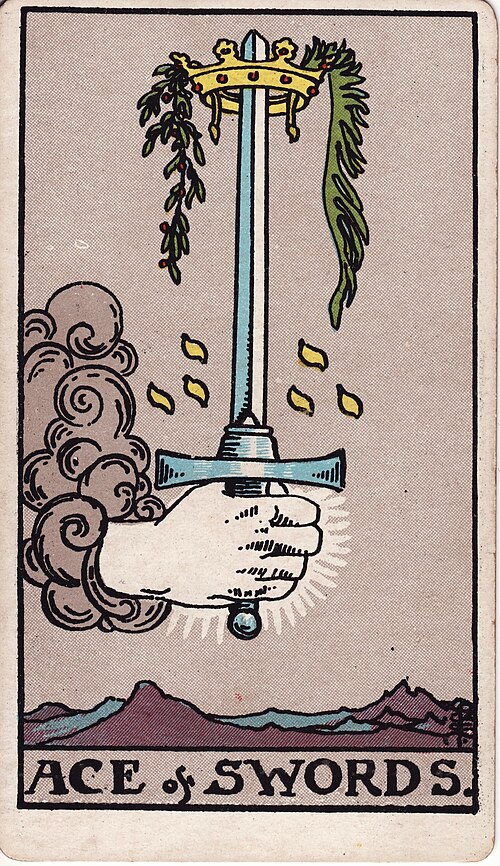
A hand emerges from a cloud and holds a sword upright. The blade forms a strong vertical line, pointing into the open sky. Near its tip is a crown, with leafy growth hanging from it; below are distant, blue-gray mountains and a pale, unsettled sky. There is no complete human figure, room, or crowd. The visible action is concentrated in the hand, the grip, and the upward direction of the blade. The contrast between the small hand, the large weapon, the high crown, and the distant terrain gives the scene both possibility and seriousness.
The image supports a reading of mental force entering awareness, but that is an editorial synthesis rather than a claim that the card scientifically measures intelligence or truth. The RWS label here identifies the pictorial tradition associated with A. E. Waite and Pamela Colman Smith. Waite's Pictorial Key to the Tarot is one historical interpretive voice; later occult correspondences and modern coaching language should not be presented as if they were all original deck instructions.
Keywords grounded in image and tradition
Clarity follows from the exposed, upright blade and the open sky: something can be distinguished. Discernment follows from a sword that separates and tests rather than merely decorates. Decision comes from the blade's single direction, while truth-testing is suggested by the need to examine what the sword cuts through. Boundaries arise from the weapon's capacity to define a limit. A beginning is present because this is an Ace, the opening expression of the suit rather than a completed story. These keywords work as a compact vocabulary; the question and spread position decide which one leads.
Upright meaning: clarity that needs responsible use
Upright, the Ace of Swords can describe a fresh insight, a direct conversation, a useful standard, a clean distinction, or a decision that removes avoidable confusion. Its strength is not simply being forceful. It is the ability to name the real question, identify relevant evidence, and communicate without hiding the central issue. It may support research, drafting, editing, negotiation, study, or setting a boundary that protects a workable relationship.
- Potential strengths include precise language, intellectual courage, honest feedback, a well-framed question, and the ability to begin again with better information. Risks of excess include cutting people off too quickly, treating a clever argument as proof, using bluntness as a substitute for care, or turning every difference into a contest. Practical actions include writing the decision in one sentence, listing facts separately from interpretations, checking a primary source, asking one specific question, and stating a boundary with a consequence you can actually keep.
Reversed meaning: the blade is blocked, turned inward, or misdirected
Reversed does not automatically mean failure or bad news. It can show a blockage in forming a conclusion, a thought that remains private, an insight that is difficult to express, or a decision delayed until more information arrives. The sword may be turned inward as self-criticism or internal debate; it may be excessive as harsh judgment, argument for its own sake, or over-analysis. It can also indicate that a clear idea is pointed at the wrong problem.
- For blockage, ask what evidence, vocabulary, permission, or conversation is missing. For internalization, notice whether the important work is private reflection before public speech. For excess, reduce the argument to the smallest claim that can be supported. For delay, set a review date rather than forcing certainty today. For direction adjustment, restate the question from the standpoint of responsibility and observable facts. A reversed Ace can therefore describe careful revision, a necessary pause, or the release of a conclusion that no longer fits.
Applications in everyday areas
- Relationships and emotions: The card favors naming needs and clarifying agreements rather than guessing at a partner's inner state. Upright it may support a candid, respectful talk
- reversed it may show withheld words, defensive analysis, or a need to pause before sending a sharp message. Focus on observable interaction and consent, not third-party mind-reading.
- Work and study: Upright it supports a research question, a useful critique, a contract detail, or a new framework. Reversed it can describe unclear instructions, scattered notes, perfectionism, or an argument that needs fact-checking. Turn the insight into a brief outline, test, or request for clarification.
- Money and resources: Treat the card as a prompt for terms, records, comparison, and decision criteria, not as a promise of profit. Upright may favor reading the agreement
- reversed warns of assumptions, missing data, or a delayed decision. Use budgets and qualified advice for financial choices.
- Personal growth: Practice distinguishing a thought from a fact and a boundary from a punishment. Upright supports honest self-definition
- reversed invites gentler language, a wider perspective, and a check on whether self-criticism has become its own habit.
Ace of Swords in spreads and positions
In a one-card reading, ask: What deserves clearer naming today, and what evidence would help me act on it? The card does not answer with a fixed event; it focuses the prompt on language, standards, and a responsible next step. If reversed, ask whether the needed move is to speak, wait, revise, or stop arguing with an assumption.
- In a three-card past, present, future spread, the Ace in the past can mark an earlier realization or conversation that still shapes the question
- in the present it highlights the need to define the issue now
- in the future it suggests a possible clarification that depends on honest action and new information. In a situation, action, outcome spread, it can show a problem that needs precise framing, an action such as checking facts or stating terms, and an outcome of greater definition rather than guaranteed victory.
- In relationship positions, self asks how you are using language and boundaries
- other person should be read as the role or communication pattern you can observe, not as private thoughts
- interaction shows whether words create clarity, defensiveness, distance, or a fair agreement. A reversed card can move emphasis toward unsaid material or the need to repair tone.
- In decision positions, opportunity may be a chance to learn, clarify, negotiate, or make a principled choice
- risk may be premature certainty, unnecessary severing, or information treated as complete
- advice is to define criteria, verify the key claim, and communicate the decision plainly. The card changes emphasis according to the position, so it is not simply yes or no.
- In obstacle, advice, and outcome positions, the obstacle may be confusion, an unspoken distinction, or an overly sharp stance
- advice may be to simplify the question and test the evidence
- outcome may be a clearer boundary or decision if the process is followed. Reversed in the outcome position can mean continued ambiguity, a private realization, or a need to revise the direction before acting.
Instructional combination example
This is an instructional example, not a real case. Imagine the Ace of Swords beside the adjacent Two of Swords in a situation and advice pair. The Ace supplies a new distinction or question, while the Two shows that choosing may still be uncomfortable or postponed. Together they do not mean that clarity guarantees an immediate answer. They suggest writing down the decision criteria, identifying the fact that is still missing, and setting a time to reconsider. If the Two is reversed, the combination may emphasize a blocked stalemate beginning to loosen, but it still requires an observable action.
Common misreadings and school differences
A sword is not automatically violence, surgery, betrayal, or a literal weapon. The crown does not guarantee victory, and a vertical blade does not prove that a particular statement is true. The Ace can describe a difficult truth, a useful distinction, or an argument that needs restraint. Do not use it to diagnose health, determine a legal result, forecast investment returns, or expose a third party's supposed secret.
RWS scenic imagery gives the Ace an immediate story of a hand, blade, crown, sky, and mountains. Marseille-style pip cards may ask the reader to work more from suit, number, pattern, and tradition rather than this scene; other decks may alter the crown, landscape, colors, or even the title. RWS and Marseille traditions also differ in the numbering of Strength and Justice: RWS places Strength at VIII and Justice at XI, while Marseille commonly reverses those numbers, with some imagery differing as well. This series follows RWS numbering and primary image analysis.
Responsible use and journal prompts
Use the card for cultural learning, symbolic reading, and self-reflection. Keep the person's agency and real-world evidence in view. For medical, legal, financial, employment, or safety decisions, consult appropriate professionals and records. In relationship readings, stay with your own choices and observable communication; do not claim access to an absent person's mind. A reversed card is not a punishment, and an upright card is not a guarantee.
- What distinction am I avoiding because it would require a real choice?
- Which part of this conclusion is an observed fact, and which part is my interpretation?
- What one question, source, boundary, or conversation would make the next step more verifiable?
Suggested learning links
For sequence context, continue from the previous card, The World, at /articles/tarot-card-the-world, and proceed to the next card, Two of Swords, at /articles/tarot-card-two-of-swords. For foundations, see Tarot for Beginners at /articles/tarot-for-beginners, the Swords suit guide at /articles/tarot-swords, and the upright and reversed guide at /articles/tarot-upright-and-reversed. The question, spread, and review methods at /articles/tarot-how-to-ask, /articles/three-card-tarot-spreads, and /articles/tarot-journal-review help keep this card's interpretation conditional and accountable.