Card identity and place in the RWS sequence
The World is Major Arcana XXI, the twenty-second card in this 78-card RWS learning sequence, with The Fool numbered 0. It follows Judgement and completes the Major Arcana before the series moves to the Ace of Wands. As the final numbered Major Arcana card, it can frame completion, integration, arrival, and the relationship between an achieved whole and the next cycle. Completion here is a stage of learning, not proof that life has become permanently settled.
This series uses Rider-Waite-Smith numbering and primary image analysis. RWS and Marseille traditions differ in the numbering of Strength and Justice and in some imagery, titles, and sequence conventions. The World remains XXI in the RWS order used here, while a Marseille comparison should be made from the actual deck rather than by assuming every symbol has the same history or emphasis.
What is visibly shown in the RWS image
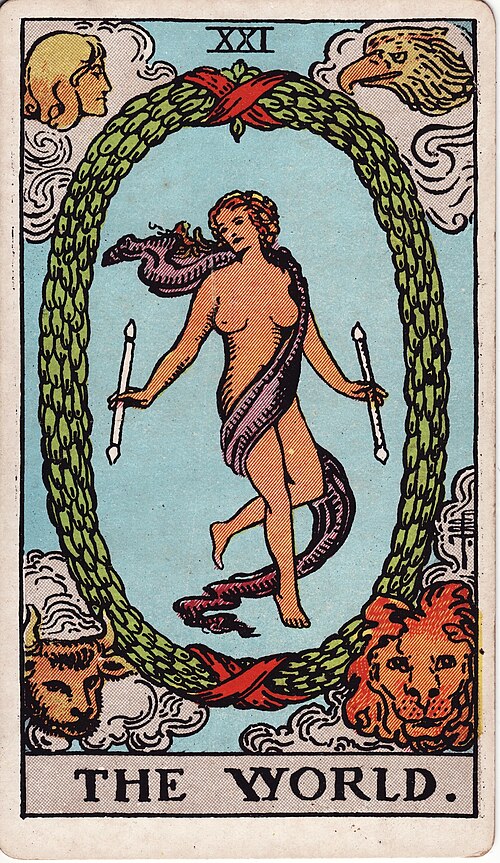
A central human figure dances within a large oval wreath. The figure holds a short wand in each hand, with one leg crossed behind the other. A purple or violet sash wraps around the body, leaving much of the figure visible. The wreath is green and tied with red ribbons at its upper and lower points. In the four corners are a human or angelic figure, an eagle, a lion, and a bull, each set against a pale blue-gray clouded background. The four beings face into the central scene and create a balanced frame.
The composition combines motion and enclosure. The dancer moves, yet the wreath gives the movement a clear boundary. The crossed legs and twin wands suggest coordination rather than passive stillness. The four corner figures recall a fourfold structure often associated with the fixed signs or the four living creatures in symbolic and religious traditions, but those correspondences are interpretive layers, not all directly stated by the printed image. The strong green, red, violet, and blue-gray colors make the central figure distinct from the surrounding sky.
Arthur Edward Waite's Pictorial Key to the Tarot, illustrated by Pamela Colman Smith and listed by the archive as a 1911 work, is an early source for RWS card explanations. This article distinguishes that historical interpretive context from modern practical reading. The observable image shows a complete, balanced field; it does not by itself guarantee fame, travel, marriage, or any other single event.
Keywords and how the image supports them
A concise keyword set is completion, integration, wholeness, participation, achievement, perspective, and transition. Completion follows the wreath's enclosing form and the card's final position in the Major Arcana. Integration follows the four corner beings gathered around one center. Wholeness describes the image's balance without claiming perfection. Participation follows the active dance and the two wands. Achievement follows the sense of having crossed a threshold, while perspective follows the figure's central view within a larger frame. Transition is included because every completed cycle creates a new starting point. These are interpretive prompts grounded in visual structure and tradition, not fixed predictions.
Upright The World meanings
Upright The World often suggests that separate strands are ready to be understood as one process. Its strength is integration: completing a course, publishing finished work, accepting a new role, or recognizing how earlier lessons now cooperate. It can mark a satisfying milestone, but its practical message is to define what has actually been completed and document it. Celebrate the result, share credit, and decide how to carry the learning into the next stage.
The risk of excess is perfectionism, over-identifying with an achievement, or believing that one successful ending removes all future work. Another excess is performing completion for an audience while leaving the essential task unfinished. Upright action is to close open loops, review the standard you met, acknowledge collaborators, and make a deliberate transition plan. The World favors a wide view, but a wide view still needs concrete evidence.
- Upright strengths: synthesis, earned completion, confidence in a larger context, and readiness to participate fully.
- Upright risks: perfectionism, status attachment, complacency, or confusing a public milestone with inner integration.
- Practical action: list what is done, what remains, who contributed, and which next cycle deserves your attention.
Reversed The World meanings
Reversed The World does not automatically mean a bad ending. It can indicate blockage when a final piece is missing, internalization when the achievement has not yet been emotionally absorbed, excess when completion standards become impossible, delay when a handoff or closure is postponed, or direction adjustment when the supposed finish line no longer matches the real goal. The card may also describe a near-completion that needs a smaller, more honest definition of done.
For blockage, identify the one unfinished dependency rather than declaring the whole project a failure. For internalization, allow time to recognize the accomplishment without requiring public applause. For excess, reduce perfectionism to a clear quality standard. For delay, schedule the final review, submission, or conversation. For direction adjustment, ask whether you are finishing an old identity because it is familiar rather than useful. Reversed The World can therefore invite completion through revision, rest, or a change of scale.
Relationships, emotions, work, money, and personal growth
- Relationships and emotions: Upright, The World can emphasize mutual recognition, a completed chapter, or a relationship that has found a workable shape. Reversed, it may show an unresolved ending, emotional lag after a milestone, or pressure to display a perfect relationship. It cannot prove what a partner or former partner feels.
- Work and study: Upright, it supports graduation, delivery, publication, certification, portfolio completion, or a role that uses several learned skills. Reversed, check the missing requirement, delayed handoff, incomplete feedback loop, or ambition that has outgrown the current project.
- Money and resources: Upright, review whether a financial goal has truly been met and whether resources can support the next cycle. Reversed, watch for completion spending, sunk-cost attachment, unclear accounting, or postponing a necessary closeout. The card is not a guarantee of wealth or investment return.
- Personal growth: Upright, integrate different parts of your experience without reducing yourself to a single label. Reversed, notice whether you are waiting for external recognition before accepting growth, or trying to finish a process that needs another honest phase. Professional support remains appropriate for serious mental health concerns.
The World in different spread positions
- One-card prompt: What is ready to be integrated, completed, or consciously carried into the next cycle? The emphasis is on defining the whole process and the next transition, not naming a guaranteed event.
- Three cards, past, present, future: In the past, The World can show a completed lesson or cycle that still supplies context
- in the present, an integration point or milestone
- in the future, a possible closure followed by a new horizon. In a situation, action, outcome spread, it describes the whole field, the act of closing or synthesizing, or the result of bringing parts together.
- Relationship positions, self, other person, interaction: In self, The World asks whether you can bring your whole experience into the relationship. In the other-person position, it describes their role in completion or perspective without claiming their private thoughts. In interaction, it emphasizes shared recognition, closure, or a relationship entering a new form.
- Decision positions, opportunity, risk, advice: As opportunity, The World favors a role that uses integrated skills and a wider perspective. As risk, it warns against perfectionism, complacency, or ending something only to impress others. As advice, finish the defined work, acknowledge the evidence, and choose the next cycle deliberately.
- Obstacle, advice, outcome: As obstacle, an unfinished detail, identity attachment, or unclear definition of completion may keep the wreath closed. As advice, establish a practical completion criterion and allow a transition. As outcome, the card suggests integration or closure, while the actual result depends on action, timing, and external conditions.
Instructional combination-reading example
Instructional example, not a real case: Judgement beside The World shifts completion toward a reviewed and accountable ending; the World supplies integration after Judgement's call to answer. The World beside the Ace of Wands shifts the emphasis from finished cycle to a new project that uses what was learned. In any spread, the neighboring card modifies the question and position; it does not turn the combination into a guaranteed timeline.
Common misreadings, deck differences, and responsible use
A common misreading treats The World as automatic success, permanent happiness, certain travel, or a literal world tour. Its structure more reliably supports themes of wholeness, completion, and transition. Some schools emphasize Saturn, the four elements, fixed signs, sacred fourfold imagery, or spiritual ascent; these associations vary by tradition and deck. Marseille versions may use a different central figure, surrounding creatures, colors, and sequence context. Modern decks may alter gender presentation or replace the corner figures. Observe the deck in front of you before applying RWS symbolism.
Tarot is a cultural and symbolic-reading practice for reflection, study, and meaning-making. It is not a scientifically validated predictive method. Do not use The World to read a third party's mind, diagnose health, settle a legal dispute, guarantee investment returns, or make a high-stakes decision without qualified advice and real evidence. A completion card can encourage a review and a transition plan; it cannot certify that every obligation is finished or that a desired result must occur.
Tarot Journal Prompts
- What evidence shows that this chapter is complete, and what unfinished detail still needs a name?
- Which parts of my experience can work together now instead of competing for attention?
- What would a grounded transition into the next cycle look like over the next month?
Suggested learning links
For sequence context, review the previous card, Judgement, at tarot-card-judgement, and continue into the Minor Arcana with the Ace of Wands at tarot-card-ace-of-wands. For foundations, build on tarot-for-beginners, major-arcana-guide, tarot-upright-and-reversed, three-card-tarot-spreads, tarot-how-to-ask, tarot-journal-review, and ethics-and-boundaries. These links support method and boundaries without repeating every foundational explanation here.