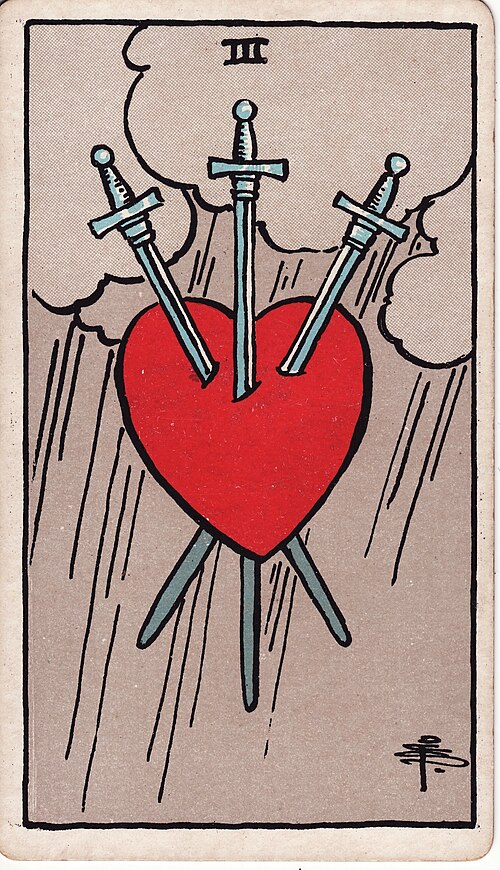
Three of Swords at a glance
The Three of Swords is Minor Arcana, Swords suit, rank Three, and position 53 in this 78-card RWS series. It follows the Two of Swords and precedes the Four of Swords. Its central image is unusually spare: a red heart suspended against a grey sky and pierced by three swords while rain falls. The picture does not prove that a breakup, betrayal, or other fixed event will occur. Instead, it gives a compact symbolic language for pain, separation, a difficult truth, or the need to let an experience be named. Read it with the question and surrounding cards, then translate the theme into choices that can be checked in ordinary life.
What the RWS image shows
The card has no visible human figures, buildings, animals, or road. A bright red heart occupies the center, open to view rather than protected by a body or container. Three long swords enter and cross the heart, creating a strong diagonal and triangular tension. Behind it is a dark, clouded grey field, and narrow streaks of rain descend across the scene. The palette contrasts the heart's saturated red and the swords' pale metallic bodies with the muted sky. The composition directs the eye inward to the wounded center; there is little visual distraction or promise of an immediate escape. These observations are separate from interpretation: the traditional Swords association with thought, language, judgment, and conflict helps explain why later readers connect the image with mental anguish and words that cut.
Keywords derived from image and tradition
- Exposure and vulnerability — the uncovered heart is visible without a shield or surrounding figure.
- Separation — three blades divide and penetrate the central form, suggesting a cut, boundary, or painful distinction.
- Grief and emotional clarity — the rain and stark composition give sorrow a definite shape rather than leaving it vague.
- Difficult truth — Swords traditionally organize thought and language, so the image can point to facts or words that hurt but clarify.
- Release and repair — the card records pain, but a wound that is acknowledged can become the starting point for boundaries, support, and adjustment.
These keywords are a reading framework, not an unexplained list of guaranteed outcomes. The visual center supports vulnerability and pain; the number three can invite attention to a relationship among forces, a third factor, or a process moving beyond the initial split; and the Swords suit adds analysis, communication, and conflict. Some readers also begin with Waite's older divinatory associations, including removal, absence, delay, division, and dispersion, then adapt the emphasis to the position and question. A modern reflective reading may therefore ask what needs to be acknowledged, not simply what will be lost.
Upright meaning
Upright, the Three of Swords often marks an experience that cannot be improved by pretending it is harmless. Its core dynamic is contact with disappointment, grief, separation, criticism, or a truth that disrupts a preferred story. Its strength is precision: once the pain is named, the reader can distinguish facts from assumptions, identify the actual boundary, and stop spending energy on denial. Its risk of excess is rumination, rehearsing the injury until the card becomes an identity rather than a signal. Practical action is to write down what is known, what is inferred, and what still needs a direct conversation or reliable evidence. Allow emotion without letting a symbolic card make accusations. If a repair is possible, choose a clear, respectful statement; if it is not, choose a boundary, support person, or small task that restores agency.
Reversed meaning
Reversed, the Three of Swords does not automatically mean that everything is fine or that pain is worse. It can show blockage when a person cannot admit what has hurt, internalization when the conflict has turned into private self-criticism, excess when analysis becomes compulsive replay, delay when a necessary conversation or grieving process is postponed, or direction adjustment when the meaning of the event is being revised. In some contexts it suggests gradual release, forgiveness, or a wound becoming less dominant; in others it points to avoidance disguised as calm. Ask which mechanism is present. A useful adjustment is to reduce the story to observable events, postpone irreversible decisions until emotion settles, and choose one honest next step rather than demanding total closure.
Applications in everyday life
- Relationships and emotions — Upright can highlight heartbreak, conflict, a needed truth, or grief within a bond
- reversed may describe unspoken hurt, guarded healing, or the need to stop reopening an old wound. Do not use it to read another person's private thoughts. Ask what can be communicated and what boundary protects both people.
- Work and study — The card can point to critical feedback, a disappointing result, a difficult discussion, or a plan that must be revised. Its constructive use is to separate useful information from personal attack and turn the lesson into a specific correction. Reversed, check whether fear of criticism is delaying a submission or conversation.
- Money and resources — Read it as a warning to face an unpleasant figure, loss, obligation, or disagreement without catastrophizing. Review records and seek qualified advice for financial decisions
- a card cannot forecast returns or replace due diligence. Reversed may show avoidance of a bill or the gradual repair of a strained resource plan.
- Personal growth — This card asks for emotional honesty and compassionate discernment. Name the loss, notice the belief attached to it, and decide what remains possible. Reversed, adjust the direction from self-punishment toward processing, support, and an evidence-based choice.
The card in different spread positions
- One-card prompt — What painful truth or emotional fact deserves clear attention today? The position turns the card into a focused journaling question, not a prediction.
- Three-card past, present, future — In the past, it may describe an earlier rupture shaping the question
- in the present, a current hurt or honest realization
- in the future, a likely theme of acknowledgment or separation if present patterns continue. Treat the future as a possibility to test, not a fixed event.
- Three-card situation, action, outcome — As situation, it identifies the emotional or verbal tension
- as action, it recommends naming facts, setting a boundary, or seeking support
- as outcome, it describes the emotional consequence of clarity, which may be repair, release, or a necessary ending depending on neighboring cards.
- Relationship positions: self, other person, interaction — In self, examine your hurt, assumptions, and communication style. In the other-person position, read the role or dynamic represented in the question rather than claiming access to that person's mind. In interaction, look for the pattern between you: a cut, a truth, a third influence, or a chance to repair.
- Decision positions: opportunity, risk, advice — The opportunity may be honest clarity or a clean boundary
- the risk is acting from fresh pain, revenge, or an unverified story
- the advice is to gather facts, speak plainly, and protect dignity without escalating.
- Obstacle, advice, outcome — As obstacle, unresolved grief or fear of a hard conversation may narrow perception. As advice, acknowledge the wound and choose a proportionate response. As outcome, the card may show consequences of truth-telling or the end of denial, not a guaranteed breakup.
Instructional combination example
Instructional example, not a real case: Two of Swords, Three of Swords, and Four of Swords appear together in a short sequence. The Two can show guarded indecision; the Three gives the avoided issue an emotional and verbal edge; the Four of Swords then modifies the sequence by recommending a pause before further confrontation. Together they do not prove betrayal. They teach a reading movement from suspended judgment, through naming the hurt, toward rest and deliberate response. If the Three were reversed, the same sequence might emphasize internalized pain or a delayed admission rather than an openly stated conflict.
Common misreadings, traditions, and responsible use
A common misreading treats the pierced heart as a literal promise of a breakup, death, betrayal, or permanent misery. The image is emotionally direct, but its meaning changes with the question, position, and deck. Many Marseille-style decks use pip arrangements rather than the RWS scene, so a reader may begin with the number, suit, symmetry, and local tradition instead of the heart-and-swords narrative. RWS and Marseille traditions also differ in some imagery and in the numbering of Strength and Justice: this series follows RWS, where Strength is VIII and Justice is XI; Marseille commonly places Strength at XI and Justice at VIII. Reversals are a method used by some schools, not a universal rule, and can indicate blockage, inwardness, excess, delay, or redirection rather than simple bad luck. Tarot is best used here as cultural study, symbolic reading, and self-reflection. It is not scientifically validated predictive power. Do not use the card as medical, legal, investment, or safety advice, and do not use it to diagnose or expose a third party.
Tarot journal prompts
- What is the observable fact at the center of my concern, and which part is interpretation?
- What boundary, conversation, or act of support would acknowledge the hurt without enlarging it?
- If I read this card as an invitation to clarity rather than a sentence, what is one reversible step I can take today?
Suggested learning links
For sequence context, continue from Two of Swords at tarot-card-two-of-swords and next read Four of Swords at tarot-card-four-of-swords. For foundations, pair this article with Tarot for Beginners at tarot-for-beginners, Tarot Upright and Reversed at tarot-upright-and-reversed, Three-Card Tarot Spreads at three-card-tarot-spreads, Tarot Journal Review at tarot-journal-review, and the Swords suit guide at tarot-swords. Those articles explain general method; this entry applies the method specifically to the Three of Swords without treating the general court-cards guide as a card article.