Six of Cups at a glance
The Six of Cups is the sixth card of the Cups suit, a Minor Arcana card, and position 42 in the 78-card Rider-Waite-Smith sequence. It follows the Five of Cups and turns from visible disappointment toward memory, familiarity, generosity, and the ways the past enters the present. The scene is gentle, but gentle does not mean automatically accurate or harmless: memory can support belonging and can also idealize what happened. A useful reading question is, "What from the past is worth carrying forward, and what must be updated before I repeat it?" Tarot here is a symbolic language for cultural study and self-reflection, not a scientifically validated predictive system.
For historical framing, The Pictorial Key to the Tarot is a 1911 work credited to A. E. Waite, with illustrations by Pamela Colman Smith. It is one reference for the RWS tradition, while the keyword explanations and practical applications below are editorial synthesis rather than a claim that every modern association appears in that source.
What the RWS image shows
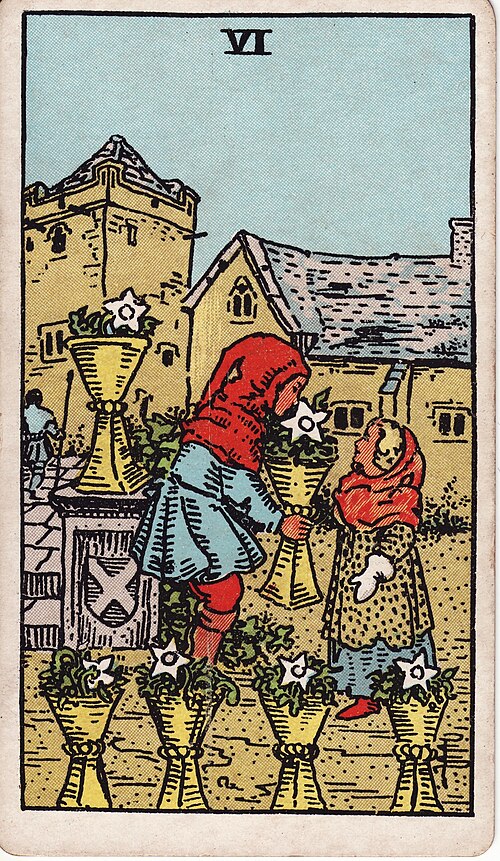
Two childlike figures stand in a courtyard or settlement. One figure holds a cup containing pale flowers and offers it toward the other, who faces the exchange. Several other cups, also filled with white flowers, stand around the scene. Buildings and a wall or doorway frame the background, while the warm yellow and blue areas create a clear, open atmosphere rather than the gray isolation of the preceding Five. The figures are close enough for an exchange, but the card does not identify their names, exact relationship, or private feelings.
The flower-filled cups make the vessels look like containers of living memory, care, or a modest gift, but those meanings are interpretive rather than proof of a literal childhood event. The courtyard places the action in a familiar, bounded environment. The children may suggest early experience, openness, dependence, or a developmental stage; they do not require the reader to assign a fixed age, gender, or personality to a real person. For this card, visible gesture and setting should be separated from later traditions about nostalgia, reunion, or innocence.
Keywords and how they arise
A concise keyword set is memory, familiarity, kindness, exchange, innocence, continuity, nostalgia, and present-day integration. Memory and familiarity follow from the child figures and enclosed home-like setting. Kindness and exchange arise from one child offering a flowered cup to another. Innocence can describe openness and uncomplicated generosity, but it becomes risky when treated as a claim that the past was pure. Continuity follows from repeated cups and a shared setting. Nostalgia names the emotional pull of the past, while present-day integration is the practical task of carrying a useful lesson forward without living inside an edited version of history.
- Keywords: memory
- familiarity
- kindness
- exchange
- innocence
- continuity
- nostalgia
- present-day integration. These are interpretive pathways from the image, the Cups suit, and traditional practice, not automatic descriptions of a person or future event.
Upright meaning
Upright, the Six of Cups can describe a return to a familiar place, an old connection, a generous exchange, a memory that supplies context, or a simple pleasure that restores emotional proportion. Its strength is the ability to receive and give care without making every interaction a negotiation. It can also support learning from earlier experience, preserving a meaningful tradition, mentoring, or asking what once helped you feel safe and connected.
Its risk is excess. Nostalgia can become idealization, regression, dependency, rescuing, sentimentality, or a refusal to recognize that people and circumstances have changed. A warm memory is not the same as current evidence, and a familiar person is not automatically a safe person. A practical upright action is to name the memory, identify the value it represents, and express that value in a present-day way: make a respectful invitation, teach a skill, restore a ritual, or offer help with clear boundaries.
Reversed meaning
Reversed, the Six of Cups does not automatically mean that the past is bad or that a reunion will fail. It may show blockage in accessing comfort, difficulty trusting a kind exchange, or a memory that remains internalized and hard to discuss. Excess can appear as living in the past, romanticizing childhood, repeating an old role, clinging to familiar harm, or using sentiment to avoid current responsibility. Delay may concern a reunion, reconciliation, creative return, or emotional integration that needs more time and clearer conditions.
The direction adjustment is to bring the useful part of the past into present conditions. Check what is remembered, what is documented, what has changed, and what boundaries are needed now. A small step might be writing a balanced memory, contacting someone only with consent, updating an old method, accepting support without becoming dependent, or creating a new ritual that serves today's life. Reversed can signal release from an old script, but it can also show that forcing a return would ignore important information.
Applications in everyday life
Relationships and emotions: The Six of Cups can highlight tenderness, shared history, friendship, family patterns, a reunion, or a wish for uncomplicated care. It may suggest a kind conversation or an honest look at what the relationship has taught you, but it cannot prove that another person misses you, wants to reconcile, or is emotionally innocent. Focus on direct communication, present behavior, and consent. Reversed, ask whether familiar comfort is being confused with compatibility, or whether an old hurt is preventing a fair view of the current relationship.
Work and study: This card can point to a former teacher, mentor, method, classmate, earlier project, or skill that remains useful. Revisit the past for evidence and technique, not to avoid learning what the current context requires. A practical action could be requesting feedback from an experienced person, adapting an old study routine, or helping a beginner while keeping the role clear. Reversed, watch for outdated procedures, comparison with an earlier success, or returning to a comfortable task instead of addressing a new challenge.
Money and resources: Read the Six of Cups through sharing, inherited habits, recurring obligations, practical support, and the emotional stories attached to possessions, not as a promise of an inheritance or financial return. Review gifts, loans, family arrangements, and subscriptions in writing so affection does not replace clarity. For consequential decisions, use budgets, records, contracts, and qualified advice. Reversed, check for sentimental spending, rescuing someone beyond your capacity, dependence on old resources, or assuming that a past arrangement still has the same terms.
Personal growth: The card invites a balanced conversation with earlier versions of yourself. Ask what you learned, what you needed, what was missing, and which pattern no longer fits. Self-compassion can be useful, but it does not require rewriting history or excusing harm. Reversed, growth may involve separating authentic values from an inherited script, setting an adult boundary, or letting a memory be incomplete. If childhood experiences involve serious distress or trauma, use qualified support; tarot should not be used as diagnosis or recovered-memory proof.
Six of Cups in spreads and positions
One-card prompt: "What past influence can I use wisely in the present, and what needs updating?" Upright, emphasize memory, reciprocity, familiarity, and the practical value of kindness. Reversed, examine blockage, internalization, excess, delay, and the direction adjustment that prevents nostalgia or avoidance from controlling the reading. The card's emphasis changes with the position and does not deliver a fixed promise of reunion.
Three-card past, present, future: In the past, the Six can describe an influential memory, formative relationship, earlier skill, or inherited pattern. In the present, it highlights what is being exchanged, remembered, or repeated now. In the future, it may suggest revisiting a source of support or creating continuity, but only current choices and conditions can shape what happens. In a situation, action, outcome spread, it describes the history or emotional tone; the middle card shows how to respond in the present; and the final card reflects what that response may make more likely.
Relationship positions: As self, the Six describes the history, needs, generosity, or old role you bring into the connection. As the other person, it describes a role or observable pattern, never their private mind as fact. As interaction, it highlights reciprocity, shared memories, comfort, or a tendency to repeat a familiar script. Reversed in one position, ask whether the connection is blocked by old hurt, idealized by nostalgia, delayed by circumstances, or ready for a more adult boundary.
Decision positions: In opportunity, the Six may point to a proven method, supportive relationship, apprenticeship, or value worth restoring. In risk, it warns of rose-colored memory, dependency, outdated assumptions, and giving beyond your capacity. In advice, verify the past, define present boundaries, and adapt the useful lesson. In obstacle, look for regression, family pressure, sentimental avoidance, or fear of becoming unfamiliar. In outcome, it may show continuity, a modest exchange, or a chance to integrate history; surrounding cards and real actions determine whether that continuity is healthy.
Instructional combination example
Instructional, not a real case: The Five of Cups followed by the Six of Cups can show grief turning toward memory or a familiar source of care. The Five keeps attention on what was lost; the Six asks whether the past offers a usable value rather than an escape into idealization. If the Six is followed by a card of practical work, remembrance may become a new routine; if it is reversed beside a card of departure, the reading may emphasize releasing an old script. Adjacent cards add conditions rather than guaranteeing reconciliation.
Common misreadings, traditions, and responsible use
Do not reduce the Six of Cups to a guaranteed return of an ex-partner, a literal childhood event, an inheritance, eternal innocence, or proof that a relationship is safe. The child figures, offered flowered cup, repeated vessels, and enclosed setting visibly support exchange, familiarity, and memory as interpretive themes; they do not identify a hidden person's feelings. In a Marseille-style deck, the Six may be a pip arrangement rather than an RWS narrative, so number, suit, pattern, and neighboring cards carry more of the analysis. RWS and Marseille traditions also differ in the numbering of Strength and Justice and in some imagery; this series uses RWS order and primary image analysis.
Tarot can support cultural learning, symbolic reading, and self-reflection, but it has no scientifically validated power to predict events. Do not use the Six of Cups as medical, legal, investment-return, or guaranteed-fate advice. Do not diagnose childhood experiences, recover memories through cards, read a third party's mind, or pressure someone into contact because a spread looks warm. For consequential choices, use direct consent, current evidence, clear boundaries, and qualified professional support.
Tarot journal prompts
- 1. Which memory is influencing my current choice, and what present evidence supports or challenges it?
- 2. What value from the past can I express in a new, healthier form?
- 3. Where do kindness and familiarity need clearer boundaries?
Suggested learning links
Continue backward to the Five of Cups (/articles/tarot-card-five-of-cups) and forward to the Seven of Cups (/articles/tarot-card-seven-of-cups). For foundations, use Tarot for Beginners (/articles/tarot-for-beginners), the Cups suit guide (/articles/tarot-cups), the Upright and Reversed guide (/articles/tarot-upright-and-reversed), How to Ask a Tarot Question (/articles/tarot-how-to-ask), Three-Card Tarot Spreads (/articles/three-card-tarot-spreads), Tarot Journal Review (/articles/tarot-journal-review), and Ethics and Boundaries (/articles/ethics-and-boundaries). These links provide method and context without replacing the Six-specific image and position analysis above.