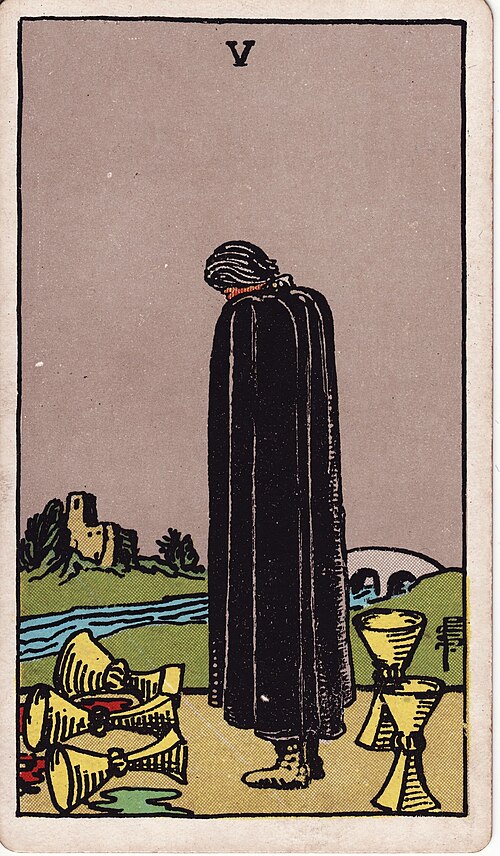
Five of Cups at a glance
The Five of Cups is the fifth card of the Cups suit, a Minor Arcana card, and position 41 in the 78-card Rider-Waite-Smith sequence. It follows the Four of Cups and shifts the suit's quiet dissatisfaction toward a visible encounter with loss, disappointment, or changed expectations. The card does not say that everything is gone: its image places spilled cups in the foreground and standing cups behind the figure. A useful reading question is, "What has been lost, what remains usable, and what would a careful next step look like?" Tarot here is a symbolic language for cultural study and self-reflection, not a scientifically validated predictive system.
For historical framing, The Pictorial Key to the Tarot is a 1911 work credited to A. E. Waite, with illustrations by Pamela Colman Smith. It is one reference for the RWS tradition, while the keyword explanations and practical applications below are editorial synthesis rather than a claim that every modern association appears in that source.
What the RWS image shows
A cloaked figure stands in a gray landscape with their back turned toward the viewer. Three cups lie overturned in the foreground, with their contents spilled on the ground. Two cups remain upright behind the figure, but the posture does not show that they have been noticed. A river runs through the scene, and a bridge leads toward a building or settlement in the distance. The figure's dark clothing contrasts with the pale sky and muted ground, while the arrangement makes the eyes move first to the loss and only later to what is still standing.
The image gives no named person, confirmed cause, or inevitable ending. The bridge is visibly a route across the water, not proof that reconciliation will occur; the distant building is a destination in the scene, not a guaranteed homecoming. These distinctions matter. Observable details support a tension between grief and remaining options, but the question, position, surrounding cards, and real-world evidence determine whether the emphasis is mourning, repair, acceptance, or a boundary.
Keywords and how they arise
A concise keyword set is grief, disappointment, selective attention, loss, remaining resources, acceptance, repair, and emotional accountability. Grief and disappointment follow from the overturned cups and the figure's withdrawn stance. Selective attention describes the way the body faces the spilled cups while the standing cups remain behind. Remaining resources comes directly from the two upright vessels. Acceptance and repair are practical directions suggested by the bridge and the possibility of turning around, not promises that pain will disappear. Emotional accountability asks what can be acknowledged without blaming the card or using it to avoid a needed conversation.
- Keywords: grief
- disappointment
- selective attention
- loss
- remaining resources
- acceptance
- repair
- emotional accountability. These are interpretive pathways from the visible scene, the Cups suit, and traditional practice, not fixed labels for a person or event.
Upright meaning
Upright, the Five of Cups can describe a real disappointment, an ending that needs to be acknowledged, or a period when attention is understandably drawn to what cannot be restored in its old form. Its strength is honest recognition. Naming the loss can prevent false optimism, clarify what changed, and make room for an appropriate apology, boundary, grieving practice, or practical repair. The card can also support humility: an outcome may be painful without making the whole life, relationship, or project meaningless.
Its risk is excess. Focus on the spilled cups can become rumination, shame, resentment, isolation, catastrophizing, or the assumption that one loss invalidates every remaining option. The figure's turned back can describe privacy and dignity, but it can also show refusal to receive support. A practical upright action is to write two short inventories: what is genuinely over, and what is still available. Then choose one proportionate action, such as asking for clarification, making a repair attempt, updating a plan, or speaking with a trusted person.
Reversed meaning
Reversed, the Five of Cups does not automatically mean recovery, nor does it turn the upright card into a simple negative. It may show blockage in grieving, difficulty admitting disappointment, or an inability to see what remains because the feeling has become internalized. Excess can appear as repetitive guilt, bitterness, forced positivity, rescuing others to avoid one's own pain, or repeatedly reopening an old story. Delay may mark the time required for trust, mourning, reconciliation, or a practical replacement to become possible.
The direction adjustment is to change the angle of attention without denying the loss. Turn toward the two standing cups, but verify what they actually contain; cross the bridge only when the route is safe and the other side is relevant. A small action might be naming the feeling, asking one direct question, setting a review date, accepting support, or defining the conditions for repair. Reversed can indicate gradual release, but it can also warn against rushing to closure or treating nostalgia as evidence.
Applications in everyday life
Relationships and emotions: The Five of Cups can describe mourning, regret, a broken expectation, or a conversation shaped by what has already hurt. It may invite an honest account of impact and a clear request, while leaving room for the other person to respond or decline. It does not prove that someone is unfaithful, secretly sorry, or destined to return. In a relationship position, stay with observable behavior, consent, and communication. Reversed, distinguish genuine repair from apology without changed conduct, and distinguish renewed contact from pressure to forgive before trust is rebuilt.
Work and study: This card may reflect a rejected application, disappointing result, failed method, difficult feedback, or a project that no longer has its original scope. Its constructive side is review: identify the exact loss, preserve useful work, and separate a setback from a global judgment about ability. Ask what can be revised, resubmitted, learned, or consciously abandoned. Reversed, watch for hiding a problem, overworking to escape embarrassment, or returning too quickly without understanding what failed.
Money and resources: Read the Five of Cups through loss awareness, recovery planning, opportunity cost, and resource triage, not as a prediction of financial ruin or gain. List obligations, available cash, time, skills, insurance or support that is actually accessible, and the information still missing. Do not let grief produce impulsive spending, secrecy, or a desperate risk. For consequential financial, legal, or debt decisions, use records and qualified professional advice. Reversed, check whether avoidance is delaying a manageable conversation or whether an apparently hopeful option has been idealized.
Personal growth: The card asks for a form of self-compassion that is neither denial nor permanent self-punishment. Let the loss have a name, a boundary, and a place in the story, then ask what remains capable of care or development. A journal, trusted conversation, or structured review can help. If the feeling is overwhelming or persistent, seek appropriate mental-health support rather than treating tarot as diagnosis or treatment. Reversed, practice releasing a role built around regret and update the next step to match present conditions.
Five of Cups in spreads and positions
One-card prompt: "What loss needs honest acknowledgment, and what remains available to me now?" Upright, emphasize the actual disappointment, the limits of immediate repair, and the difference between grief and a totalizing conclusion. Reversed, examine blockage, internalization, excess, delay, and the direction adjustment that could restore a balanced view. The card answers the position's question; it does not supply a fixed event.
Three-card past, present, future: In the past, the Five can describe an earlier disappointment that still colors the present. In the present, it highlights grief, regret, or selective attention and asks for a more complete inventory. In the future, it may suggest a period of processing followed by a choice about repair, release, or support, not a guaranteed new beginning. In a situation, action, outcome spread, it describes the emotional conditions; the middle card shows what can be done with them; and the final card reflects what that response may make more likely.
Relationship positions: As self, the Five describes your grief, regret, guardedness, or readiness to discuss impact. As the other person, it can describe a role or observable pattern, but never establishes their private thoughts as fact. As interaction, it points to a shared disappointment, an apology that needs substance, or attention fixed on what went wrong. Reversed in one position, ask whether the issue is hidden sorrow, refusal to process, premature forgiveness, or a cautious willingness to reconnect.
Decision positions: In opportunity, the Five may reveal an option to learn from a setback, recover a neglected resource, or make a proportionate repair. In risk, it warns of rumination, shame-based choices, sunk-cost thinking, and overlooking workable alternatives. In advice, name the loss, verify the remaining options, and take one reversible step. In obstacle, look for avoidance, grief that has not been acknowledged, or a demand for closure that is too fast. In outcome, it may show continued processing, partial repair, or a changed direction; surrounding cards and real actions determine the emphasis.
Instructional combination example
Instructional, not a real case: The Four of Cups followed by the Five of Cups can show a movement from withdrawal or dissatisfaction into clearer recognition of what has actually been lost. The Four asks whether attention is disengaged; the Five asks whether disappointment is now dominating the field. If the Five is followed by the Six of Cups, memory, kindness, or a familiar support may help, but the combination does not guarantee reunion. Adjacent cards modify one another by adding conditions, not by creating a fixed prediction.
Common misreadings, traditions, and responsible use
Do not reduce the Five of Cups to permanent sadness, a guaranteed breakup, death, betrayal, or the instruction to forgive immediately. The three overturned cups, two standing cups, turned figure, river, bridge, and distant building visibly support a tension between loss and remaining possibility. The card's position may make grief the topic, a risk, a past influence, or an obstacle to action. In a Marseille-style deck, the Five may be a pip arrangement rather than an RWS scene, so number, suit, pattern, and neighboring cards carry more of the analysis. RWS and Marseille traditions also differ in the numbering of Strength and Justice and in some imagery; this series uses RWS order and primary image analysis.
Tarot can support cultural learning, symbolic reading, and self-reflection, but it has no scientifically validated power to predict events. Do not use this card as medical, legal, investment-return, or guaranteed-fate advice. Do not diagnose grief, read a third party's mind, or treat a bridge in an image as an instruction. For high-stakes choices, combine reflection with direct communication, reliable information, consent, safety planning, and qualified professional support.
Tarot journal prompts
- 1. What exactly has changed, and what am I adding to that fact through fear or self-blame?
- 2. Which two resources, relationships, skills, or choices remain available, and how can I verify them?
- 3. What would a proportionate repair, boundary, or next step look like this week?
Suggested learning links
Continue backward to the Four of Cups (/articles/tarot-card-four-of-cups) and forward to the Six of Cups (/articles/tarot-card-six-of-cups). For foundations, use Tarot for Beginners (/articles/tarot-for-beginners), the Cups suit guide (/articles/tarot-cups), the Upright and Reversed guide (/articles/tarot-upright-and-reversed), How to Ask a Tarot Question (/articles/tarot-how-to-ask), Three-Card Tarot Spreads (/articles/three-card-tarot-spreads), Tarot Journal Review (/articles/tarot-journal-review), and Ethics and Boundaries (/articles/ethics-and-boundaries). These links provide method and context without replacing the Five-specific image and position analysis above.