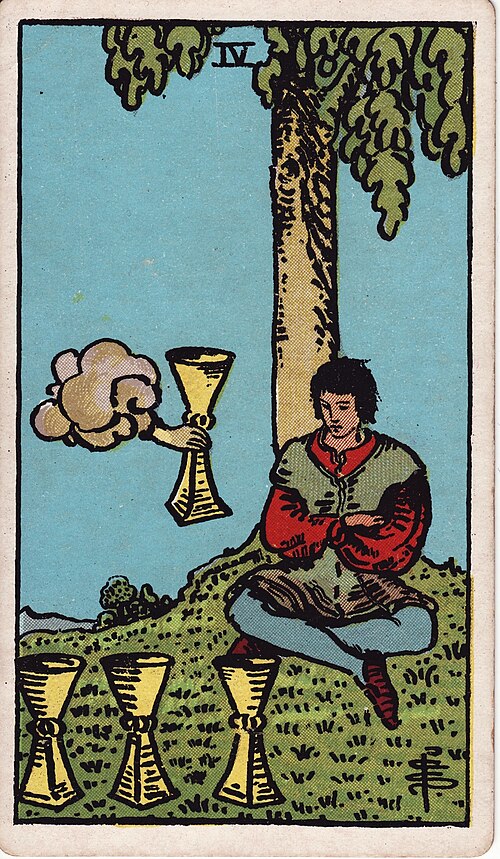
Four of Cups at a glance
The Four of Cups is the fourth card of the Cups suit, a Minor Arcana card, and position 40 in the 78-card Rider-Waite-Smith sequence. It follows the Three of Cups and turns attention from group celebration toward private evaluation. The card can describe contemplation, emotional saturation, dissatisfaction, withdrawal, discernment, or a possibility that is difficult to notice. Cups are symbolic lenses for feeling, imagination, relationship, and values, not scientific measurements or fixed forecasts. A useful question is: “What am I not engaging with, and what would help me choose rather than simply react?”
What the RWS image shows
A seated figure rests beneath a tree in a green landscape. The figure’s arms are crossed and the gaze is directed downward, away from three cups placed on the ground in front. A fourth cup is offered from a hand emerging from a cloud at the side of the image. The figure and the offered cup are visible together, but the posture does not show a response. The scene therefore holds an open possibility and a clear act of non-engagement at the same time.
The tree creates shade and a boundary around the seated figure, while the cups form a low horizontal arrangement in the foreground. Muted greens and blues make the setting quieter than the warm activity of the Three of Cups, and the distant hills or mountains keep the wider world present without drawing the figure into it. The hand has no identifiable face or body, so the card does not name a particular benefactor, lover, or supernatural command. Waite’s The Pictorial Key to the Tarot is a historical reference for the RWS tradition; this article distinguishes visible structure from traditional keywords and modern practical synthesis.
Keywords and how they arise
A concise keyword set is contemplation, dissatisfaction, pause, emotional saturation, withdrawal, discernment, overlooked possibility, and re-engagement. Contemplation and pause follow from the seated posture and downward gaze. Dissatisfaction and saturation arise from the figure’s refusal to reach toward the three cups already present. Withdrawal follows from crossed arms and the shaded space under the tree. Discernment is the constructive side of not accepting the first offer. The offered fourth cup supports overlooked possibility, while re-engagement names the direction the card may ask for when the pause has done its work.
- Keywords: contemplation
- dissatisfaction
- pause
- emotional saturation
- withdrawal
- discernment
- overlooked possibility
- re-engagement. These are interpretive pathways from the image and Cups tradition, not automatic judgments about a person.
Upright meaning
Upright, the Four of Cups can describe a period when available options no longer feel meaningful, when attention needs to turn inward, or when a person is evaluating whether an offer matches their actual values. Its strength is discernment: the card does not require saying yes to every cup simply because something is offered. A deliberate pause can prevent impulsive acceptance, help separate desire from habit, and reveal what kind of emotional or practical nourishment is missing.
Its risk is excess. Withdrawal can become apathy, rumination, contempt, emotional unavailability, or a habit of comparing real options with an ideal that cannot be tested. The offered cup may be missed not because it is perfect, but because attention is fixed on disappointment. A practical upright action is to inventory the three existing cups, state what is unsatisfying, and set a time to review the new possibility. A clear no can be healthier than passive avoidance, while a measured experiment can be wiser than a dramatic commitment.
Reversed meaning
Reversed, the Four of Cups does not automatically mean sudden happiness or a negative reversal. It may show blockage in recognizing desire, difficulty responding to an offer, or a pattern of disengagement that has become hard to interrupt. Internalization may mean that a feeling is being examined privately before it can be communicated. Excess can appear as endless self-analysis, retreat from every invitation, novelty-seeking to escape boredom, or rejecting useful support because it is imperfect. Delay may reflect emotional readiness, missing information, or the time needed to recover attention after prolonged dissatisfaction.
The direction adjustment is to make engagement small and testable. Look up from the familiar complaint, ask one clarifying question, name one need, accept or decline an offer explicitly, or try a limited change before making a larger decision. Reversed can indicate re-entry after a pause, but it can also warn against forcing activity merely to escape stillness. Let the surrounding cards show whether the next movement is toward connection, work, rest, or a revised definition of satisfaction.
Applications in everyday life
Relationships and emotions: The Four of Cups can show emotional distance, boredom, guardedness, or a person needing time to identify what they actually feel. It may support a candid conversation about unmet needs, but it does not prove rejection, depression, a breakup, or another person’s hidden thoughts. Look for observable patterns such as postponed conversations, reduced initiative, or a clear request for space. Reversed, distinguish renewed willingness to engage from anxious overcorrection or accepting any contact simply because silence feels uncomfortable.
Work and study: This card can describe a stale assignment, loss of motivation, waiting for feedback, or a useful opportunity that is being overlooked because attention is fixed on what is disappointing. Its strength is the ability to pause and reassess the purpose of the task. Its risk is disengagement without a plan. Review the brief, ask for specific feedback, change the study method, or set a short experiment. Reversed, re-enter gradually and check whether the new option solves the real problem rather than only adding stimulation.
Money and resources: Read the Four through satisfaction, opportunity cost, ignored information, and the emotional meaning of consumption, not as a promise of wealth or investment return. Existing cups may be resources already available but undervalued; the offered cup may be a proposal that still requires due diligence. Compare terms, timing, risks, and exit options before accepting. Reversed, watch for boredom spending, rejecting a sound option without reviewing it, or chasing novelty after frustration. Use records and qualified financial or legal advice for consequential decisions.
Personal growth: The card asks whether you are resting to hear yourself or withdrawing to avoid choice. Try a quiet inventory: what is present, what is missing, what is being offered, and what would make a fair test possible? Practice declining without apology when an option is wrong, and practicing curiosity when an option is merely unfamiliar. Reversed, notice whether constant activity is preventing honest reassessment. Growth lies in choosing attention deliberately, not in treating every pause as failure.
Four of Cups in spreads and positions
One-card prompt: “What am I overlooking, and what would a clear response require?” Upright, emphasize the quality of the pause, the unmet need, and the distinction between a deliberate no and passive avoidance. Reversed, examine blockage, internalization, excess, delay, and the direction adjustment that could restore selective engagement.
Three-card past, present, future: In the past, the Four can describe disappointment, a missed invitation, a period of withdrawal, or a learned habit of protecting attention. In the present, it highlights dissatisfaction and the offer or information that deserves a fair look. In the future, it may suggest a chance to re-engage or a continued need to reassess, not a guaranteed opportunity. In a situation, action, outcome spread, it describes the emotional posture; the middle card shows how to respond; and the final card reflects what that response may make more likely.
Relationship positions: As self, the Four describes your availability, guardedness, need for space, or difficulty naming desire. As the other person, it describes an observable role or pattern, never their private mind as fact. As interaction, it highlights a quiet gap, mismatched offers, or the need for a better-defined invitation. Reversed in one position, ask whether the issue is hidden processing, over-withdrawal, pressure to re-engage, or a genuine change in what the relationship can hold.
Decision positions: In opportunity, the card points to a pause that allows discernment, a modest alternative, or information currently outside your focus. In risk, it warns of apathy, sunk attention, idealization, and rejecting an option without examination. In advice, name the unmet need, ask one useful question, and run a bounded experiment. In obstacle, look for emotional fatigue, comparison, avoidance, or an offer that does not address the actual problem. In outcome, it may show continued evaluation or selective re-engagement; surrounding cards and real actions determine which.
Instructional combination example
Instructional, not a real case: The Three of Cups followed by the Four of Cups can show movement from social fullness into a private pause. The Three highlights shared activity and available support; the Four asks whether that activity still meets the individual’s needs or has become a performance. If the Four is followed by a card of clear action, the pause may become a deliberate experiment; if it is reversed beside a strong social card, renewed contact may be possible but should not be forced. Adjacent cards modify one another rather than creating a fixed prediction.
Common misreadings, traditions, and responsible use
Do not reduce the Four of Cups to laziness, depression, rejection, a guaranteed missed chance, or proof that a hidden offer will transform life. The seated figure, crossed arms, three grounded cups, and cloud-held fourth cup visibly support a tension between available options and limited engagement; the question and position determine whether the useful emphasis is rest, discernment, avoidance, or re-entry. In a Marseille-style deck, the Four may appear as a pip arrangement rather than an RWS scene, so number, suit, pattern, and neighboring cards carry more of the analysis. RWS and Marseille traditions differ in the numbering of Strength and Justice and in some imagery; this series uses RWS order and primary image analysis.
Tarot is used here for cultural study, symbolic reading, and self-reflection, not scientifically validated predictive power. Do not use this card as medical, legal, or investment-return advice, and do not make guaranteed-fate claims. Do not diagnose a person, read a third party’s mind, or treat a symbolic offer as a command. For high-stakes decisions, use direct communication, reliable information, clear consent, and qualified professional support.
Tarot journal prompts
- 1. What am I dissatisfied with, and what specific change would address it?
- 2. Is my current pause helping me discern, or helping me avoid a clear choice?
- 3. What small, reversible experiment would let me evaluate the offered option fairly?
Suggested learning links
Continue backward to the Three of Cups (tarot-card-three-of-cups) and forward to the Five of Cups (tarot-card-five-of-cups). For foundations, build on Tarot for Beginners (tarot-for-beginners), the Cups suit guide (tarot-cups), the Upright and Reversed guide (tarot-upright-and-reversed), How to Ask a Tarot Question (tarot-how-to-ask), the Three-Card Tarot Spreads guide (three-card-tarot-spreads), and Tarot Journal Review (tarot-journal-review). These links support the method without replacing the Four-specific image and position analysis above.