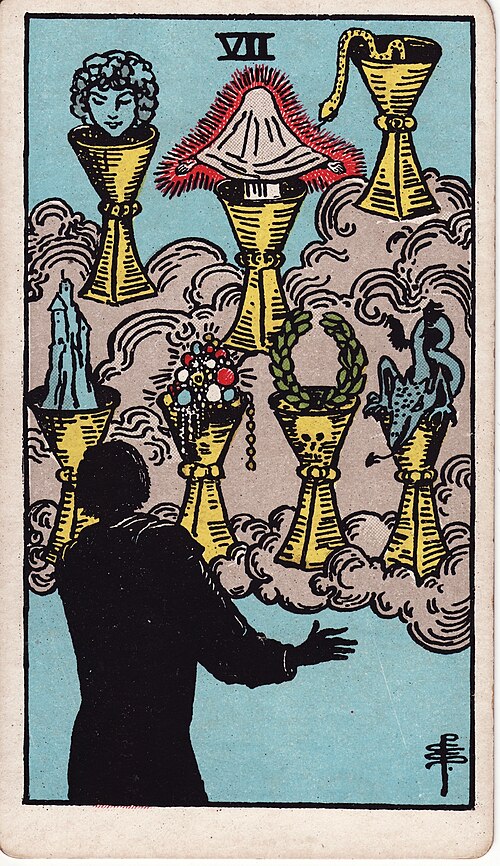
Seven of Cups at a glance
The Seven of Cups is Minor Arcana VII in the Cups suit and the seventh numbered Cups card. In the 78-card RWS sequence it is position 43: twenty-two Major Arcana cards come first, followed by the fourteen Wands cards, then the first six Cups cards. Its central question is not simply “Which option is best?” but “What am I actually seeing, wanting, and willing to test?”
The RWS image is the primary reference for this series. RWS and Marseille traditions differ in the numbering of Strength and Justice and in some imagery; Marseille pip cards also use a different visual language. Here, the RWS order places Strength at VIII and Justice at XI, and the Seven of Cups is read from its scenic image rather than treated as a fixed prediction.
For historical context, A. E. Waite’s The Pictorial Key to the Tarot, published in 1911 and illustrated by Pamela Colman Smith in the associated deck tradition, is a period source for descriptions and meanings. A period source records one layer of tradition; modern reflective applications below are editorial synthesis, not scientific evidence that tarot predicts events.
What the RWS image shows
A dark-haired figure is shown from behind in the foreground, facing a pale cloud that holds seven golden cups. The person looks into the scene rather than at the reader, so attention is directed toward possibilities and projections. The cups are presented at roughly eye level, without a visible hand selecting one. This lack of a clear choice is as important as the number of vessels.
The cups contain different forms: a human or veiled figure, a serpent, a tower or castle, jewels, a wreath, and a winged or monstrous creature are commonly identifiable in RWS reproductions. The exact visual detail can vary by printing, so the safest observation is that the vessels hold contrasting rewards, threats, identities, and mysteries. Blue and gray cloud forms create a dreamlike background, while the warm cups provide separate points of focus.
The figure faces into an elevated, unstable display rather than standing in a settled landscape. The composition has no road, measuring tool, or external authority to decide among the cups. It shows imagination opening faster than discernment can organize it.
Keywords derived from the image
Useful keywords are imagination, options, projection, temptation, discernment, and emotional fog. Imagination follows from the cloud and the unusual contents; options follow from seven separate cups; projection follows from the figure seeing possibilities from the outside rather than touching or testing them. Temptation names the attractive or frightening pull of the contents, while discernment is the practical skill the image withholds. Emotional fog describes the atmosphere, not a diagnosis: a person may be creative and perceptive while still lacking decision criteria.
Upright Seven of Cups meaning
Upright, this card often describes a wide field of wishes, images, invitations, or possible futures. Its strength is generative attention: brainstorming, imagining a different life, noticing several emotional truths, or allowing an emerging idea to become visible. It can support artistic work, honest naming of desires, and a pause before committing.
Its risk is confusing intensity with evidence. A beautiful cup may be a real opportunity, an untested fantasy, or a symbol of a need that has not yet been translated into action. Too many options can scatter time; fear can also masquerade as endless research. The card does not promise that any choice will succeed, and it does not require rejecting imagination.
A practical upright response is to turn the cloud into a shortlist. Write down the options, separate needs from fantasies, define two or three criteria, and test the most workable choice with a small reversible step. Ask what can be verified, what resource is required, and what you would choose if applause or fear were removed. Keep an alternative open only when doing so has a clear cost and purpose.
Reversed Seven of Cups meaning
Reversed, the same theme may be blocked, internalized, excessive, delayed, or redirected. A blockage can feel like blankness, inability to imagine a path, or distrust of every desire. Internalization can show private fantasies, unspoken longing, or a decision that remains in the mind instead of entering conversation. Excess can appear as compulsive browsing, escapism, idealizing a person, or chasing every appealing possibility.
Delay may come from waiting for perfect certainty, repeatedly changing the criteria, or allowing an attractive distraction to consume the decision window. Direction adjustment can be constructive: narrow the field, return to a neglected option, check a promise against facts, or replace a seductive goal with a value that is actually yours. Reversed is not automatically negative; it can mark clarity after excess. Upright is not automatically positive; an upright abundance of options can still produce avoidance.
Applications in ordinary life
In relationships and emotions, the Seven of Cups can describe attraction, romantic possibility, mixed signals, or several stories being projected onto one interaction. Its constructive use is to name feelings and ask clear questions. Its warning is not to infer another person’s thoughts from chemistry, silence, or a symbolic card. Reversed, clarify expectations, reduce fantasy, and notice whether emotional withdrawal is protecting a boundary or avoiding a needed conversation.
For work and study, it favors ideation, portfolio thinking, creative research, and comparing routes. The practical task is prioritization: select a deliverable, deadline, and test rather than collecting infinite plans. Reversed, check whether distraction, perfectionism, or fear of evaluation is blocking work; a smaller assignment can restore traction.
For money and resources, this is a prompt to distinguish a priced opportunity from an attractive story. Compare costs, terms, time, and downside before committing. Do not use the card as investment-return advice. Reversed, delay a discretionary choice until facts are available, or simplify a budget that has too many competing goals.
For personal growth, the card invites honest contact with desire without treating every desire as an instruction. Journal, visualize, then reality-test. Growth may mean choosing one value and accepting the grief of not pursuing six other images at once.
Reading the Seven of Cups in spreads
One-card prompt: “What possibility, projection, or distraction deserves clearer examination today?” The emphasis is on observation and a test, not on naming a guaranteed outcome.
In a three-card situation, action, outcome spread, the Seven of Cups in the situation position describes a crowded field of wishes or interpretations. In action, it asks for criteria, comparison, and one concrete experiment. In outcome, it suggests that the result depends on selection and follow-through; without a choice, ambiguity remains the main outcome.
In a relationship spread, Seven of Cups as self can show hopes, fears, or competing narratives the querent brings. As the other person, it describes how that person is being represented in the reading, not their private mind; look for observable behavior and ask rather than assume. As interaction, it points to projection, chemistry, uncertainty, or many possible directions that require explicit communication.
In a decision spread, as opportunity it may reveal a creative route or a broader menu. As risk it warns of seductive terms, scattered effort, or choosing from fear. As advice it says to define criteria, verify claims, and take a reversible step before a major commitment.
As obstacle, it highlights too many cups, unclear priorities, or an idealized standard. As advice, it recommends narrowing attention and naming what is real now. As outcome, it leaves several paths open unless the surrounding cards show a decision and a practical next move.
Instructional combination reading
Instructional example, not a real case: Six of Cups beside the Seven of Cups can turn a memory or familiar comfort into a current fantasy; ask which part is a useful value and which part is nostalgia. Seven of Cups beside Eight of Cups can show discernment becoming departure: after comparing imagined paths, the reader may choose to leave what no longer feels meaningful. The neighboring card modifies emphasis; neither pair is a guaranteed event.
Common misreadings, traditions, and boundaries
A common misreading is “seven choices, one is secretly the correct answer.” The image does not label a winner. Another is treating every cup as a literal promise of wealth, romance, or danger. RWS scenic minors encourage visual analysis, while Marseille readers may begin with number, suit, and pip structure; elemental, psychological, and fortune-telling schools also assign different weight to the same symbol. Reversals are optional in some schools, so state your method before reading.
Use the Seven of Cups as a cultural and symbolic reflection tool, not as scientifically validated prediction. Do not use it to read a third party’s mind, guarantee fate, or replace medical, legal, financial, academic, or safety advice. For high-stakes choices, consult qualified professionals and verifiable information. A responsible tarot question preserves agency: “What should I examine or test?” is safer than “What must happen?”
Tarot-journal prompts
- 1. Which cup represents a verifiable opportunity, and which represents a story I have not tested?
- 2. What criteria would make my next choice clearer?
- 3. Where am I using more options to avoid one honest decision?
Suggested learning links
Previous card: Six of Cups Tarot Card (tarot-card-six-of-cups). Next card: Eight of Cups Tarot Card (tarot-card-eight-of-cups). Foundational reading: Tarot for Beginners (tarot-for-beginners), How to Ask Tarot Questions (tarot-how-to-ask), Tarot Upright and Reversed (tarot-upright-and-reversed), and Three-Card Tarot Spreads (three-card-tarot-spreads). These articles provide method and spread context without replacing this card-specific analysis.