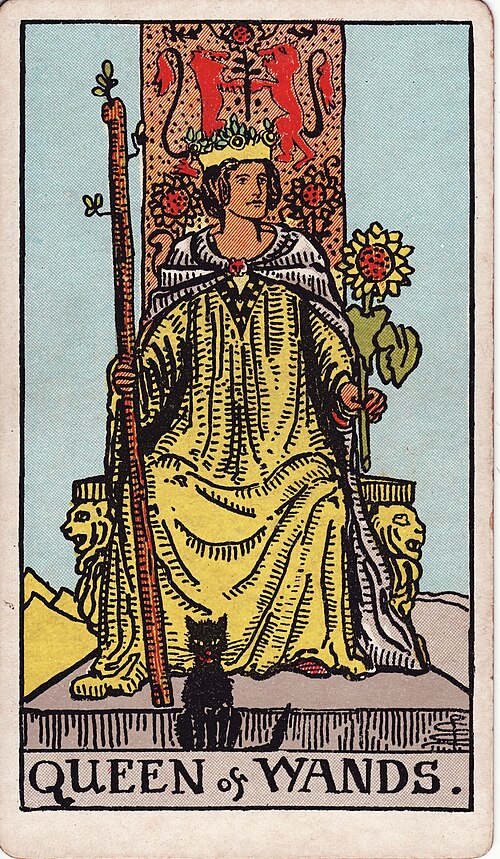
Queen of Wands at a glance
In the Rider-Waite-Smith (RWS) tradition, the Queen of Wands is a court card in the Minor Arcana and the thirty-fifth card in the 78-card sequence. She follows the Knight of Wands and comes before the King of Wands. Where the Knight pushes energy outward, the Queen shows fire that has become embodied: warm, visible, creative, self-possessed, and attentive to the life around it. Tarot here is a cultural and symbolic reading practice for reflection, not a scientifically validated method of predicting events.
RWS and Marseille traditions differ in some imagery and in the numbering of Strength and Justice. RWS places Strength at VIII and Justice at XI; many Marseille decks reverse those numbers. This series follows RWS order and uses the RWS image for primary analysis.
What the RWS image shows
A seated woman occupies the center of the card on a substantial throne. Her body and gaze are presented openly toward the viewer, giving the scene a direct and self-possessed quality. She holds an upright wand in one hand and a bright sunflower in the other. The throne carries lion imagery, while a black cat sits near her feet. Warm yellow, orange, and red tones dominate the clothing and background, with green in the living plants and wand. The setting is open rather than enclosed, but the throne supplies a clear seat of presence and authority.
These visible details support a reading of confident attention rather than a promise of effortless success. The upright wand gives the Queen an active tool; the sunflower turns attention toward vitality, expression, and what is being cultivated; the cat introduces an independent, watchful presence that does not need to perform for approval. Her centered posture suggests steadiness, while the warm palette makes her presence conspicuous. Direction in the picture is a visual cue for emphasis, not a fixed prediction about what will happen.
Keywords derived from image and tradition
Useful keywords are confidence, warmth, visibility, creativity, discernment, independence, encouragement, and boundaries. Confidence follows from the Queen's composed seat and direct presentation. Warmth and encouragement arise from the sunflower and the inviting fire palette. Creativity follows from the living wand and the Wands suit's traditional association with action and expression. Independence and discernment are supported by the alert cat and the Queen's settled self-possession. Boundaries keep the interpretation honest: visibility is not the same as availability, and charisma is not permission to control others.
- Confidence: occupy your role without waiting for universal approval. Warmth: make energy generous rather than performative. Creativity: give a living idea a form it can sustain. Discernment: notice what deserves attention and what only demands it. Independence: protect an inner standard. Boundaries: let openness coexist with consent and limits.
Upright Queen of Wands meaning
Upright, the Queen of Wands describes confident participation, creative leadership, and a visible willingness to support life as it is actually being lived. She may point to a person who encourages others without shrinking herself, or to a way of acting that combines enthusiasm with practical self-trust. Her strength is embodied initiative: she can welcome an opportunity, speak clearly, host a conversation, present work, or protect a project while keeping its human purpose in view.
The risk of excess is performative confidence, jealousy, attention-seeking, territorial behavior, or using warmth to conceal exhaustion. A practical upright response is to choose where visibility serves the work, state the limits of your availability, and convert inspiration into a repeatable practice. Upright does not guarantee admiration, romance, or success. It suggests a useful posture—warm, direct, and self-respecting—while results still depend on context, effort, consent, and feedback.
Reversed Queen of Wands meaning
Reversed, the Queen of Wands can show blockage around self-expression, an idea or feeling kept private, excess charisma used defensively, delay caused by depleted confidence, or a need to adjust direction before taking center stage. It may describe burnout behind a polished appearance, resentment when recognition is uneven, or a creative person who is waiting for permission to trust their own judgment. Reversed is not automatically negative; privacy can protect a seed, and a quieter period can restore a sustainable source of fire.
Identify the form of the reversal instead of forcing one verdict. For blockage, make a low-stakes draft or ask for specific feedback. For internalization, name the feeling in a journal before deciding whether it needs a conversation. For excess, reduce comparison, publicity, or commitments that turn expression into performance. For delay, define a modest date and a preparation task. For direction adjustment, ask whether the audience, project, or method still matches the value you want to express.
Applications in ordinary life
Relationships and emotions: Upright, this card can emphasize honest warmth, playful attraction, encouragement, and the ability to bring self-respect into intimacy. It may suggest expressing appreciation or creating a setting where both people can be fully present. It does not reveal a third party's private thoughts. Reversed, it can point to insecurity hidden behind confidence, possessiveness, emotional withdrawal, or a need to stop performing strength. Speak from observable experience and ask for consent rather than using the card to assign motives.
Work and study: The Queen favors presenting a proposal, mentoring a colleague, leading a discussion, publishing creative work, or building a study routine that keeps motivation alive. Let enthusiasm be measured by completed practice, not by how impressive the announcement sounds. Reversed, check burnout, comparison, fear of judgment, and projects that depend on constant praise. A smaller audience, clear feedback criteria, or a sustainable schedule can restore direction without abandoning the work.
Money and resources: The card may describe investing time or money in a creative practice, community, personal presentation, or skill that can produce value over time. It is not a promise of profit or a signal to spend for status. Compare costs, maintenance, opportunity cost, and downside before committing. Reversed, pause for image-driven purchases, generosity that exceeds capacity, or income plans built on attention alone. Use an ordinary budget and qualified financial advice for consequential decisions.
Personal growth: The Queen invites you to practice visible self-trust without making identity depend on applause. Notice what makes you feel more alive and what helps that energy remain available tomorrow. Reversed, ask whether you are hiding because you need restoration or because you fear being evaluated. Growth may be a private creative session, a clear boundary, or an honest decision to stop feeding a role that no longer fits.
Queen of Wands in spreads and positions
One-card prompt: ask, “Where can I bring warmth and clear self-respect to the next step?” The card may emphasize a quality to practice, a creative resource, or a boundary to make visible rather than an event. In a three-card past, present, future spread, the Queen in the past can show an earlier period of confidence or an influential creative model; in the present she highlights embodied participation and selective visibility; in the future she suggests a possible role of encouragement or leadership that still requires preparation. In a situation, action, outcome spread, she frames the situation through confidence and care, recommends a direct but generous action, and treats the outcome as feedback rather than fate.
In relationship positions, Queen of Wands as self describes your current way of offering warmth, attraction, protection, or leadership. As the other person, she describes the observable role or style relevant to the question, not hidden feelings or a fixed gender identity. As interaction, she can indicate mutual encouragement, creative chemistry, social visibility, or tension around attention and independence. In decision positions, she can show an opportunity to be seen for real ability, a risk of choosing recognition over substance, and advice to act with warmth while keeping terms and limits clear.
In obstacle, advice, and outcome positions, the Queen changes emphasis. As obstacle, insecurity, comparison, possessiveness, or exhaustion may distort the use of confidence. As advice, choose the room, audience, and action that match your values; show up fully without overpromising. As outcome, expect clearer self-expression, a supportive role, or a more visible standard, not guaranteed applause. The position and surrounding cards decide whether the fire is being shared, protected, or recalibrated.
Instructional combination reading
Instructional example, not a real case: Knight of Wands, Queen of Wands, King of Wands can be read as a progression from movement, to embodied confidence, to broader direction. The Knight brings speed and appetite for action; the Queen modifies that energy by adding discernment, presence, and care for the living environment; the King extends it into vision and responsibility. If the Queen is reversed, the same sequence may suggest that a bold plan needs recovery, clearer boundaries, or less dependence on recognition before it can be led well.
Common misreadings, traditions, and responsible use
Do not reduce the Queen to a literal “other woman,” guaranteed attractiveness, a particular zodiac sign, or proof that someone is jealous. Court cards can describe a person, role, learning phase, social style, or temporary behavior, and they do not require a gender or age assignment. A sunflower is visible imagery, not a universal promise of happiness; the cat is an observable animal, not evidence of occult danger. Marseille pip traditions use different visual methods, some decks change court imagery, and some readers do not use reversals. Keep the chosen school consistent and label traditional associations as interpretations rather than image facts.
Tarot can support cultural study, symbolic reading, and self-reflection. It should not replace medical, legal, financial, or mental-health guidance, and it should not be used to claim certainty about another person's mind or a guaranteed fate. For consequential choices, check documents, budgets, consent, safety, and professional advice. A responsible reading preserves agency, privacy, and the ability to revise a plan.
Tarot journal prompts
- What kind of visibility would serve my values rather than my need for approval? Which creative practice gives energy back instead of consuming it? Where am I keeping a feeling private, and what would make expression safe and clear? What boundary would allow warmth and independence to coexist?
Suggested learning links and source note
Read the previous card, Knight of Wands (/articles/tarot-card-knight-of-wands), and continue to the next card, King of Wands (/articles/tarot-card-king-of-wands). For foundations, use Tarot for Beginners (/articles/tarot-for-beginners), the Wands suit guide (/articles/tarot-wands), Upright and Reversed Tarot (/articles/tarot-upright-and-reversed), Three-Card Tarot Spreads (/articles/three-card-tarot-spreads), and Tarot Journal Review (/articles/tarot-journal-review). A historical reference point is A. E. Waite's The Pictorial Key to the Tarot, published in 1911 with illustrations by Pamela Colman Smith. This article keeps period source material, observable RWS imagery, later practice, and editorial synthesis distinct.