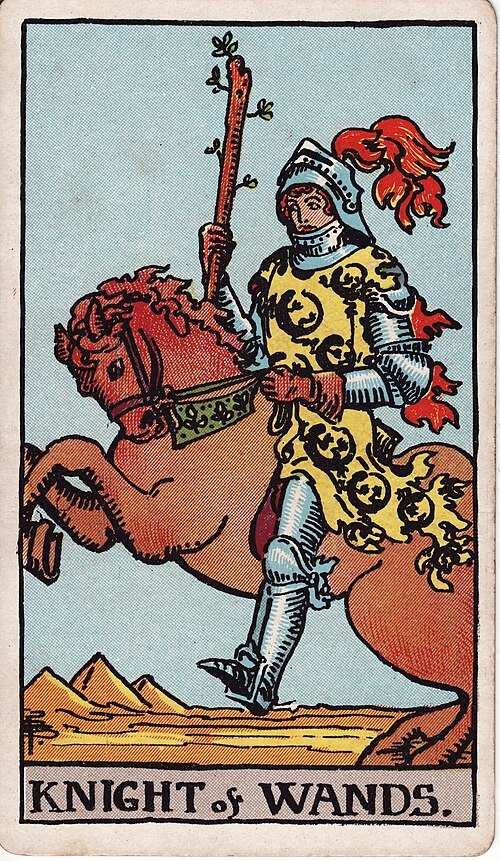
Knight of Wands at a glance
In the Rider-Waite-Smith (RWS) tradition, the Knight of Wands is a court card in the Minor Arcana and the thirty-fourth card in the 78-card sequence. It follows the Page of Wands and comes before the Queen of Wands. Where the Page notices a spark, the Knight carries that energy outward through movement, risk, pursuit, and visible commitment. The card is useful for thinking about how enthusiasm becomes action, while remembering that symbolic interpretation is a reflective practice, not a scientifically validated prediction.
RWS and Marseille traditions differ in some imagery and in the numbering of Strength and Justice. RWS places Strength at VIII and Justice at XI; many Marseille decks reverse those numbers. This series uses RWS numbering and the RWS illustration as its primary visual reference.
What the RWS image shows
A mounted figure moves across a hot, open landscape. The horse is shown in active motion, with its front legs lifted, while the rider faces toward the left and holds a wand upright. Armor appears beneath a yellow tunic patterned with salamander-like forms; a red plume and warm red, orange, and yellow colors reinforce the visual heat. The background is spare, with dry ground and distant hills rather than a settled domestic scene. The wand carries leaves, keeping growth present inside the speed.
The image combines readiness with instability. The horse supplies force and momentum, but the rider must still guide it. The raised wand is a sign of purpose or a mission in hand, not proof that the destination has been reached. The open landscape can suggest travel or exposure, yet it is better treated as an invitation to consider movement, timing, and direction than as a literal promise of a journey.
Keywords derived from image and tradition
Useful keywords are momentum, initiative, adventure, pursuit, courage, charisma, urgency, and volatility. Momentum and pursuit follow from the moving horse. Initiative and courage follow from the mounted figure carrying a chosen tool into open space. Adventure and travel are traditional possibilities, not mandatory events. Charisma reflects the card's visible confidence and dramatic presence. Urgency and volatility name the risks created when speed outruns planning, stamina, or consideration for others.
- Momentum: energy is already moving and needs steering. Initiative: take responsibility for the next step. Adventure: meet the unfamiliar with preparation. Charisma: make the purpose visible without demanding agreement. Urgency: distinguish a real deadline from excitement. Volatility: check whether the plan can survive changing conditions.
Upright Knight of Wands meaning
Upright, the Knight of Wands is a strong signal for deliberate action, a bold proposal, a campaign, a trip, a performance, or a period in which waiting has become less useful than testing the route. Its strength is mobilization. The Knight can turn a Page's idea into a pitch, rehearsal, application, conversation, or first field attempt. It favors courage, responsiveness, and a willingness to be seen doing the work.
The card's risks are overconfidence, impatience, inconsistent follow-through, unnecessary conflict, and confusing intensity with effectiveness. A practical Knight of Wands plan has a destination, a reason, a time limit, and a way to stop or revise. Upright does not guarantee victory, romance, travel, or a fast result. It says that movement is part of the lesson, and that the quality of movement depends on judgment, consent, preparation, and feedback.
Reversed Knight of Wands meaning
Reversed, the Knight of Wands can describe blockage in momentum, internalization of anger or ambition, excess speed, delay caused by poor preparation, or a direction that needs adjustment before further action. Sometimes it shows a rider who keeps launching without finishing; sometimes it shows energy turned inward while the person rehearses a confrontation or fears losing control. Reversed is not automatically negative. A pause can prevent reckless action, expose a weak route, or make room for a more sustainable form of courage.
Name the specific problem. For blockage, reduce the task to one controllable action. For internalization, write the message or discuss the concern with a willing participant rather than acting out. For excess, slow the pace and check consequences. For delay, replace vague urgency with a schedule and a dependency list. For direction adjustment, revisit the destination, not just the speed. The reversed card often asks whether the current route serves the stated purpose.
Applications in ordinary life
Relationships and emotions: Upright, the Knight can describe direct pursuit, an exciting date, a passionate conversation, or a relationship energized by shared adventure. It can also show a need to make intentions clear without treating intensity as commitment. Do not use the card to read a third party's mind. Reversed, it may highlight hot-and-cold behavior, an argument launched too quickly, internalized anger, or delayed clarity. Slow down enough to hear consent, boundaries, and actual words.
Work and study: This is useful for launching a presentation, applying for a role, traveling for a project, competing, or taking a visible lead. Break the sprint into deliverables so boldness produces evidence. In study, use the Knight for timed practice and active recall rather than endless preparation. Reversed, inspect missed deadlines, overpromising, burnout, and direction changes. A supervisor, syllabus, or written milestone can turn force into reliable progress.
Money and resources: The Knight may indicate a business test, travel expense, equipment purchase, or opportunity requiring quick but informed response. It does not guarantee profit or authorize speculation. Set a ceiling for spending, check terms, and preserve an exit route. Reversed, pause for impulsive purchases, unstable income assumptions, or fees hidden by excitement. Use a budget and qualified financial advice for consequential decisions.
Personal growth: The Knight teaches the difference between courage and compulsion. Choose a challenge that expands capacity while keeping the consequences proportionate. Reversed, ask whether constant motion is avoiding grief, uncertainty, or a difficult conversation. Rest, reflection, and route correction are forms of discipline, not evidence that the fire has disappeared.
Knight of Wands in spreads and positions
One-card prompt: ask, “Where would a prepared next move teach me more than continued waiting?” In a past, present, future spread, the Knight in the past can show a previous push or unfinished campaign; in the present it emphasizes active momentum and the need to steer it; in the future it suggests a possible period of pursuit that still depends on choices and conditions. In a situation, action, outcome spread, it frames the situation as energetic, recommends a bounded action, and treats the outcome as feedback rather than fate.
In relationship positions, Knight of Wands as self describes your current style of pursuit, desire, or conflict response; as the other person it describes the observable role they may be playing in the question, not their hidden feelings; as interaction it suggests chemistry, shared movement, competition, or a pattern of approach and retreat. In decision positions, the card can show an opportunity that rewards initiative, a risk of speed without due diligence, and advice to act with a clear limit, destination, and review point.
In obstacle, advice, and outcome positions, the Knight changes emphasis. As obstacle, impatience or repeated restarting may scatter the effort. As advice, choose the route, state the terms, and move while the information is adequate rather than perfect. As outcome, expect a visible attempt, rapid change, travel, or a decisive conversation, but not a guaranteed result. The spread position and surrounding cards decide which aspect is most relevant.
Instructional combination reading
Instructional example, not a real case: Page of Wands, Knight of Wands, Queen of Wands shows a teaching sequence from discovery to directed movement to sustained confidence. The Page keeps the Knight curious and reminds it to learn from the first test. The Queen modifies the Knight by asking for consistency, self-possession, and care for the wider environment. If the Knight appears reversed between them, the sequence may show a promising idea whose launch is delayed until pace, purpose, or boundaries are corrected.
Common misreadings, traditions, and responsible use
Do not reduce this card to a literal traveler, an affair, a reckless man, or guaranteed success. Court cards can describe a person, a role, a stage of development, or a way of acting, and they are not fixed gender or age labels. Some decks show different clothing, animals, landscapes, or court symbolism. Marseille pip traditions use another visual grammar, while readers who do not use reversals may express the same tension through surrounding cards and spread positions. Keep the tradition explicit and separate visible details from later correspondences.
Tarot is appropriate here as cultural study, symbolic reading, and self-reflection. It cannot establish scientific certainty about future events or another person's intentions. Do not use a card as a substitute for medical, legal, investment, or mental-health guidance. For serious choices, verify facts, protect privacy, obtain consent, consult qualified professionals, and retain the ability to change course.
Tarot journal prompts
- What am I rushing toward, and what evidence shows that this is the right destination? Which part of the plan needs a stop point or an exit route? Where is anger or ambition being held inside instead of communicated responsibly? What would sustainable courage look like if the pace were reduced by half?
Suggested learning links and source note
Read the previous card, Page of Wands (tarot-card-page-of-wands), and continue to the next card, Queen of Wands (tarot-card-queen-of-wands). For foundations, use Tarot for Beginners (tarot-for-beginners), the Wands suit guide (tarot-wands), Upright and Reversed Tarot (tarot-upright-and-reversed), Three-Card Tarot Spreads (three-card-tarot-spreads), and Ethics and Boundaries (ethics-and-boundaries). A historical reference is A. E. Waite's The Pictorial Key to the Tarot, published in 1911 with illustrations by Pamela Colman Smith. This article keeps the period source, observable RWS image, later practice, and editorial synthesis distinct.