King of Wands at a glance
In the Rider-Waite-Smith (RWS) tradition, the King of Wands is the highest court rank in the Wands suit, the Minor Arcana, and the thirty-sixth card in the 78-card sequence. He follows the Queen of Wands and comes before the Ace of Cups. Where the Queen embodies visible confidence and creative presence, the King organizes fire around vision, direction, responsibility, and the capacity to move other people without erasing their agency. This is symbolic reading for reflection, not a scientifically validated method of predicting events.
RWS and Marseille traditions differ in some imagery and in the numbering of Strength and Justice. RWS places Strength at VIII and Justice at XI; many Marseille decks reverse those numbers. This series uses RWS numbering and the RWS illustration as its primary visual reference.
What the RWS image shows
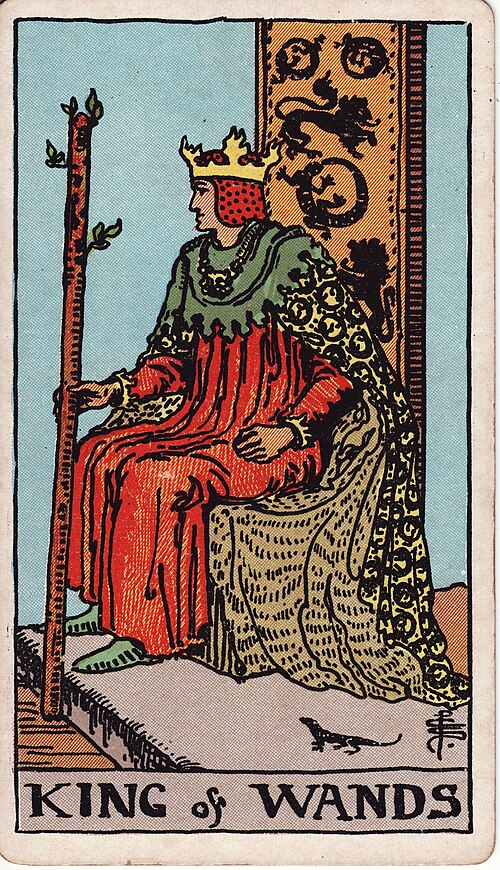
A crowned figure sits upright on a decorated throne against a warm yellow and orange field. He holds a flowering wand in one hand and maintains an alert, composed posture rather than being shown in motion. Salamander-like forms appear in the throne and clothing, and a small salamander or lizard is visible near the lower foreground in the RWS design. The palette combines yellow, orange, red, and green, while the throne's lions and the repeated fire-creature motifs give the scene an atmosphere of force held in a formal structure.
The image does not show a king conquering a visible battlefield or receiving a guaranteed reward. It shows concentrated attention, a living tool, and authority seated inside an organized setting. The flowering wand keeps growth connected to command: direction is meant to produce something, not merely display power. The warm background makes the figure's energy conspicuous, but it can also suggest heat that requires management. These observations support candidate meanings; the question and spread position determine which one is useful.
Keywords derived from image and tradition
Useful keywords are vision, leadership, direction, enterprise, confidence, generosity, accountability, and overreach. Vision follows from the King's elevated, attentive position and the wand held as a purposeful instrument. Leadership and direction follow from the court rank and the organized throne, while enterprise reflects Wands tradition as a language of initiative and creative force. Generosity is a constructive expression of influence; accountability keeps authority connected to consequences. Overreach names the danger of treating command as entitlement.
- Vision: define what the energy is trying to build. Leadership: coordinate people without making them props. Direction: choose a route and explain its purpose. Enterprise: turn an idea into a responsible initiative. Generosity: share confidence, credit, and opportunity. Accountability: review the effect of your decisions. Overreach: check control, ego, and promises.
Upright King of Wands meaning
Upright, the King of Wands describes purposeful leadership, an ambitious but coherent plan, and the ability to give creative energy a public direction. He can represent a founder, mentor, team lead, organizer, or the part of the querent that is ready to make a decision and take responsibility for its effects. His strength is not mere boldness; it is the combination of confidence, imagination, communication, and follow-through that helps a group understand why an effort matters.
The risk of excess is arrogance, impatience with slower people, domination, grand promises, or a belief that enthusiasm excuses poor listening. A practical upright response is to state the objective, delegate real authority, define review points, and leave room for evidence to change the plan. Upright does not guarantee business success, promotion, romance, or victory. It suggests a constructive leadership posture, while outcomes depend on resources, other people's choices, timing, and accountable work.
Reversed King of Wands meaning
Reversed, the King of Wands can show blockage around leadership, ambition turned inward, excess control or volatility, delay caused by an unrealistic plan, or a direction that needs adjustment before more people are recruited. It may describe someone who keeps refining a vision without acting, a leader whose temper makes collaboration unsafe, or a capable person who has lost contact with the purpose behind the performance. Reversed is not automatically negative; stepping back from command can reveal missing information or prevent an avoidable escalation.
Separate the reversal into a workable question. For blockage, name one decision that can be made with the information available. For internalization, write the vision or seek a trusted critique instead of silently rehearsing authority. For excess, reduce promises, speed, and unilateral control. For delay, identify dependencies and a realistic milestone. For direction adjustment, ask whether the project serves the stated value or merely protects status. Leadership becomes healthier when it can listen, revise, and share credit.
Applications in ordinary life
Relationships and emotions: Upright, the King can emphasize clear intention, generous protection, shared plans, and the courage to make a relationship's values visible through action. It can also warn that leadership in a partnership must remain mutual, not paternalistic. The card cannot reveal a third party's private thoughts. Reversed, it may point to pressure, hot temper, inconsistent promises, emotional suppression, or a relationship organized around one person's agenda. Focus on observable conduct, direct communication, consent, and boundaries.
Work and study: This card supports setting a direction, pitching a project, coordinating a team, teaching from experience, or taking responsibility for a public deliverable. Convert the vision into milestones and give collaborators meaningful ownership. In study, it can suggest choosing a field of concentration and building a project that demonstrates understanding. Reversed, review micromanagement, overcommitment, delays caused by vague scope, and the habit of waiting for a perfect master plan. A written brief and feedback cycle can restore movement.
Money and resources: The King may indicate strategic use of capital, equipment, time, reputation, or entrepreneurial energy, but it is not a guarantee of profit. Before committing, test assumptions, compare downside, confirm obligations, and preserve reserves. Reversed, watch for status spending, speculative enthusiasm, coercive sales pressure, or a plan that depends on constant growth. Use a budget, contracts, and qualified financial advice for consequential decisions rather than treating the card as an investment signal.
Personal growth: The King invites mature stewardship of motivation. Ask what you want to build, who is affected, and how your choices can remain both bold and revisable. Reversed, notice whether ambition is compensating for insecurity or whether fear of responsibility has kept your abilities private. Growth may mean accepting a visible role, sharing authority, apologizing for overreach, or changing the goal so the fire serves life rather than consuming it.
King of Wands in spreads and positions
One-card prompt: ask, “What vision deserves responsible direction, and what evidence will keep it honest?” The card may describe a leadership quality, a strategic decision, or a need to align action with purpose rather than forecast an event. In a three-card past, present, future spread, the King in the past can show a former authority, completed leadership lesson, or inherited ambition; in the present he highlights responsibility and direction; in the future he suggests a possible role requiring vision and accountability. In a situation, action, outcome spread, he frames the situation as a leadership question, recommends a clear and inclusive plan, and treats the outcome as feedback rather than destiny.
In relationship positions, King of Wands as self describes your observable style of initiative, protection, desire, or decision-making. As the other person, he describes a role or behavior visible in the situation, not their hidden thoughts, fixed identity, or guaranteed intentions. As interaction, he can indicate shared ambition, strong chemistry, a joint project, or a struggle over whose direction controls the relationship. In decision positions, he can show an opportunity to lead or build, a risk of overpromising or dominating, and advice to act decisively while making terms, consent, and accountability explicit.
In obstacle, advice, and outcome positions, the King changes emphasis. As obstacle, ego, impatience, unclear authority, or a vision too large for current resources may block progress. As advice, state the purpose, choose the next milestone, delegate honestly, and create a review point. As outcome, expect a clearer mandate, public responsibility, or a structured initiative, not guaranteed recognition or victory. The surrounding cards show whether the King is stewarding fire, defending status, or learning to revise.
Instructional combination reading
Instructional example, not a real case: Queen of Wands, King of Wands, Ace of Cups can be read as confidence becoming shared direction and then opening into a new emotional or relational beginning. The Queen supplies warmth, presence, and discernment; the King modifies that fire by asking for vision, accountability, and coordination; the Ace of Cups softens the command structure by introducing receptivity and care. If the King is reversed, the sequence may show that a promising opening depends on releasing control and making room for mutual response.
Common misreadings, traditions, and responsible use
Do not reduce the King to a literal man, boss, entrepreneur, father, or guaranteed authority figure. Court cards can represent a person, role, stage, social style, or way of organizing energy, and they are not fixed gender or age labels. A salamander motif is an observable feature of the RWS design, not proof of one universal occult correspondence. Some decks change the court's clothing, animals, throne, or landscape; Marseille pip traditions use another visual grammar, and some readers do not use reversals. Keep school-specific meanings separate and do not present later astrological or elemental correspondences as historical facts about the original image.
Tarot is appropriate here as cultural study, symbolic reading, and self-reflection. It cannot establish scientific certainty about future events, financial returns, health, legal outcomes, or another person's intentions. Do not use a card to pressure a partner, recruit people into a risky venture, or replace professional advice. For serious choices, verify facts, protect privacy, obtain consent, consult qualified professionals, and keep the freedom to change course.
Tarot journal prompts
- What am I trying to build, and how will I know whether the direction is working? Where do I need to share authority rather than carry or control everything? Which promise is too large for my current resources, and how can I resize it? What would accountable ambition look like in this situation?
Suggested learning links and source note
Read the previous card, Queen of Wands (/articles/tarot-card-queen-of-wands), and continue to the next card, Ace of Cups (/articles/tarot-card-ace-of-cups). For foundations, use Tarot for Beginners (/articles/tarot-for-beginners), the Wands suit guide (/articles/tarot-wands), Upright and Reversed Tarot (/articles/tarot-upright-and-reversed), Three-Card Tarot Spreads (/articles/three-card-tarot-spreads), and Tarot Journal Review (/articles/tarot-journal-review). A historical reference point is A. E. Waite's The Pictorial Key to the Tarot, published in 1911 with illustrations by Pamela Colman Smith. This article keeps period source material, observable RWS imagery, later practice, and editorial synthesis distinct.