Ace of Cups at a glance
The Ace of Cups is the first card of the Cups suit, a Minor Arcana card, and position 37 in the 78-card Rider-Waite-Smith sequence. It follows the King of Wands and begins the Cups progression with an offered vessel rather than a completed relationship or emotional result. Cups are commonly used to organize feeling, connection, imagination, receptivity, and values. These are symbolic reading lenses, not scientific measurements or promises about the future. A useful question is: “What feeling, relationship, or source of meaning is asking to be received and tested in real life?”
What the RWS image shows
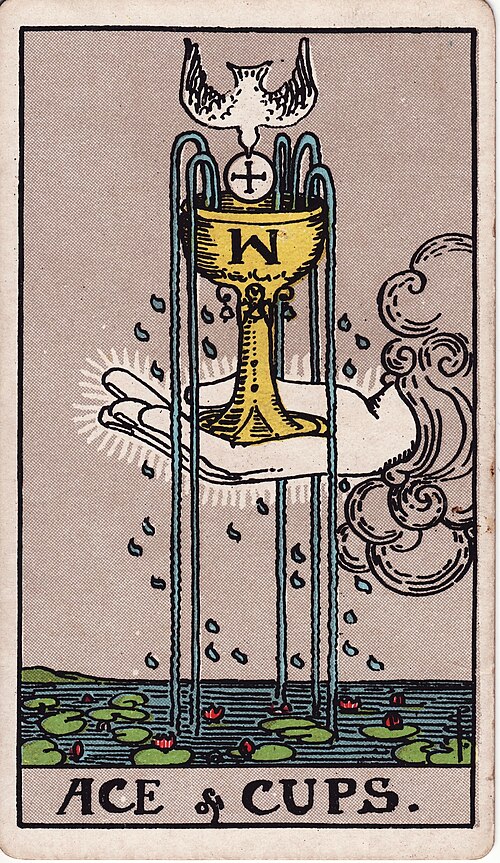
A hand extends from a pale cloud at the right side of the card and holds a large chalice above a pool. A white dove descends toward the cup with a small white disk or wafer in its beak. Five streams of water pour over the rim into the water below, where lotus flowers and leaves are visible. The foreground is watery and green; farther back, a low landscape and a building sit beneath a light sky. The central cup is steady while the liquid moves downward, giving the scene both containment and overflow.
The direction of the dove and streams matters: something enters the vessel, then becomes movement that can be seen and received. The hand has no visible face or body, so the image does not identify a particular giver, lover, or supernatural authority. Traditional RWS commentary, including A. E. Waite’s 1911 The Pictorial Key to the Tarot, is one historical reference; modern interpretations should still separate what is visible from later symbolic vocabulary and from the reader’s editorial synthesis.
Keywords and how they arise
A concise keyword set is receptivity, emotional renewal, compassion, inspiration, connection, sincerity, and overflow. Receptivity follows from the open hand and cup; renewal follows from flowing water and fresh lilies; compassion follows from the gentle dove and the suit’s relational tradition; inspiration follows from the unexpected offering from the cloud; connection follows from the vessel receiving and sharing liquid; sincerity follows from the uncluttered central image; and overflow names both generosity and the need for emotional boundaries.
- Keywords: receptivity
- emotional renewal
- compassion
- inspiration
- connection
- sincerity
- overflow. Treat these as possible functions of the image and Cups tradition, not as an automatic answer.
Upright meaning
Upright, the Ace of Cups can describe a feeling becoming available for honest attention: affection, relief, creative inspiration, grief that can finally move, or a renewed capacity to care. Its strength is openness. The card supports naming what matters, receiving support, allowing a meaningful beginning, and making a sincere gesture without pretending that one gesture settles the whole future.
Its risk is excess. Overflow can become emotional flooding, idealization, rescuing, porous boundaries, or treating intensity as proof. A practical upright action is to give the feeling a safe container: write it down, express it respectfully, schedule a conversation, or begin a creative practice. Let observable behavior, consent, and time show whether the new feeling can become a sustainable pattern.
Reversed meaning
Reversed, the Ace of Cups does not automatically mean emotional failure or bad news. It may show blockage: affection, grief, imagination, or support cannot yet move into expression. It may show internalization, with a genuine feeling being processed privately before it is shared. Excess can appear as emotional overrun, dependency, fantasy, or giving beyond one’s capacity. In timing questions, the card can point to delay while trust, safety, recovery, or a clearer boundary develops.
The direction adjustment is to ask what the vessel needs. Reduce contact if an interaction is overwhelming, seek support rather than playing rescuer, or use a private practice before making a public declaration. A reversed Ace beside active Wands may mean feeling needs an action channel; beside quiet cards it may support incubation. The aim is not to force openness but to restore a form of feeling that can be received, chosen, and communicated.
Applications in everyday life
Relationships and emotions: The Ace may suggest attraction, tenderness, reconciliation of a feeling, empathy, or a chance to begin a healthier emotional pattern. It cannot read a third party’s mind or prove commitment. Ask what has actually been said and done, then express one need or appreciation with room for the other person to respond freely. Watch for idealizing a new connection or confusing emotional intensity with compatibility.
Work and study: The card can mark inspiration, renewed motivation, a supportive mentor, or a project that feels meaningful. Its strength is caring enough to learn and contribute; its risk is taking feedback personally or relying on enthusiasm without a plan. Turn the feeling into a small deliverable, a study session, or a conversation about expectations. A reversed Ace may advise rest, private preparation, or repairing morale before a public launch.
Money and resources: Read the card as values, generosity, and the emotional meaning of resources, not as guaranteed wealth or investment return. Check whether a gift, purchase, or donation fits the budget and whether generosity is being used to buy security or approval. Reversed, review emotional spending, unclear lending, and obligations that exceed capacity. For consequential choices, use records and qualified financial advice.
Personal growth: The Ace invites a direct question about what restores aliveness and what merely creates stimulation. Practice receiving help without immediately repaying it, identify feelings without turning them into commands, and choose a repeatable ritual such as journaling, art, rest, or a supportive conversation. The card is most useful when reflection leads to a verifiable, self-directed action.
Ace of Cups in spreads and positions
One-card prompt: “What feeling or source of meaning is ready to be received today?” Upright, emphasize the available opening and the smallest respectful way to honor it. Reversed, examine blockage, internalization, excess, delay, or a needed change in emotional direction before calling it a simple no.
Three-card past, present, future: In the past, the Ace can describe the origin of a feeling, a moment of care, or an emotional opening that shaped the question. In the present, it highlights what is ready to be acknowledged or replenished. In the future, it suggests a possible emotional beginning, not a guaranteed romance or outcome. In a situation, action, outcome spread, it describes the feeling climate; the middle card shows how to handle it; and the final card reflects the consequences of that handling.
Relationship positions: As self, the Ace describes your capacity to feel, receive, offer care, or begin an honest exchange. As the other person, it describes the energy they bring to the interaction, never their hidden thoughts as fact. As interaction, it highlights emotional reciprocity, tenderness, or a shared need for safe expression. Reversed in any position, ask whether feeling is withheld, private, excessive, delayed, or changing form.
Decision positions: In opportunity, the Ace points to a meaningful beginning, supportive connection, or value that deserves protection. In risk, it warns of idealization, emotional flooding, blurred boundaries, or generosity without limits. In advice, create a safe container, communicate sincerely, and check evidence over time. In obstacle, look for avoidance, numbness, overgiving, or an unprocessed feeling. In outcome, it may show renewed emotional capacity or a new bond, with the surrounding cards setting the scale and conditions.
Instructional combination example
Instructional, not a real case: The King of Wands followed by the Ace of Cups can show decisive outward energy being softened or given meaning by a newly acknowledged feeling. The King supplies direction and initiative; the Ace asks whether the action is emotionally sincere and sustainable. If the Two of Cups follows, the sequence can move from personal vitality to mutual exchange. If the Ace is reversed, the same sequence may require emotional preparation before direct action. Adjacent cards modify one another rather than issuing isolated predictions.
Common misreadings, traditions, and responsible use
Do not reduce the Ace of Cups to a guaranteed soulmate, pregnancy, marriage, reunion, psychic message, or permanent happiness. The cup, dove, water, and lilies are visible motifs; the specific application must come from the question, position, neighboring cards, and real-world evidence. Marseille-style decks often show a pip arrangement rather than an RWS scene, so number, suit, and surrounding cards carry more of the analysis. RWS and Marseille traditions also differ in the numbering of Strength and Justice and in some imagery; this series uses RWS order and primary image analysis.
Tarot is used here for cultural study, symbolic reading, and self-reflection, not scientifically validated predictive power. Do not use this card as medical, legal, or investment-return advice, and do not make guaranteed-fate claims. Do not investigate a third party without consent or treat a reading as proof of private facts. For high-stakes emotional, financial, or safety decisions, use direct communication, reliable information, and qualified professional support.
Tarot journal prompts
- 1. What feeling is present, and what observable action would express it respectfully?
- 2. Where am I open, blocked, overwhelmed, or giving beyond my capacity?
- 3. What boundary would help this emotional or creative beginning remain sustainable?
Suggested learning links
Continue backward to the King of Wands (tarot-card-king-of-wands) and forward to the Two of Cups (tarot-card-two-of-cups). For foundations, build on Tarot for Beginners (tarot-for-beginners), the Cups suit guide (tarot-cups), the Upright and Reversed guide (tarot-upright-and-reversed), How to Ask a Tarot Question (tarot-how-to-ask), and the Spread glossary (glossary-spread). These links support the method without replacing the Ace-specific image and position analysis above.