Card identity and sequence
The Wheel of Fortune is Major Arcana X, the eleventh card in this 78-card RWS sequence. It belongs to the Major Arcana, so its themes often feel broad: changing conditions, recurring patterns, timing, agency, and the limits of personal control. “Fortune” here does not promise a prize or a fixed fate. It is a prompt to notice what is turning, what is repeating, and what choices remain available while circumstances move.
This series uses the Rider-Waite-Smith tradition for order and primary image analysis. A traditional RWS commentary associated with A. E. Waite is one historical layer; modern readers also use the card for practical reflection. Those layers should not be confused with a scientifically validated method of predicting events.
What is visible in the RWS image
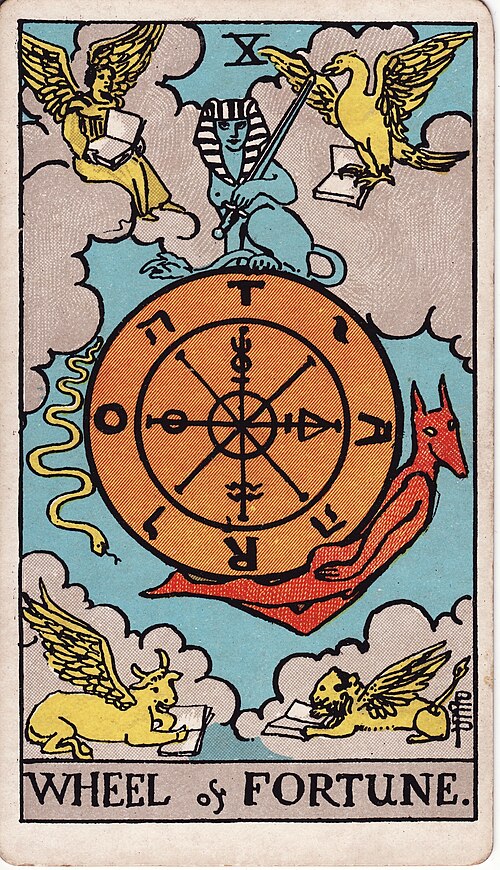
At the center is a large wheel suspended against a blue sky and pale clouds. Letters and signs appear on the wheel, while a red serpent descends on the left side and a jackal-headed figure identified in traditional commentary with Anubis rises on the right. A blue sphinx sits at the top, facing outward and holding a sword. The wheel’s colors and opposing upward and downward figures make movement, reversal, and changing position visible rather than merely stating them.
Four winged figures occupy the corners: a human or angelic figure at upper left, an eagle at upper right, a lion at lower left, and a bull at lower right. Each is shown with a book. They sit among clouds and face into the scene, creating a steady frame around the turning center. The image therefore combines motion with observation: the wheel changes, while the four figures read, witness, or study. The sword at the top also adds discernment to the idea of chance; movement still requires judgment.
Keywords derived from the image and tradition
- Cycle — the wheel presents change as a process rather than a straight line
- turning point — the figures rise and descend at different edges
- timing — the central mechanism suggests conditions that develop in phases
- agency within change — the sphinx holds a sword above the wheel
- pattern — the four readers observe recurring structure
- adaptability — the image asks how to respond when position changes.
These are not a list of guaranteed events. They follow from the visible wheel, the contrast between ascent and descent, the observing figures, and the long-standing symbolic tradition around fortune and cycles. In a reading, choose the keyword that fits the question and position instead of forcing every association into the same answer.
Upright meanings
Upright, the card can describe a change in conditions, a recurring pattern becoming visible, or a moment when timing matters. Its strength is flexibility: a person may recognize an opening, learn from a previous turn, or stop treating a temporary high or low as permanent. The wheel can also mark a wider cycle that is not fully under personal control, such as a changing schedule, group mood, market condition, or stage of a project.
Its risk is excess reliance on luck. Waiting for the wheel to rescue a plan, chasing every apparent opportunity, or calling instability “destiny” can remove useful agency. A practical upright action is to name the changing factor, separate controllables from conditions, and prepare a small response that can be revised. Check timing, keep a contingency, and record evidence before deciding that a pattern is real.
Reversed meanings
Reversed, the Wheel of Fortune may point to blockage: a cycle feels stuck, a familiar pattern keeps returning, or an external change is being resisted. It can describe internalization too, when the visible change is less important than a private belief about luck, control, or inevitability. Excess may appear as compulsive risk-taking, repeated second-guessing, or overinterpreting coincidence.
Delay is another possible emphasis. The expected turn may not be ready, or a practical dependency has not been addressed. Reversed does not automatically mean disaster; it can simply slow the reading down so that assumptions are tested. Adjust direction by asking what can be stabilized, what lesson has not been integrated, and whether the goal or only the method needs to change. Upright does not guarantee a positive outcome, and reversed does not guarantee a negative one.
Applications by life area
Relationships and emotions: The card can show a relationship entering a new phase or a familiar emotional loop becoming easier to name. It does not reveal another person’s private thoughts. Ask what interaction pattern is repeating, where timing or circumstance is affecting contact, and what response would be respectful. Reversed, pause before reacting to hot-and-cold behavior and distinguish a temporary shift from a stable pattern.
Work and study: Upright, a change of role, deadline, teacher, team, or opportunity may require adaptability. Use the card to review cycles of effort and rest, not to assume that a promotion or result is guaranteed. Reversed, diagnose bottlenecks, revise a study schedule, and check whether repeated delay comes from a missing resource, unclear instruction, or an unrealistic plan.
Money and resources: The Wheel can emphasize volatility, changing income, variable costs, or the need to use a favorable window carefully. It is not investment-return advice. Make a budget, preserve a reserve, verify terms, and avoid decisions based only on a feeling of being “lucky.” Reversed, a delayed payment or unstable plan calls for conservative assumptions and a clear stop rule.
Personal growth: This card supports observing patterns without turning them into identity labels. Track what changes when you alter one behavior, and accept that progress may be cyclical. Reversed, work with the belief that keeps you repeating the same response; the adjustment may be internal, behavioral, or environmental.
The Wheel of Fortune in spreads
One-card prompt: “What is changing, and what part of my response is still mine to choose?” In a daily or one-card reading, the emphasis is observation and preparation, not a forecast of a lucky or unlucky day.
Three-card situation, action, outcome: In the situation position, the card describes the cycle or conditions surrounding the question. In action, it advises flexibility, timing, and a response plan. In outcome, it suggests a changed position or a new phase, but the quality of that phase depends on choices and conditions not shown by this card alone. In a past, present, future layout, it can show a previous turn, a current hinge point, and an emerging trend rather than a fixed future.
Relationship positions: For self, it may emphasize your pattern, expectations about timing, or capacity to adapt. For the other person, keep the reading to observable behavior and the role of changing circumstances rather than claiming to know their mind. For the interaction, it highlights the loop between you: when contact rises, falls, repeats, or needs a new rhythm.
Decision positions: In opportunity, the Wheel may show a window, useful change, or access to a different route. In risk, it warns about volatility, passivity, and treating chance as a plan. In advice, it recommends acting on what is timely while keeping options open. In obstacle, it can identify resistance to change or an unstable dependency. In outcome, it describes movement or reconfiguration, not a guaranteed success.
Instructional combination example
Instructional example, not a real case: The Wheel of Fortune beside The Hermit changes from general movement to a cycle that needs careful observation. The Hermit can slow the impulse to chase every turn, while the Wheel reminds the Hermit that solitude is a phase rather than a permanent retreat. Read the pair as “watch the pattern, then choose a timely response,” not as a promise that fate will intervene.
Common misreadings, traditions, and responsible use
A common misreading is “you will win” or “everything is out of your hands.” The image contains both movement and a sword-bearing sphinx, so responsiveness and discernment matter. Another error is treating every coincidence as a cycle. Define the pattern, record the facts, and allow ordinary explanations. Some tarot schools read the card through astrology, alchemy, or esoteric correspondences; others focus on the pictured wheel and the sequence of the Major Arcana. Decks may change letters, corner figures, colors, or symbolic details. Compare those systems without presenting one later correspondence as the historical meaning of every deck.
RWS and Marseille traditions also differ in some imagery and in the numbering of Strength and Justice. The RWS order used here places Strength at VIII and Justice at XI; many Marseille-style sequences reverse those numbers. This article follows RWS and should not be used to flatten that school difference. Tarot is best treated as cultural study, symbolic reading, and self-reflection. It cannot scientifically establish future events, replace medical, legal, financial, or mental-health advice, or justify coercive decisions about another person.
Tarot journal prompts
- What condition or pattern appears to be turning, and what evidence supports that observation?
- Which part of this situation is controllable, influenceable, or outside my control?
- Where am I waiting for luck instead of preparing a practical response?
- What small action would test whether my interpretation is useful?
Suggested learning links
For the previous card, continue to The Hermit Tarot Card (tarot-card-the-hermit), where inward observation provides a useful contrast to the Wheel’s motion. The next card is Justice (tarot-card-justice), which brings judgment, accountability, and balance to changing circumstances. For foundations, see Tarot for Beginners (tarot-for-beginners), How to Ask Tarot Questions (tarot-how-to-ask), Upright and Reversed Tarot (tarot-upright-and-reversed), Three-Card Tarot Spreads (three-card-tarot-spreads), Tarot Journal and Review (tarot-journal-review), and Responsible Mysticism (ethics-and-boundaries).