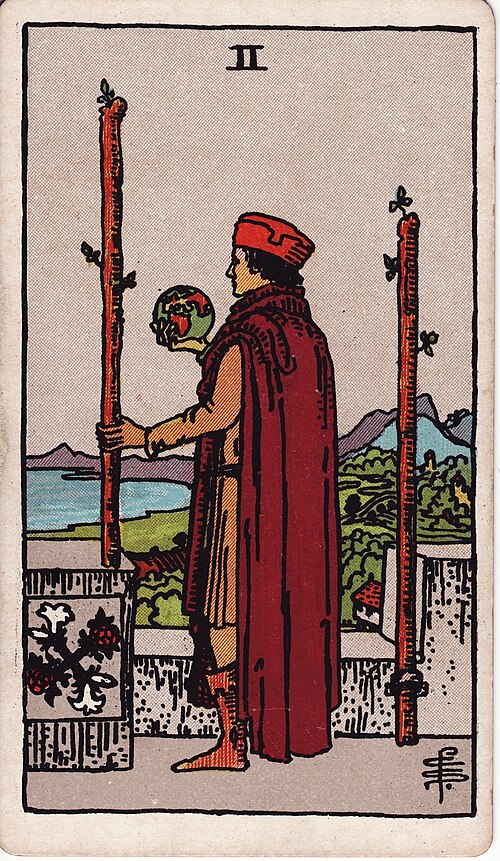
Two of Wands at a glance
The Two of Wands is the Two of the Wands suit, a Minor Arcana card and position 24 in the 78-card Rider-Waite-Smith sequence. It follows the Ace of Wands and develops the first spark into a question of direction, scope, and choice. Wands traditionally organize initiative, creative force, desire, movement, and will. The Two adds a relationship between a secure position and a wider horizon. These meanings are symbolic and reflective, not scientifically validated predictions. A useful question is “What can I see from here, and what information or commitment would make a next move responsible?”
What the RWS image shows
A solitary figure stands on a stone wall or elevated terrace, shown mostly from behind and looking across a broad landscape. The figure holds a globe in one hand and rests the other near a wand; a second wand is fixed to the wall nearby. Red and warm brown clothing contrasts with green land, blue water, distant mountains, and a pale sky. The town or buildings below appear smaller than the person’s elevated viewpoint. The card visibly places a human decision-maker between a bounded stronghold and an open world.
The paired wands create a structural tension: one is held as an active instrument while another remains anchored. The globe is an observable object, not proof that a reading concerns foreign travel or world domination. The outward gaze and high vantage support traditional themes of planning, vision, and expansion, but they can also describe delay, distance, or the difficulty of acting after seeing many possibilities. The meaning should be adjusted by the question, position, neighboring cards, and whether the card is upright or reversed.
Keywords and how they arise
A concise keyword set is planning, perspective, choice, expansion, foresight, independence, and controlled risk. Planning follows from the elevated viewpoint and the figure’s pause; perspective follows from looking over a larger terrain; choice follows from the paired wands and the contrast between holding and anchoring; expansion follows from the globe and distant landscape as traditional motifs; independence follows from the solitary figure; and controlled risk follows from the protected wall meeting an uncertain horizon.
- Keywords: planning
- perspective
- choice
- expansion
- foresight
- independence
- controlled risk. Treat them as interpretive pathways, not fixed answers or promises of travel.
Upright meaning
Upright, the Two of Wands often describes a pause that is purposeful rather than passive. The initial idea exists, and now the reader must compare routes, resources, timing, and consequences. Its strength is strategic range: you can step back from immediate excitement and decide what kind of future the project or relationship is meant to serve. The card favors a written plan, a clear criterion, and enough information to distinguish a genuine opportunity from a merely dramatic one.
The risk is overcontrol. Planning can become avoidance, superiority, restlessness, or an attempt to guarantee every variable before leaving safety. The figure sees the horizon but has not yet entered it. A practical action is to choose between the live options, state what is non-negotiable, and schedule a small field test. Keep room for revision; foresight is useful only when it can meet new evidence.
Reversed meaning
Reversed, the Two of Wands does not automatically mean a bad outcome. It may show blockage through a narrow horizon, fear of leaving a familiar position, missing information, or dependence on someone else’s permission. It may describe internalization when the plan is real but not ready for public discussion. Excess can appear as micromanagement, endless comparison, grand claims, or impatience with local responsibilities. Delay may be practical: travel, funding, approval, skills, or emotional readiness may not yet be in place.
The direction adjustment is to bring the distant vision back into a manageable scale. Verify assumptions, ask for relevant feedback, or choose a reversible step instead of demanding certainty. In some spreads, the reversal says the original route no longer matches the goal; changing direction is not the same as abandoning ambition. If neighboring cards show movement, the reversed Two can mark a plan being revised in motion. If they show withdrawal, give the private planning stage a defined end point.
Applications in everyday life
Relationships and emotions: The card can show two people considering what the relationship could become, negotiating distance, or deciding whether shared values support a larger step. As an emotional mirror, it may indicate desire mixed with caution. It cannot reveal another person’s thoughts or guarantee commitment. Ask directly about expectations, pace, geography, and practical support rather than treating the globe as a romantic promise.
Work and study: The Two supports strategy, applications to a larger program, choosing a specialization, market research, or comparing roles. Its strength is seeing the system around a task. Its risk is polishing a plan without seeking feedback or starting the work. Define the decision deadline, list evidence for each option, and conduct one small test before committing extensive time or money.
Money and resources: Read the card as resource allocation and risk assessment, not as guaranteed wealth, overseas profit, or investment return. Review the budget, obligations, downside, and opportunity cost. Upright, it may help compare a stable option with a growth option. Reversed, delay a major commitment until assumptions, funding, or advice have been checked; professional financial guidance may be appropriate.
Personal growth: The card asks where your current boundaries protect you and where they have become a ceiling. Practice holding a broad vision without using it to reject present duties. A useful exercise is to write two plausible routes, name what each teaches, and select one next action that keeps learning possible.
Two of Wands in spreads and positions
One-card prompt: “What horizon should I examine, and what choice is mine to make?” Upright, emphasize perspective, planning, and a measured move. Reversed, investigate the narrowed view, internal plan, excess control, delay, or direction change before reading the card as a simple no.
Three-card past, present, future: In the past, the Two may describe an earlier choice, a plan formed from a protected position, or a tension between safety and expansion. In the present, it identifies the options and criteria that need attention now. In the future, it suggests a planning stage or a decision point rather than guaranteed travel or success. In a situation, action, outcome spread, it describes the landscape; the middle card shows how to choose or test; and the last shows what the chosen method is likely to produce.
Relationship positions: As self, the Two describes your expectations, boundaries, and readiness to choose a direction. As the other person, it describes the role or energy they bring to the shared decision, not their hidden feelings. As interaction, it highlights negotiation, distance, a shared horizon, or unequal willingness to move. Reversed in one position, ask whether that person or the relationship is blocked, private, overmanaged, delayed, or changing course.
Decision positions: In opportunity, the card highlights a wider field, a partnership between planning and action, or a chance to choose deliberately. In risk, it warns of analysis without movement, inflated scope, or leaving a stable base without sufficient support. In advice, compare options, define criteria, and take a reversible first step. In obstacle, look for fear, missing information, or a horizon that is too narrow. In outcome, it may indicate a plan, a crossroads, or expanded responsibility; the surrounding cards determine whether that expansion is workable.
Instructional combination example
Instructional, not a real case: The Ace of Wands followed by the Two of Wands can describe a spark becoming a deliberate choice. The Ace supplies energy and possibility; the Two asks where that energy should go and what trade-offs matter. If the Two is reversed, the sequence may show a strong idea stalled by overplanning or fear of leaving safety. If the next card is the Three of Wands, the combination can shift from choosing a horizon to testing expansion. Adjacent cards modify one another rather than issuing isolated predictions.
Common misreadings, traditions, and responsible use
Do not reduce the Two of Wands to guaranteed travel, emigration, a foreign partner, business success, or a choice between exactly two people. The globe and landscape are visible motifs, while the specific application comes from the question and spread. Do not confuse perspective with superiority, or planning with evidence that a plan will work. Marseille-style decks often present a pip arrangement rather than the RWS figure and globe, so number, suit, and surrounding cards may carry more weight. Schools also differ on elemental and astrological correspondences. RWS and Marseille traditions differ in the numbering of Strength and Justice and in some imagery; this series uses RWS order and primary image analysis.
Tarot is best used here as cultural study, symbolic reading, and self-reflection. It does not provide scientifically validated predictive power. Do not use this card as medical, legal, or investment-return advice, and do not turn a spread into a guaranteed-fate statement. Do not read a third party’s mind or make consequential decisions without direct communication, evidence, consent, and appropriate professional support.
Tarot journal prompts
- 1. Which option expands my life while remaining consistent with my actual resources?
- 2. Where has planning become a way to avoid a reversible first step?
- 3. What information, boundary, or conversation would make my next direction clearer?
Suggested learning links
Continue backward to the Ace of Wands (tarot-card-ace-of-wands) and forward to the Three of Wands (tarot-card-three-of-wands). For method, build on Tarot for Beginners (tarot-for-beginners), the Wands suit guide (tarot-wands), the Three-Card Tarot Spreads guide (three-card-tarot-spreads), the Upright and Reversed guide (tarot-upright-and-reversed), and the Spread glossary (glossary-spread). These foundations support, but do not replace, the Two-specific image and position analysis above.