Two of Pentacles at a glance
The Two of Pentacles is the second card of the Pentacles suit, a Minor Arcana card, and position 66 in the 78-card RWS sequence. It organizes material life as movement: allocating time, money, attention, energy, or responsibilities while conditions keep changing. The Two is not a promise that everything will stay balanced. It asks whether a workable rhythm can be created, revised, and maintained.
What the RWS image shows
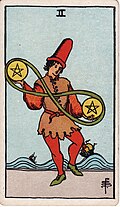
A youthful figure stands in the foreground, holding two gold pentacles and tracing them with an unbroken looping band. The loop resembles an infinity shape, joining the coins without making them identical. The figure wears red and white with green accents and shifts weight as if responding to motion. Behind the figure, a blue sea rises and falls; two ships appear on the waves, one lifting while the other descends. The horizon is open, but the water is not still.
The figure faces the viewer at an angle rather than presenting a rigid frontal pose. The hands and coins create a repeating circuit, while the sea and ships show forces outside the figure's direct control. Green, red, white, blue, and gold combine growth, effort, clarity, feeling, and value without fixing a single meaning. The scene visibly supports adaptation and coordination, not the fantasy of perfect control.
Keywords derived from the image
- Balance and prioritization: two coins require attention to more than one claim. Adaptability: the shifting stance and waves imply response to changing conditions. Rhythm and timing: the loop suggests a recurring exchange rather than a one-time choice. Resourcefulness: the figure keeps both coins in play with limited visible support. Instability with agency: the ships and sea move, but the figure can still adjust grip, pace, and allocation. These keywords grow from the structure of the scene and from traditional suit-number interpretation, not from an unexplained word list.
Upright meaning
Upright, the Two of Pentacles describes active juggling. It can be useful when a person is coordinating work and study, two budgets, family and personal needs, or several stages of a practical project. Its strength is flexibility: notice what is changing, keep the essential items moving, and use a routine that can be revised. The card favors clear priorities and visible limits over pretending that every demand has equal weight.
Its risk is busyness becoming an identity. Constant motion can conceal avoidance, weak boundaries, or a plan that depends on exhaustion. Practical action may include ranking obligations, setting a capacity limit, asking for help, automating a repeatable task, and deciding what can be paused. The card describes a decision environment; it does not guarantee that an energetic response will produce a desired outcome.
Reversed meaning
Reversed, the Two of Pentacles may indicate a blocked rhythm, internalized pressure, or a system that is carrying more than it can safely hold. Blockage can show up as missed deadlines, conflicting commitments, poor cash flow, or an inability to decide what matters first. Internalization may mean privately rehearsing options, hiding strain, or trying to solve a coordination problem alone. Excess can become frantic multitasking, constant switching, overpromising, or using flexibility to avoid a firm choice. Delay may come from rework, unstable conditions, or waiting for information that changes the priorities.
- Blockage: the exchange between demands and resources has stalled. Internalization: pressure is being managed inwardly and may not be visible to others. Excess: juggling has become distraction, overextension, or compulsive responsiveness. Delay: timing, logistics, or a missing decision prevents forward movement. Direction adjustment: reduce the number of active tasks, renegotiate a deadline, choose a sequence, or build a buffer. A reversal can therefore be protective and clarifying rather than simply bad news.
Applications by life area
Relationships and emotions: the card asks how care, availability, independence, and shared duties are being balanced. Upright, discuss schedules and realistic capacity instead of equating love with constant access. Reversed, notice when emotional strain is hidden behind jokes, busyness, or repeated rescheduling; ask directly without claiming to know another person's private motives.
Work and study: use a short planning cycle, identify the two or three truly active priorities, and place transitions on the calendar. Reversed, stop adding tasks until scope, staffing, or deadlines are clarified. A change in method may be more useful than more effort.
Money and resources: compare incoming and outgoing commitments, separate fixed costs from optional ones, and create a modest contingency. The card is not an investment-return forecast or financial advice. Reversed, pause discretionary spending and verify due dates, fees, and obligations before making a new commitment.
Personal growth: practice flexibility without making instability a virtue. Track energy as well as time, and learn the difference between a healthy rhythm and repeated self-abandonment. One sustainable boundary can express the card better than an impressive but temporary performance.
Two of Pentacles in spreads
- One-card prompt: What needs to be balanced today, and what can be deliberately left out? Read the card as a question about allocation, not as proof that you must do everything. Three-card past, present, future: in the past, it may show an established juggling pattern
- in the present, the current rhythm and its cost
- in the future, a possible adaptation if priorities are made explicit. Situation, action, outcome: the situation identifies competing material demands, the action is the adjustment or sequence, and the outcome shows what that choice may make more manageable. Relationship spread—self, other person, interaction: self may show one's capacity and priorities, the other position describes the practical pressure visible in the connection rather than a hidden mind, and interaction shows how responsibilities are exchanged. Decision spread—opportunity, risk, advice: opportunity is the useful flexibility, risk is overload or loss of focus, and advice defines the limit or order of operations. Obstacle, advice, outcome: obstacle shows where the rhythm breaks, advice selects one correction, and outcome describes the likely practical effect of following it.
Combination example
Instructional example, not a real case: Ace of Pentacles beside Two of Pentacles turns a new resource into a question of capacity. The Ace says, 'Here is something tangible to develop'; the Two asks, 'How will it fit among existing commitments?' Together they favor a small trial, explicit costs, and a review point. With Three of Pentacles, the pair shifts toward collaboration and skill-building, so balancing may be improved by sharing the work rather than juggling alone.
Common misreadings, traditions, and boundaries
Do not read the Two as a command to multitask or as a guarantee of financial success. Sometimes its wisest expression is choosing one priority and allowing another to wait. Modern RWS-based practice often reads Pentacles through material and earth-oriented concerns, while Marseille pip-card traditions may emphasize number, suit pattern, and local reading conventions; other decks alter the figure, colors, or surrounding scene. RWS and Marseille commonly differ in the numbering of Strength and Justice: RWS places Strength at VIII and Justice at XI, while Marseille commonly reverses those positions. They also differ in some imagery and pip conventions. This series uses RWS order and primary image analysis. Tarot here is cultural symbolism and a self-reflection tool, not scientifically validated prediction. Do not use a card as medical, legal, investment-return, or guaranteed-fate advice, and do not use it to claim access to a third party's thoughts.
Tarot-journal prompts
- Which two demands are genuinely active, and which one is only creating noise? What limit, sequence, or request for help would make my current rhythm safer? Where do I call something flexibility when it is actually avoidance or overcommitment?
Suggested learning links
For sequence context, read Ace of Pentacles (tarot-card-ace-of-pentacles) before continuing to Three of Pentacles (tarot-card-three-of-pentacles). For foundations, pair this article with Tarot for Beginners (tarot-for-beginners), the Pentacles suit guide (tarot-pentacles), Upright and Reversed Tarot (tarot-upright-and-reversed), How to Ask Tarot Questions (tarot-how-to-ask), Three-Card Tarot Spreads (three-card-tarot-spreads), and Tarot Journal Review (tarot-journal-review). These links add method and context without replacing the individual card analysis.