Two of Cups at a glance
The Two of Cups is the second card of the Cups suit, a Minor Arcana card, and position 38 in the 78-card Rider-Waite-Smith sequence. It follows the Ace of Cups and develops an offered feeling into an encounter, exchange, or negotiated bond. Cups commonly organize emotion, imagination, relationship, receptivity, and values; the number two adds polarity, response, comparison, and mutual influence. These are symbolic reading lenses, not guarantees about another person or the future. Ask: “What is being exchanged, and what would make this connection reciprocal and well-defined?”
What the RWS image shows
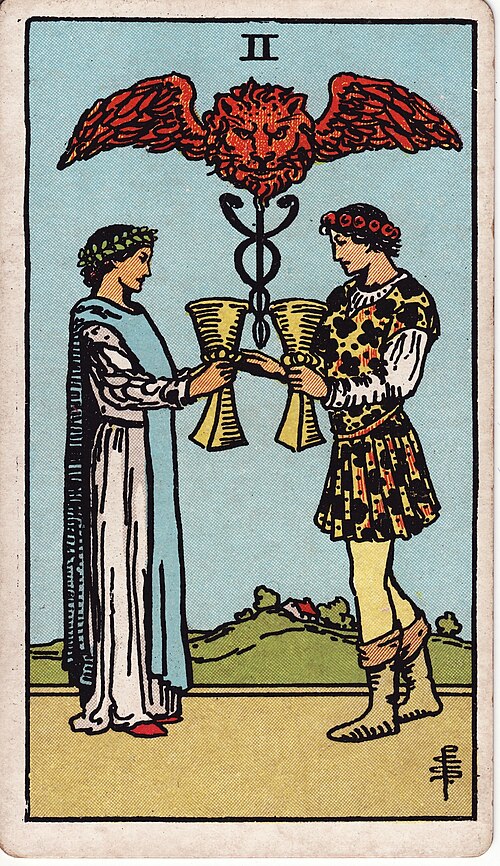
Two human figures stand opposite one another in a green landscape, each holding a raised cup toward the other. Their faces and bodies are oriented into the exchange rather than away from it. One figure wears lighter blue and the other warmer colors, creating a visible contrast without requiring a fixed gender or personality assignment. Between them is a winged lion-headed emblem above a staff-like, intertwined symbol. Behind them are low hills and a house or settlement beneath an open sky.
The composition is organized around balance: one person, one cup, and one side of the meeting answer the other. The cups are held rather than poured, so the image shows an offered exchange but not the entire history or future of the relationship. The central emblem can support traditional themes of union and vitality, but it is a visible motif, not proof of a soulmate bond. A. E. Waite’s 1911 The Pictorial Key to the Tarot, illustrated by Pamela Colman Smith, is a historical RWS reference; later relationship language remains interpretive and context-dependent.
Keywords and how they arise
A concise keyword set is reciprocity, meeting, dialogue, attraction, agreement, mutual care, repair, and boundaries. Reciprocity follows from two equal cups raised toward each other; meeting follows from the face-to-face stance; dialogue follows from the visible exchange; attraction follows from the paired figures and traditional Cups vocabulary; agreement follows from the balanced structure; mutual care and repair follow when the exchange is respectful; and boundaries remind us that two separate people remain visible even in connection.
- Keywords: reciprocity
- meeting
- dialogue
- attraction
- agreement
- mutual care
- repair
- boundaries. Let the question and observed behavior decide which pathway has priority.
Upright meaning
Upright, the Two of Cups can describe a relationship in which attention, feeling, or effort is being exchanged. It may apply to romance, friendship, collaboration, reconciliation, mentorship, or a conversation where both sides can speak and listen. Its strength is mutual recognition: each participant brings something and receives something. A practical action is to clarify the shared aim, name expectations, and confirm consent rather than relying on a symbolic promise.
The risk is excess. The desire for harmony can become fusion, projection, people-pleasing, premature commitment, or avoidance of necessary disagreement. A balanced pair is not the same as identical needs. Test the connection through consistent behavior, clear boundaries, and the ability to repair a small difference. The card can invite closeness while still requiring each person to keep responsibility for their own choices.
Reversed meaning
Reversed, the Two of Cups does not automatically mean a breakup or hostile outcome. It may show blockage in communication, unequal effort, an agreement that cannot yet be made, or feelings that are not being expressed safely. It may be internalized when one person is privately evaluating trust or attachment before responding. Excess can appear as dependency, appeasement, possessiveness, or trying to preserve peace at any cost. In timing questions, delay may reflect missing information, distance, repair work, or a need to renegotiate terms.
The direction adjustment is to restore differentiation and honest exchange. Ask what each person has actually agreed to, what remains assumed, and whether the relationship can tolerate a clear no. Reversed may also redirect the question away from “Will we unite?” toward “What pattern of relating needs attention?” A surrounding card showing communication can support a direct conversation; a card showing withdrawal may advise space and self-protection before contact.
Applications in everyday life
Relationships and emotions: The card can describe attraction, mutual appreciation, a trusted friendship, a repair conversation, or a partnership with a shared emotional language. It does not prove that someone loves you, will return, or is faithful. Look for reciprocal invitations, reliable follow-through, and respect for consent. Reversed, distinguish temporary miscommunication from a repeated imbalance rather than forcing either a romantic story or a final verdict.
Work and study: The Two of Cups favors collaboration, peer support, mentoring, mediation, and agreements about shared tasks. Its strength is alignment; its risk is avoiding useful critique to preserve rapport. Put responsibilities, deadlines, credit, and decision rights in writing. Reversed, revisit unclear roles, one-sided labor, or a partnership that needs a pause. A good working bond still benefits from independent competence and transparent process.
Money and resources: Read the card as negotiation, shared values, fair exchange, or a contract conversation, not guaranteed financial gain or investment return. Check who contributes what, who bears downside, and how the arrangement can end. Reversed, review informal loans, financial dependency, emotional spending between partners, or terms assumed but never documented. Use qualified financial or legal advice for consequential agreements.
Personal growth: The Two asks you to practice both intimacy and self-definition. Notice whether you listen to understand or only to secure agreement. Try stating one preference, receiving a different preference, and finding a workable boundary. Growth may involve learning to accept support, repair trust gradually, or leave an exchange that repeatedly erases your needs.
Two of Cups in spreads and positions
One-card prompt: “What kind of exchange would be honest and reciprocal here?” Upright, emphasize meeting, mutual attention, and a clearly stated agreement. Reversed, examine blockage, internalization, excess, delay, or a change in direction before reading the card as an automatic separation.
Three-card past, present, future: In the past, the Two may describe a formative bond, earlier agreement, or unresolved pattern of giving and receiving. In the present, it highlights the quality of the current exchange and what must be spoken plainly. In the future, it can suggest an opportunity for cooperation or repair, but not a guaranteed relationship result. In a situation, action, outcome spread, it names the relational dynamic; the middle card shows how to participate; and the final card reflects what that method may produce.
Relationship positions: As self, the Two describes how you offer, receive, negotiate, or seek recognition. As the other person, it describes the role or observable energy they bring, not their private mind. As interaction, it highlights reciprocity, attraction, agreement, or the need to repair a mismatch. Reversed in one position, ask whether the imbalance belongs to the person, the shared pattern, the timing, or an assumption that needs correction.
Decision positions: In opportunity, the card points to cooperation, a useful alliance, a candid conversation, or values that can be aligned. In risk, it warns of projection, dependency, unequal labor, or a deal made to avoid conflict. In advice, define terms, listen for a real response, and preserve boundaries. In obstacle, look for silence, appeasement, mistrust, or an unspoken condition. In outcome, it may show an agreement or productive meeting, while surrounding cards and real choices determine its durability.
Instructional combination example
Instructional, not a real case: The Ace of Cups followed by the Two of Cups can show a private emotional opening becoming a mutual conversation. The Ace supplies feeling and receptivity; the Two asks whether another person or circumstance can meet it with an actual exchange. If the Three of Cups follows, shared support or community may widen the bond. If the Two is reversed, the sequence may instead teach that a feeling is real while reciprocity remains unconfirmed. Adjacent cards modify one another rather than guaranteeing an outcome.
Common misreadings, traditions, and responsible use
Do not reduce the Two of Cups to guaranteed marriage, a soulmate, pregnancy, reunion, sexual compatibility, or a third party’s hidden feelings. The paired figures and cups visibly support a theme of exchange, but the question and evidence decide whether the subject is romance, friendship, work, family, or inner integration. Marseille-style decks often use pip arrangements rather than the RWS scene, so number, suit, and neighboring cards may carry more weight. RWS and Marseille traditions differ in the numbering of Strength and Justice and in some imagery; this series uses RWS order and primary image analysis.
Tarot is used here as cultural study, symbolic reading, and self-reflection, not scientifically validated predictive power. Do not use this card as medical, legal, or investment-return advice, and do not turn it into a guaranteed-fate claim. Do not read a third party’s mind or make a consequential decision for someone else. Use direct communication, documented facts, consent, and qualified professional support when the issue is high stakes.
Tarot journal prompts
- 1. What is being offered, what is being received, and what remains assumed?
- 2. Where am I protecting harmony at the expense of honesty or a clear boundary?
- 3. What observable behavior would demonstrate reciprocity over time?
Suggested learning links
Continue backward to the Ace of Cups (tarot-card-ace-of-cups) and forward to the Three of Cups (tarot-card-three-of-cups). For foundations, build on Tarot for Beginners (tarot-for-beginners), the Cups suit guide (tarot-cups), How to Ask a Tarot Question (tarot-how-to-ask), the Three-Card Tarot Spreads guide (three-card-tarot-spreads), the Upright and Reversed guide (tarot-upright-and-reversed), and the Spread glossary (glossary-spread). These links support the method without replacing the Two-specific image and position analysis above.