Three of Wands at a Glance
Card identity: Three of Wands. System: Rider-Waite-Smith (RWS). Suit and rank: Wands, Three. Group: Minor Arcana. Sequence position: 25 of 78, after the Two of Wands and before the Four of Wands. As a numbered Wands card, it brings the suit's themes of energy, initiative, creativity, and direction into a stage where an initial choice has already created momentum.
The Three of Wands is best read as a relationship between a prepared foundation and an expanding field. It can describe waiting for information, sending work outward, cooperating across distance, or deciding how much of a larger plan to make real. It is not a promise that a desired result will arrive. It is an invitation to examine what has been launched, what remains outside your control, and what deliberate step keeps the horizon connected to the present.
Visible RWS Image
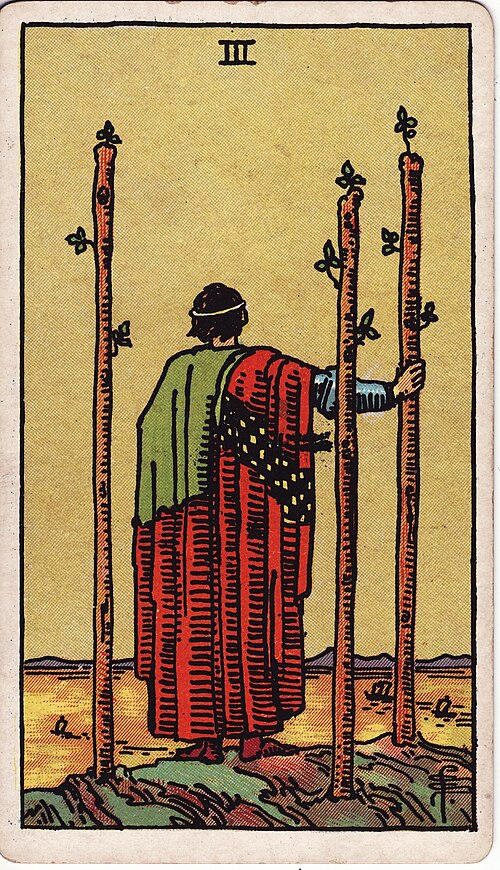
In the RWS image, a solitary figure stands on an elevated shore or rocky rise with their back toward the viewer. The figure faces outward across a broad body of water rather than toward the nearby ground. Three tall wands are planted upright around the figure; the stance is still, but the gaze is directed toward distance. Small ships are visible on the water, while far land or mountains sit below a wide sky. Warm red and orange clothing contrasts with green land, blue water, and the pale gold atmosphere. The picture is organized around the line from rooted foreground to moving horizon.
The image gives no close-up of the figure's expression and does not identify what the ships carry or where they will land. Those limits matter. Observation supports attention, distance, preparation, and outward movement; traditional interpretation develops these into expansion, trade, enterprise, foresight, and results that require patience. The wands are not magic guarantees, and the ships are not fixed predictions. They are visual prompts for asking what your actions have set in motion and how you will evaluate feedback.
Keywords from Image and Tradition
A concise keyword set is: expansion, foresight, progress, distance, collaboration, and patience. Expansion follows from the open water and far horizon; foresight follows from the figure looking beyond the immediate foreground; progress follows from the three planted wands and the sense of an established next stage; distance follows from the ships and separated land; collaboration follows from the implication that something travels between people or places; and patience follows from a still observer waiting for movement to become legible. These are interpretive handles, not a list of guaranteed events.
Upright Three of Wands Meaning
Upright, the card describes a plan entering its outward phase. You may have chosen a direction, built a first version, or committed resources; now the useful work is tracking what happens beyond your immediate reach. Its strength is strategic patience: the ability to keep a long view without abandoning practical checks. It can support travel, publishing, entrepreneurship, cross-cultural work, study that opens a new field, or any project whose results arrive through a wider network.
- Potential strengths: perspective beyond the next task
- willingness to collaborate or communicate across distance
- confidence grounded in prior preparation
- capacity to learn from early feedback
- and a measured appetite for growth.
- Risks of excess: waiting so long that reflection becomes avoidance
- assuming a promising horizon guarantees success
- overlooking local responsibilities while chasing scale
- or treating other people and places as resources rather than partners.
- Practical actions: define the next milestone
- confirm timelines and responsibilities
- ask for evidence from the people receiving your work
- compare more than one route to the goal
- and reserve time to revise the plan when new information arrives.
Reversed Three of Wands Meaning
A reversed card does not automatically mean failure. It can show the Three of Wands theme turned inward, slowed down, or needing a change of direction. Read the reversal against the question and the rest of the spread rather than treating it as a negative switch.
- Blockage: a project cannot reach its audience, a partnership lacks a clear handoff, or fear keeps the questioner from taking the prepared next step. Check the bridge between intention and delivery.
- Internalization: the horizon becomes an imagined future used for private planning, rehearsal, or identity work. This can be useful if it leads to a testable plan, but isolating yourself from feedback can preserve an attractive fantasy.
- Excess: ambition, travel, novelty, or scaling has displaced care for existing commitments. The card may ask for narrower scope, better consent, or a more realistic use of time and money.
- Delay: information, payment, approval, transport, or a response is taking longer than expected. Replace vague waiting with a follow-up date, a contingency, and a clear threshold for changing the plan.
- Direction adjustment: look again at the route, audience, or definition of success. A smaller local experiment may be wiser than a larger launch, or an apparently distant opportunity may need stronger foundations first.
Applications by Life Area
- Relationships and emotions: The card can describe a bond growing through shared plans, distance, travel, or a conversation about the future. It may also show one person looking outward while the other needs presence now. Ask each person what is known, hoped for, and mutually agreed
- do not use the card to claim certainty about another person's private thoughts.
- Work and study: Upright, it favors publishing, networking, applications, research extensions, international or remote collaboration, and reviewing early results. Reversed, check unclear ownership, delayed feedback, scope creep, and the difference between a compelling concept and a delivered piece of work.
- Money and resources: The image supports planning for growth, comparing markets, and allowing time for an investment of effort to mature. It does not promise profit or justify speculation. Use budgets, independent advice, written terms, and a downside plan
- reversed, audit delays and exposure before committing more.
- Personal growth: Practice holding a wider view without escaping the present. Journal the evidence that supports your direction, name the uncertainty, and choose one action that turns a distant aim into a near-term experiment.
The Three of Wands in Spreads and Positions
A card's position changes its emphasis. The Three of Wands is not a fixed answer such as travel, success, or yes; its image supplies a question about foundations, reach, and feedback.
- One-card prompt: What has my recent choice set in motion, and what evidence should I watch before expanding? The card may indicate a horizon to investigate, not an outcome to assume.
- Three-card past, present, future: In the past, it can show an earlier launch or decision
- in the present, it highlights monitoring, outreach, and patience
- in the future, it suggests a wider field of options if the present position remains adaptable. In a situation, action, outcome spread, it describes the current range, recommends a deliberate outward step, and makes the outcome dependent on response and timing.
- Relationship spread - self, other person, interaction: In self, it can show your level of readiness to imagine a shared future. In the other person's position, it describes the role or direction they bring to the interaction, not their hidden mind. In interaction, it asks whether your timelines, distance, and expectations can be coordinated.
- Decision spread - opportunity, risk, advice: As opportunity, it points to reach, learning, and a broader network. As risk, it warns of overextension, vague forecasts, or neglect of what is close at hand. As advice, it recommends a staged plan with feedback rather than a blind leap.
- Obstacle, advice, outcome: As obstacle, waiting or scale may be obscuring the next concrete task. As advice, establish a checkpoint and communicate across the gap. As outcome, it can show a larger field or useful information becoming visible, while leaving the final result open.
Combination Reading Example
Instructional example, not a real case: Two of Wands beside the Three of Wands can move a reading from choosing a direction to testing that direction in the wider world. If the Four of Wands follows, expansion is modified by a need for community, a stable base, or a shared milestone. The adjacent cards do not turn the Three into a prediction; they specify whether the horizon is being planned, reached, or integrated.
Common Misreadings, Schools, and Deck Differences
A common misreading is to treat the ships as proof that success is already secured or to reduce the card to literal travel. Another is to read the distant gaze as emotional unavailability without checking the question. In the RWS tradition, the illustrated scene carries more narrative detail than a purely pip-based card. Marseille-style decks may show numbered wands in a different arrangement and rely more on number, suit, and surrounding cards; meanings therefore should not be transferred mechanically. RWS and Marseille traditions also differ in the numbering of Strength and Justice and in some imagery. This series follows RWS, where Strength is VIII and Justice is XI, for both sequence order and primary image analysis. A. E. Waite's Pictorial Key is a historical reference for traditional meanings, while the practical applications here are a modern editorial synthesis.
Responsible Use
Tarot is presented here as a cultural and symbolic-reading practice that can support self-reflection, conversation, and journaling. It has no established scientific basis for guaranteed prediction. Use a card to frame options and questions, then verify important matters with evidence and qualified professionals. Do not use the Three of Wands to read a third party's mind, make medical or legal decisions, promise investment returns, or declare an unavoidable fate. Keep consent, privacy, and the questioner's agency at the center.
Tarot Journal Prompts
- What have I already launched, and what observable feedback would show that it needs revision?
- Where am I mistaking a wide horizon for a complete plan?
- Which partnership, message, or checkpoint would connect my present foundation to the next stage?
Suggested Learning Links
- Previous card: Two of Wands - /tarot-card-two-of-wands
- Next card: Four of Wands - /tarot-card-four-of-wands
- Foundations: Tarot for Beginners - /tarot-for-beginners
- Wands Suit Guide - /tarot-wands
- Upright and Reversed Reading - /tarot-upright-and-reversed
- Practice: How to Ask Tarot Questions - /tarot-how-to-ask
- Three-Card Tarot Spreads - /three-card-tarot-spreads
- Tarot Journal Review - /tarot-journal-review