Three of Pentacles at a Glance
The Three of Pentacles is Minor Arcana, Pentacles suit, rank three, and position 67 in this RWS series of 78 cards. Its central subject is work that becomes stronger when skill, planning, and feedback meet. The card can describe a craft, a team, an apprenticeship, or the first visible proof that an idea is being built well. It is a symbolic reading tool, not a guarantee of recognition or material success.
This series follows the Rider-Waite-Smith order. In RWS, Strength is VIII and Justice is XI; many Marseille decks reverse those numbers, and other decks change details of costume, setting, or symbolism. The analysis below uses the RWS image and labels traditional interpretations as traditions rather than historical certainties.
RWS Image: Work Made Visible
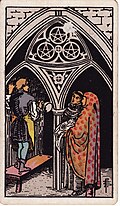
The RWS scene is a gray stone interior with an arched structure. Three pentacles are set high in the arch, arranged as part of the building rather than held as loose coins. A central artisan stands elevated on a bench or platform and raises a tool toward the stonework. Two other visible figures stand below and face the work; one appears to consult or hold a plan. Their different positions create a clear exchange between making, observing, and evaluating.
The artisan's upward action, the built arch, and the deliberately placed coins support themes of applied skill and standards made tangible. The warm reds and ochres of clothing contrast with the cool stone and darker interior, making the human labor visible inside a larger structure. There is no open landscape or dramatic movement: attention stays on a shared task. The figures are not proof of a specific profession or social class; those identifications vary by deck and reader.
A historical note helps keep the reading grounded. A. E. Waite's The Pictorial Key to the Tarot was published in 1911 and illustrated by Pamela Colman Smith. Waite's account is one source within an esoteric tradition, while the card image itself supplies observable evidence. Modern readers may extend the card toward collaboration and reflective practice, but those applications should be identified as editorial synthesis rather than recovered historical fact.
Keywords and Why They Fit
- Craftsmanship and skill: the elevated worker is actively shaping a durable structure. Collaboration and feedback: two other figures attend to the result, so the work is situated in a relationship rather than performed in isolation. Apprenticeship and learning: the scene allows a developing practitioner to receive standards and instruction. Recognition: the completed or displayed pentacles make quality visible, but do not promise praise. Planning and shared standards: the architectural setting and apparent plan connect effort with a design.
These keywords are not a fixed word list. They follow from the card's figures, tools, elevation, architecture, and placement of the pentacles, then connect with common Minor Arcana traditions that read the suit through resources, labor, skills, and tangible results.
Upright Three of Pentacles Meaning
Upright, the Three of Pentacles describes constructive participation. A project improves when the right people contribute distinct abilities and agree on what good work looks like. Its strength is disciplined cooperation: ask for expertise, practise a technique, document progress, and let useful criticism refine the result. The card favors a process that can be inspected, repeated, and improved rather than a flash of inspiration that cannot be sustained.
Its risk is excess. Collaboration can become committee delay, external approval-seeking, over-specialization, or a hierarchy that treats one person's contribution as invisible. A technically polished result can still fail if the shared purpose is unclear. Practical action is to define the deliverable, assign responsibilities, name the standard, and schedule a review. Let recognition follow evidence; do not make praise the only reason to continue.
Reversed Three of Pentacles Meaning
Reversed, this card does not automatically mean failure. It can show a useful skill being kept private, feedback being internalized, or a team process that needs redesign. The emphasis may shift from public construction to practice, revision, or a quieter assessment of whether a collaboration is suitable.
- Blockage: unclear roles, missing tools, poor communication, or a gatekeeper prevents work from joining together. Internalization: the person is learning alone, doubting their competence, or absorbing criticism without discussing it. Excess: perfectionism, status competition, excessive consultation, or technical detail crowds out the purpose. Delay: a review, dependency, training gap, or rework postpones the visible result. Direction adjustment: simplify the brief, seek a better-qualified partner, renegotiate standards, or return to fundamentals before scaling.
A reversed position may therefore advise a private rehearsal, a clearer contract, or a change in how feedback is given. Check the question and neighboring cards before deciding whether the issue is lack of effort, lack of coordination, or a wise pause.
Applications in Life Areas
Relationships and emotions: upright, the Three of Pentacles favors showing care through dependable participation, practical problem-solving, and respect for each person's contribution. It can describe learning how to build trust through repeated actions rather than grand declarations. Reversed, ask whether one person is doing invisible labor, whether criticism has become personal, or whether both people are trying to earn approval instead of naming needs. It describes interaction patterns, not the private thoughts of a third party.
Work and study: upright, it supports mentorship, peer review, portfolios, group projects, technical training, and measurable milestones. Divide work by strengths without isolating contributors. Reversed, audit instructions, dependencies, and feedback channels before blaming ability; a delay may be structural or educational. A practical step is to submit a small version for review.
Money and resources: the card points to income through skill, cooperative work, training, or a tangible improvement in a resource. It is not a promise of profit. Compare costs, scope, contracts, and the time needed to become competent. Reversed, look for underpricing, unclear ownership, duplicated effort, or a purchase made to signal expertise. Do not treat a card as investment advice.
Personal growth: upright, choose a craft and practise it in public enough to receive specific feedback. Reversed, distinguish healthy privacy from avoidance and constructive revision from endless self-criticism. Keep a record of what changed, what evidence supports the change, and which standard is genuinely yours.
The Three of Pentacles in Spreads
A card's position changes its emphasis. The Three of Pentacles is not a fixed answer such as yes, success, or teamwork in every layout.
- One-card prompt: What skill, support, or standard would make this situation more workable? Read the card as today's observable practice, not a prediction. Three-card situation, action, outcome: in Situation, identify the existing team, craft, or quality problem
- in Action, define the next contribution or feedback loop
- in Outcome, assess what becomes demonstrably stronger, while leaving room for changed circumstances. Relationship self, other person, interaction: for Self, examine your contribution and willingness to learn
- for Other Person, read the role they occupy in the shared process, not their hidden mind
- for Interaction, focus on communication, division of labor, and mutual standards. Decision opportunity, risk, advice: Opportunity may be a collaboration or training path
- Risk may be overreliance on approval or unclear ownership
- Advice is to test competence, scope, and agreements before committing. Obstacle, advice, outcome: as Obstacle, locate the missing role, tool, or review
- as Advice, make the plan concrete and invite useful critique
- as Outcome, read the quality of the completed step rather than a guaranteed reward.
Instructional Combination Reading
Instructional example, not a real case: Two of Pentacles, Three of Pentacles, and Four of Pentacles in sequence can show movement from juggling demands, to coordinating a workable craft, to protecting or consolidating the result. The Three does not erase the Two's time pressure, and the Four may either preserve a sound foundation or become overly controlling. Adjacent cards modify the emphasis; read the images and positions together rather than adding three isolated definitions.
Common Misreadings, Deck Differences, and Boundaries
A common mistake is reducing this card to "teamwork" or assuming that the three figures guarantee promotion. The RWS scene can support cooperation, but it also asks who sets standards, who receives credit, and whether the structure is sound. Some readers emphasize apprenticeship; others emphasize craftsmanship, public evaluation, or the number three as an early stage of form. Marseille pip cards, modern illustrated decks, and decks without the same architectural scene may shift the visual emphasis. State the deck and method when the difference matters.
Use tarot for cultural study, symbolic reading, and self-reflection. Do not use the card to make medical, legal, or financial decisions, to promise a job or payment, or to claim scientifically validated prediction. In relationship questions, protect privacy and avoid declaring what another person thinks. Pair reflection with evidence, consent, qualified advice, and your own agency.
Tarot Journal Prompts
- What part of a current project is visible, and what part still needs a standard or review? Which contribution am I making, and which contribution should I acknowledge? What feedback could I request in a specific, non-defensive form? Where might perfectionism or approval-seeking be replacing useful practice?
Suggested Learning Links
Continue backward with the independent Two of Pentacles article at tarot-card-two-of-pentacles, then forward to Four of Pentacles at tarot-card-four-of-pentacles. For foundations, build on the site's Tarot for Beginners article at tarot-for-beginners, the Pentacles suit guide at tarot-pentacles, the upright and reversed method at tarot-upright-and-reversed, the three-card spread guide at three-card-tarot-spreads, and the Tarot journal review at tarot-journal-review. These links support the card-specific reading without replacing it.