Three of Cups at a glance
The Three of Cups is the third card of the Cups suit, a Minor Arcana card, and position 39 in the 78-card Rider-Waite-Smith sequence. It follows the Two of Cups and expands a one-to-one exchange into a group setting: friendship, community, shared feeling, celebration, or collaborative support. Cups are symbolic lenses for emotion, imagination, relationship, and values, not scientific measurements or promises about the future. A useful question is: “What is ready to be shared, and what kind of community would help it grow?”
What the RWS image shows
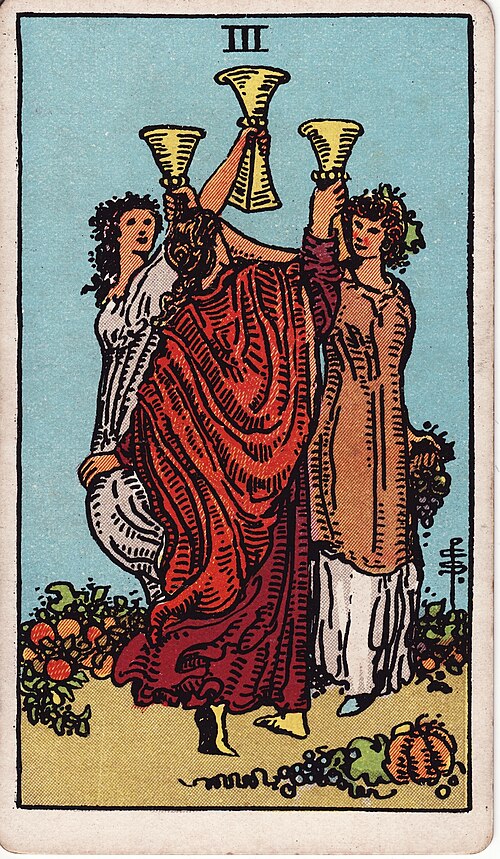
Three figures stand together in a green field, arranged in a loose circle. Each raises a cup toward the center, creating a visual triangle of equal participation rather than a single leader receiving attention. Their bodies turn inward toward the shared action. The clothing uses contrasting warm, pale, and blue tones, and the figures’ dresses move as they dance or step together. The scene presents people as distinct individuals who are nevertheless joined by a common gesture.
Fruit and gourds are visible across the foreground, with a leafy landscape and open sky behind the figures. The foreground harvest supports an impression of abundance, but it is an image of available produce, not proof of money or a guaranteed result. The cups are held aloft rather than poured, so the card shows recognition and shared enjoyment more clearly than it shows a specific promise. A. E. Waite’s The Pictorial Key to the Tarot is a historical reference for the RWS tradition; this article separates traditional interpretation from direct visual observation and modern editorial synthesis.
Keywords and how they arise
A concise keyword set is celebration, friendship, community, shared joy, support, creative flow, gratitude, and social excess. Celebration follows from the raised cups and coordinated movement. Friendship and community follow from three people participating in one circle rather than one person receiving an offering. Shared joy and support arise from the mutual gesture. Creative flow follows from the dancing energy and the Cups suit’s association with feeling and imagination. Gratitude and abundance connect the cups with the visible harvest. Social excess is the necessary caution: a group can nourish, but it can also encourage indulgence, comparison, or exclusion.
- Keywords: celebration
- friendship
- community
- shared joy
- support
- creative flow
- gratitude
- social excess. Treat these as possible functions of the image and Cups tradition, not as an automatic answer.
Upright meaning
Upright, the Three of Cups can describe a supportive circle, a reunion, a shared milestone, collaborative creativity, or a moment when feelings become easier to express with trusted people present. Its central strength is mutual nourishment. Instead of carrying an experience alone, you may be able to ask for help, share credit, receive encouragement, or let a small success be acknowledged. The card may apply to friendship, family, a study group, a team, or a community project as readily as to romance.
Its risks appear when celebration replaces responsibility. Excess can look like overindulgence, gossip, groupthink, social comparison, or staying busy with company to avoid a necessary private decision. A practical upright action is to name who contributed, invite the right people, and give the gathering a clear boundary of time, purpose, or budget. Enjoyment becomes more sustainable when it includes consent, inclusion, rest, and a plan for what follows the celebration.
Reversed meaning
Reversed, the Three of Cups does not automatically mean betrayal, a breakup, or a bad social outcome. It may show blockage in belonging, difficulty finding supportive people, or a group process that cannot yet coordinate. Internalization may be present when joy, grief, or creative energy is being processed privately rather than shared. Excess can appear as partying to avoid a feeling, comparison with other people’s lives, gossip, or dependence on group approval. Delay may reflect postponed plans, unresolved tension, or the time required to rebuild trust and practical arrangements.
The direction adjustment is to change the scale or structure of participation. Choose a smaller and safer conversation, speak directly instead of through the group, clarify an invitation, or take a restorative pause from a noisy environment. Reversed can also indicate re-entry after isolation: the useful move may be one modest, honest connection rather than a dramatic return to public activity. Ask whether the theme needs more community, more privacy, clearer boundaries, or a different way to celebrate.
Applications in everyday life
Relationships and emotions: The Three of Cups favors friendship, emotional support, shared humor, group belonging, and celebrations of a relationship milestone. It can describe a social setting around a romantic connection, but it does not by itself prove a third party, an affair, or a future reunion. Look at actual invitations, conversations, and patterns of inclusion. Reversed, distinguish temporary scheduling problems from repeated exclusion, triangulation, gossip, or a circle that asks you to perform happiness.
Work and study: This card supports teamwork, peer review, collaborative learning, recognition of contributions, and a productive social atmosphere. Its strength is that people exchange encouragement and skills; its risk is that informal rapport hides unclear roles or unequal labor. Put tasks, deadlines, credit, and decision rights in writing. Reversed, review cliques, meeting overload, group distraction, or a project delayed because no one has taken ownership. A smaller working group may be more effective than a larger one.
Money and resources: Read the card through shared costs, event planning, mutual aid, gifts, hospitality, and the emotional value of having enough to include others. The harvest does not guarantee profit or investment return. Check the budget before a celebration, record who pays, and avoid lending or spending to purchase belonging. Reversed, watch for social pressure, repeated small expenses, unclear contributions, or a shared fund that lacks accountability. Use records and qualified advice for consequential financial choices.
Personal growth: The card asks whether you can receive support without losing your own judgment and whether you can celebrate progress without turning it into a comparison. Practice naming one person who has helped, offering specific thanks, or sharing a creative result before it is perfect. Reversed, examine loneliness, approval-seeking, and the habit of hiding difficulty behind a cheerful group role. Growth may mean building one reliable connection rather than seeking universal acceptance.
Three of Cups in spreads and positions
One-card prompt: “What deserves to be celebrated, supported, or shared today?” Upright, emphasize available community, gratitude, and the smallest appropriate gathering or message. Reversed, examine blockage, internalization, excess, delay, and the direction adjustment that would make connection safer or more honest.
Three-card past, present, future: In the past, the Three can describe a formative friendship, group experience, shared success, or social pattern that still shapes the question. In the present, it highlights the people, feedback, and collective feeling currently available. In the future, it may suggest an invitation, reunion, or supportive network, but not a guaranteed event or permanent belonging. In a situation, action, outcome spread, it names the social climate; the middle card shows how to participate; and the final card reflects what that approach may produce.
Relationship positions: As self, the Three describes how you seek community, offer encouragement, or bring group energy into a bond. As the other person, it describes the role or observable energy they bring, never their private thoughts as fact. As interaction, it highlights shared enjoyment, friendship around the bond, or the influence of a wider circle. Reversed in one position, ask whether the imbalance is personal withdrawal, group pressure, poor communication, or a need for more defined boundaries.
Decision positions: In opportunity, the card points to collaboration, a useful network, shared celebration, or a chance to learn through peers. In risk, it warns of distraction, groupthink, overcommitment, social spending, or approval becoming the decision criterion. In advice, invite the right support, share credit, and set a practical limit. In obstacle, look for exclusion, unresolved group tension, or a private need hidden behind sociability. In outcome, it may show community support or a gathering, while surrounding cards and real choices determine whether it is nourishing.
Instructional combination example
Instructional, not a real case: The Two of Cups followed by the Three of Cups can show a private exchange widening into friendship, community, or shared support. The Two supplies one-to-one reciprocity; the Three asks how the bond functions when other people, resources, and group norms enter the picture. If the Four of Cups follows, the sequence may move from social fullness to a need for quiet evaluation. If the Three is reversed, even a warm connection may need clearer boundaries before it is opened to a wider circle. Adjacent cards modify one another rather than guaranteeing an outcome.
Common misreadings, traditions, and responsible use
Do not reduce the Three of Cups to a guaranteed party, pregnancy, wedding, best-friend promise, financial abundance, or third-party relationship. The three figures, raised cups, and harvest visibly support a theme of shared experience, but the question and position decide whether that experience concerns romance, friendship, work, family, or creative practice. A Marseille-style deck may show a pip arrangement rather than this RWS scene, so number, suit, pattern, and neighboring cards carry more of the analysis. RWS and Marseille traditions differ in the numbering of Strength and Justice and in some imagery; this series uses RWS order and primary image analysis.
Tarot is used here for cultural study, symbolic reading, and self-reflection, not scientifically validated predictive power. Do not use this card as medical, legal, or investment-return advice, and do not make guaranteed-fate claims. Do not read a third party’s mind, infer infidelity from a symbol, or pressure someone into a social or romantic choice. For high-stakes decisions, use direct communication, reliable records, consent, and qualified professional support.
Tarot journal prompts
- 1. What support is genuinely available, and what observable behavior shows that it is reliable?
- 2. Where am I celebrating, comparing, or performing belonging instead of naming a need?
- 3. What would a sustainable amount of social participation look like this week?
Suggested learning links
Continue backward to the Two of Cups (tarot-card-two-of-cups) and forward to the Four of Cups (tarot-card-four-of-cups). For foundations, build on Tarot for Beginners (tarot-for-beginners), the Cups suit guide (tarot-cups), the Upright and Reversed guide (tarot-upright-and-reversed), How to Ask a Tarot Question (tarot-how-to-ask), the Three-Card Tarot Spreads guide (three-card-tarot-spreads), and Tarot Journal Review (tarot-journal-review). These links support the method without replacing the Three-specific image and position analysis above.