The Tower at a glance
The Tower is Major Arcana XVI, the seventeenth card in the 78-card Rider-Waite-Smith (RWS) sequence. Its group is the Major Arcana, so it usually frames a concentrated life theme rather than a minor passing detail. The card is often associated with disruption, revelation, structural change, and the release of what cannot remain stable. Those are interpretive possibilities, not guaranteed events. In a reading, let the question, position, surrounding cards, and observable image narrow the emphasis.
This series follows RWS numbering. RWS places Strength at VIII and Justice at XI; many Marseille traditions reverse those numbers and use different imagery for the two cards. That difference does not change The Tower's RWS number XVI, but it is a useful reminder to name the deck and school before comparing a sequence.
RWS image and historical frame
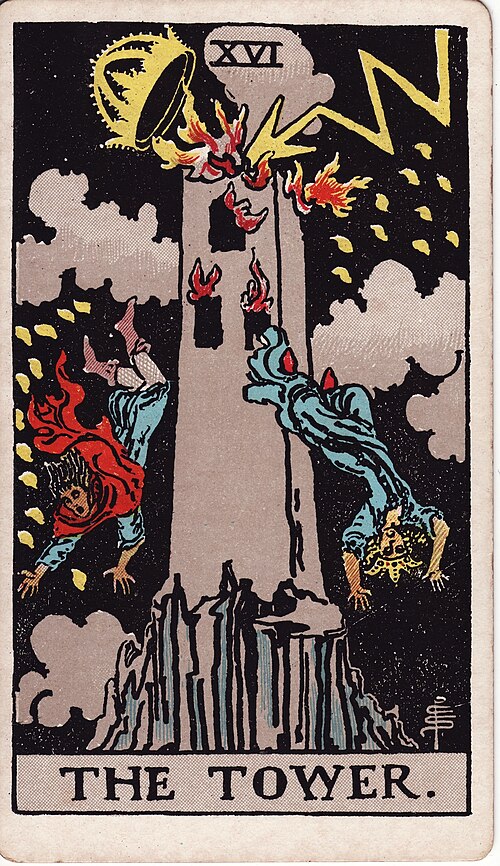
The RWS image shows a tall gray stone tower on a dark, sharply rising rocky peak. A bright lightning bolt descends from the upper right and strikes the crown-like top, knocking that crown away. Red and yellow flames burst from the tower and around its upper sections. Two human figures tumble from the structure in opposite directions: one falls headfirst along the left side, while the other drops on the right. The background is dark, with small flame-like shapes visible around the tower. The scene is vertical, sudden, and exposed; there is no calm interior space in which to hide.
The card's visible details are the starting evidence. The crown suggests a claim to control or status, but the image does not prove that a particular authority is corrupt. The lightning makes the change abrupt and external-looking, while the falling bodies show the loss of a secure position. The height and bare rock emphasize isolation and unstable foundations. Traditional readers have connected the image with catastrophe, pride, and the collapse of an established form, but a modern reflective reading can also ask what truth becomes visible when a protective structure fails.
The deck is commonly called Rider-Waite-Smith because A. E. Waite guided the project and Pamela Colman Smith created the art; William Rider is associated with its publication around 1909–1910. Waite's The Pictorial Key to the Tarot is a public-domain source for the period's explanations and is dated 1911 in the edition consulted here. Historical description and later psychological interpretations should not be treated as the same layer. This article uses the RWS picture for primary image analysis and labels practical suggestions as editorial synthesis.
Keywords and how they arise
Useful keywords are upheaval, exposure, revelation, release, instability, reset, and humility. Upheaval follows the lightning strike and the falling figures; exposure follows the open, broken tower with its occupants suddenly visible. Revelation comes from the flash that illuminates what the structure concealed. Release and reset describe the possibility that a damaged arrangement no longer needs to be defended. Instability and humility keep the reading honest: a high position is not the same as a secure foundation, and the card does not promise that the next structure will be better without deliberate rebuilding.
Upright meaning
Upright, The Tower can describe a sharp change that interrupts a settled plan, exposes a contradiction, or makes an old arrangement impossible to maintain. Its strength is clarity under pressure. A disruption can break denial, end a false certainty, or free attention from a role that has become too narrow. The constructive question is not simply, "What will collapse?" It is, "What can be rebuilt on evidence rather than appearance?"
The risk of excess is dramatizing every surprise, provoking a crisis to feel alive, or assuming that destruction itself is proof of truth. The practical action is to verify facts, protect immediate safety, separate urgent repairs from long-term redesign, and name the assumption that has been disproved. In a personal decision, pause before making irreversible moves; a revealed problem may require a boundary or a conversation, not an impulsive total reset.
Reversed meaning
Reversed The Tower does not automatically mean that disaster is avoided or that the card is negative. It may show blockage when someone refuses to acknowledge a failing structure, internalization when the upheaval is being processed privately, excess when fear turns a manageable adjustment into catastrophe-thinking, or delay when a necessary conversation keeps being postponed. It can also describe a smaller correction that is contained before it becomes public.
For direction adjustment, ask whether the reading calls for a slower dismantling, clearer evidence, or a safer exit rather than a dramatic break. Reversed may indicate that the external event is less visible but the inner reorganization is substantial. It can also warn against rebuilding the same pattern with different decoration. A useful next step is to identify one assumption, dependency, or routine to test this week, then record what actually happens instead of treating anxiety as evidence.
Applications by life area
Relationships and emotions: Upright, The Tower may mark an honest disclosure, a conflict that reveals a real incompatibility, or the end of an unstable relationship pattern. It can also clear space for more truthful relating. Reversed, feelings may be held in, feared, or repeatedly deferred. Do not use the card to declare what another person secretly thinks. Ask what has been observed, what needs to be said directly, and what boundary protects both people.
Work and study: Upright, a changed brief, failed method, institutional shake-up, or unexpected feedback may require rapid learning. The strength is willingness to revise the model. The risk is abandoning useful skills because one plan failed. Reversed can show resistance to feedback, private burnout, or a delayed decision about a course, role, or project. Make a contingency plan, seek concrete criteria, and distinguish a temporary setback from a broken system.
Money and resources: The Tower is not a promise of financial loss or gain. Upright can suggest that a budget, contract assumption, or resource dependency needs urgent review. Reversed can indicate avoidance, hidden costs, or a gradual correction. Use ordinary financial due diligence: check terms, preserve a buffer, and consult a qualified professional for consequential decisions. Never treat a card as investment-return advice.
Personal growth: Upright supports honest deconstruction of an identity or belief that no longer fits lived evidence. Reversed may show the slow, private work of loosening a defense. The growth task is to let evidence update the story without replacing one rigid certainty with another. If the image evokes trauma or panic, stop the reading and use appropriate real-world support.
The Tower in spreads
One-card prompt: Ask, "What assumption needs to be tested today?" Upright emphasizes a visible disruption or a truth that can no longer be postponed. Reversed emphasizes internal resistance, a contained correction, or the need to regulate before acting. The card is a prompt for observation and action, not a forecast of a fixed event.
Three-card situation, action, outcome: In the situation position, The Tower describes the unstable condition or breakthrough already shaping the question. In the action position, it advises removing a false support, telling the relevant truth, or making a careful contingency plan rather than escalating. In the outcome position, it suggests a changed structure and a need to rebuild; it does not guarantee either ruin or relief. In a past, present, future layout, it can show an earlier rupture, current exposure, or a possible future reset, with the surrounding cards supplying timing and scale.
Relationship positions: In self, The Tower can show the belief or defense the querent is confronting. In the other-person position, read it as the role or behavior visible in the spread, not a claim about private motives. In interaction, it may describe the pressure point that makes honest communication unavoidable. Look for consent, safety, and direct conversation before turning symbolism into a relationship decision.
Decision positions: In opportunity, The Tower may be the chance to leave a weak foundation or correct a plan early. In risk, it warns of overconfidence, poor preparation, or a reaction that creates needless damage. In advice, it favors verification, timely disclosure, and a reversible first step where possible. In obstacle, it may identify denial or a structure that cannot support the desired result. In outcome, it highlights reorganization and the work required after the revelation.
Combination reading example
Instructional example, not a real case: The Devil, The Tower, and The Star form a sequence of adjacent Major Arcana cards. The Devil can frame the attachment or dependency; The Tower shows the moment that pattern is exposed or interrupted; The Star shifts the emphasis toward recovery, perspective, and a modest path forward. The three cards do not prove that a breakup, job loss, or other event will happen. They demonstrate how neighboring cards can turn a frightening image into a process: notice the bond, test the structure, then rebuild hope through concrete care.
Misreadings, traditions, and responsible use
A common misreading is treating The Tower as a literal prediction of catastrophe, death, or unavoidable failure. Another is assuming every upright Tower is bad or every reversed Tower is good. Some schools use reversals; others read all cards upright and use position and surrounding cards for nuance. Marseille and other decks may show a different tower, title, color system, or number convention. Even within RWS-inspired decks, artwork varies, so describe the actual card in hand before importing a memorized meaning.
Tarot is a cultural and symbolic-reading practice that can support self-reflection; it is not a scientifically validated predictive method. Do not use The Tower to diagnose health, decide legal matters, direct investments, guarantee fate, or read a third party's mind. For urgent safety, medical, legal, financial, or mental-health concerns, use appropriate professional and emergency resources. A responsible reading preserves choice, privacy, uncertainty, and the possibility of ordinary explanations.
Journal prompts and learning links
- Journal prompts: What visible fact challenges the structure I am relying on? Which part of this situation is urgent, and which part can wait? What would a safer, evidence-based rebuild require? What did I fear the card would mean before I described its actual image?
Suggested learning links: review The Devil at /tarot-card-the-devil, then continue to The Star at /tarot-card-the-star. For foundations, see /tarot-for-beginners, /major-arcana-guide, /tarot-upright-and-reversed, /three-card-tarot-spreads, /tarot-how-to-ask, /tarot-journal-review, and /ethics-and-boundaries. These resources add method and boundaries without replacing the card-specific reading above.