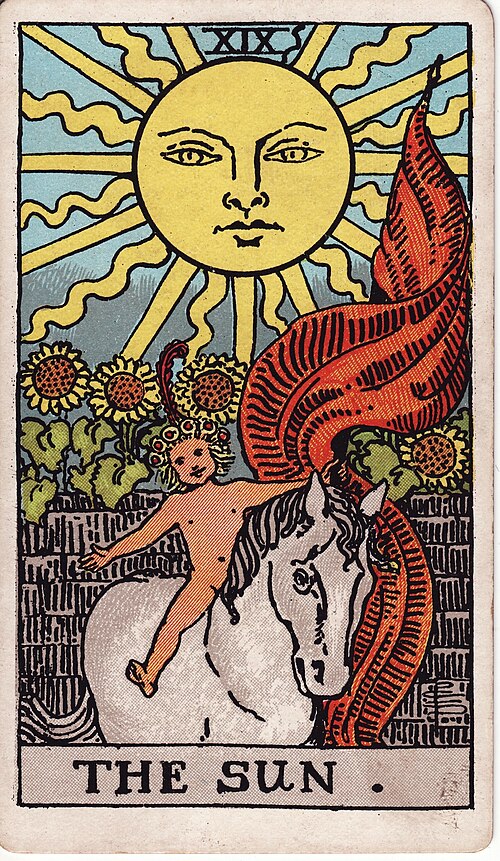
The Sun in the RWS sequence
The Sun is Major Arcana XIX, the twentieth card in the 78-card sequence, with The Fool numbered 0. It follows The Moon and comes before Judgement. In a Rider-Waite-Smith reading, The Sun often brings a question into clearer view: vitality, visibility, honest expression, and the ability to recognize what is working. Its brightness is not a promise that every circumstance will be easy. It can also expose an inconvenient fact, inflate confidence, or invite celebration before the work is complete.
The deck commonly called RWS was first published by William Rider & Son in 1909, with A. E. Waite's instructions and Pamela Colman Smith's illustrations. Waite's interpretations are one historical layer, while the visible composition and the question supply others. This article separates image observation, traditional interpretation, and modern practical synthesis. Tarot is treated here as cultural symbolism and a self-reflection practice, not as a scientifically validated predictive system.
RWS visual details
The card is dominated by a large golden Sun in a pale yellow sky. It has a human face and alternating straight and wavy rays. A naked child rides a white horse in the foreground, facing toward the left side of the image while the child turns outward toward the viewer. The child raises one arm and carries a tall red banner in the other. Behind the rider is a low gray wall and a row of sunflowers rising above it. Green ground fills the lower scene, creating a strong contrast with the yellow sky, red flag, and white horse.
The image is open rather than enclosed. The child is unarmored, the horse is not shown with a saddle, and the banner is displayed rather than hidden. The horse's white body and the child’s exposed posture can suggest innocence or vulnerability, but neither requires a literal reading about a particular person. The Sun's face and rays make illumination the central visual fact. The sunflowers turn upward toward that light, so growth and attention are visible actions in the composition. These observations support the interpretive keywords below without proving a fixed outcome.
Keywords and how they arise
A concise keyword set for The Sun is clarity, vitality, joy, confidence, visibility, success, openness, and integration. Clarity follows from the strong light and lack of a night veil. Vitality and growth follow from the child, horse, green ground, and sunflowers. Confidence and visibility follow from the rider's open posture, raised banner, and central placement. Joy and openness describe the direct, unhidden quality of the scene. Integration is an editorial synthesis: the card gathers body, attention, expression, and environment into one readable picture. These are interpretive lenses, not guarantees.
- Use clarity to ask what can now be named
- vitality to assess available energy and sustainable pace
- confidence to distinguish prepared self-trust from performance
- visibility to consider what needs to be communicated
- joy to recognize nourishment rather than demand constant happiness
- openness to make information and expectations explicit
- and integration to connect insight with a concrete action.
The Sun upright meaning
Upright, The Sun points to illumination, warmth, successful communication, and a stronger connection between what you value and what you do. Its potential strength is directness: say the important thing plainly, show the work, accept useful recognition, or let a good result be real without minimizing it. It can support learning, creative expression, collaboration, recovery of confidence, and a sense of shared momentum. Its risk of excess is overexposure, ego, forced positivity, or assuming that a bright first impression settles every question.
A practical upright action is to make progress visible and measurable. Share a draft, confirm the agreement, celebrate a completed stage, teach what you have learned, or schedule the next step while motivation is available. Keep the warmth sustainable: rest, feedback, and honest correction protect a success better than applause alone. The Sun can describe a favorable climate for action, but the question still determines whether the right response is celebration, disclosure, repair, or disciplined continuation.
The Sun reversed meaning
Reversed, The Sun may describe clarity that is partial, delayed, blocked, or turned inward. A blockage can appear as shame, self-doubt, burnout, fear of being seen, or a practical success that is not yet acknowledged. Internalization can make joy private or make confidence dependent on approval. Excess may look like denial of real problems, forced optimism, vanity, or promising more than resources can support. Delay suggests that recognition, energy, or understanding is arriving in stages rather than failing completely.
- For blockage, identify what would make the next step more visible or manageable. For internalization, record a genuine achievement without demanding public praise. For excess, name the inconvenient fact that positive language is hiding. For delay, define an interim milestone and a review date. For direction adjustment, share the truth with the right audience, reduce the scale, or rebuild energy before taking on more. Reversed is not automatically negative: it can show a quiet recovery, a modest success, or the removal of pressure to perform happiness.
Applications by life area
The Sun changes tone according to the life area and the position in a spread. It may describe a resource already present, a need for honest expression, or a warning that visibility has become performance. In all areas, distinguish symbolic encouragement from evidence.
- Relationships and emotions: Look for warmth, mutual enjoyment, direct communication, and the freedom to be seen without a role. Reversed, ask whether one person is hiding hurt behind cheerfulness or whether approval has become the measure of love. Use the card to support a clear conversation, not to declare another person's feelings or promise a relationship outcome.
- Work and study: Upright, The Sun can highlight comprehension, recognition, teaching, a successful presentation, or a project whose purpose is clear. Reversed, check for fatigue, unclear credit, unrealistic deadlines, or a gap between public confidence and actual preparation. Show evidence of progress and request specific feedback.
- Money and resources: The card may encourage transparent budgeting, acknowledging a material improvement, or investing effort in a skill with visible results. Reversed, inspect optimism, spending for appearances, and assumptions about future income. The card is not financial advice and cannot guarantee profit, repayment, or security.
- Personal growth: Explore authentic self-expression, healthy confidence, play, and the ability to receive good experiences without suspicion. Reversed, practice compassion for low energy and question the belief that growth must look impressive. Professional support remains appropriate for health, trauma, or mental-health concerns.
The Sun in spreads and positions
The Sun is not a fixed promise of a happy ending. Its position determines whether light is describing a condition, a behavior, a resource, or an outcome, and nearby cards show what the light reveals.
- One-card prompt: What can I make clearer, more honest, or more sustainable today? The emphasis is on a visible and proportionate action, not on demanding certainty.
- Three-card situation, action, outcome: In situation, The Sun describes the central truth, available energy, or success already shaping the issue. In action, it favors direct communication, public accountability, teaching, or celebrating a completed stage while staying realistic. In outcome, it can indicate recognition or clearer understanding, but the reader should define the observable result rather than assume perfection.
- Relationship spread: In self, notice your capacity for openness, joy, and honest self-presentation. In the other person position, read only the interactional evidence represented by the spread
- do not treat The Sun as access to private thoughts. In interaction, it highlights shared warmth, visibility, play, or a need to remove ambiguity through plain speech.
- Decision spread: In opportunity, The Sun points to a chance to be seen, learn, create, or act with a clear purpose. In risk, it warns of overconfidence, exposure without preparation, or ignoring a less pleasant fact. In advice, make the relevant information explicit and choose the step that can be evaluated in daylight.
- Obstacle, advice, outcome: As obstacle, it may show fear of visibility, exhaustion, or the pressure to appear fine. As advice, restore energy, tell the truth, and let success be specific rather than inflated. As outcome, it suggests clearer feedback, recognition, or a result that can be openly assessed
- surrounding cards may qualify how lasting or complete that result is.
Instructional combination example
Instructional example, not a real case: The Moon followed by The Sun can describe uncertainty becoming more testable as information appears. The Sun does not erase the Moon's emotional complexity; it illuminates what was previously hard to distinguish. The Sun beside Judgement can shift the emphasis from personal confidence to public acknowledgment, review, or a decision based on what has been brought into the open. Adjacent cards modify the scale and timing of the message; they do not turn a symbolic reading into a guaranteed forecast.
Common misreadings and school differences
A common mistake is reading The Sun as an unconditional yes, guaranteed wealth, perfect health, or proof that every problem has ended. Another is dismissing the reversed card as simply bad luck. Light can reveal a difficult truth, and a person can be successful while tired or uncertain. Some decks change the child's age, horse, flag, flowers, or solar face, while Marseille and other traditions use different compositions and historical associations. RWS and Marseille also differ in the numbering of Strength and Justice: RWS places Strength at VIII and Justice at XI, while many Marseille sequences place Justice at VIII and Strength at XI. This series follows RWS numbering and uses RWS imagery for primary analysis.
The RWS deck's 1909 publication history and the roles of Waite and Smith belong to deck history. Waite's Pictorial Key to the Tarot is a valuable public-domain historical reference, but traditional associations are not scientific evidence. Later psychological, astrological, or esoteric correspondences should be labeled as school-specific or modern rather than presented as the only meaning.
Responsible use and journal prompts
Do not use The Sun to diagnose health, replace legal or financial advice, guarantee a relationship or job result, or claim certainty about another person's thoughts. For decisions with serious consequences, use qualified advice, relevant records, informed consent, and a realistic plan. Tarot can help organize attention and reflection. It cannot make risk disappear or transfer responsibility away from the person making the choice.
- What is genuinely clear now, and what still needs verification?
- Where am I confusing healthy confidence with the need to be admired?
- How can I celebrate progress while remaining honest about limits and unfinished work?
Suggested learning links
- Previous card: The Moon — tarot-card-the-moon.
- Next card: Judgement — tarot-card-judgement.
- Foundations: Tarot for Beginners — tarot-for-beginners
- Upright and Reversed Tarot — tarot-upright-and-reversed
- Three-Card Tarot Spreads — three-card-tarot-spreads
- Tarot Journal and Review — tarot-journal-review
- Major Arcana Guide — major-arcana-guide.
- Historical reference: A. E. Waite, The Pictorial Key to the Tarot — sacred-texts.com/tarot/pkt/index.htm. Compare the historical text with the visible RWS composition and with the question being asked.