The Star at a glance
The Star is Major Arcana XVII, the eighteenth card in the 78-card Rider-Waite-Smith (RWS) sequence. Its group is the Major Arcana, so it often places a personal question inside a larger process of renewal, orientation, or meaning-making. The card is commonly linked with hope, openness, restoration, and a guiding ideal. These are interpretive possibilities, not guarantees. Read The Star through the question, the spread position, the surrounding cards, and what is actually visible in the image.
This series uses RWS numbering. RWS places Strength at VIII and Justice at XI, while many Marseille traditions place those two cards in the opposite numerical order and use different imagery. The Star remains XVII in the RWS sequence. Stating the tradition prevents a sequence difference from being mistaken for a disagreement about the card's entire meaning.
RWS image and historical frame
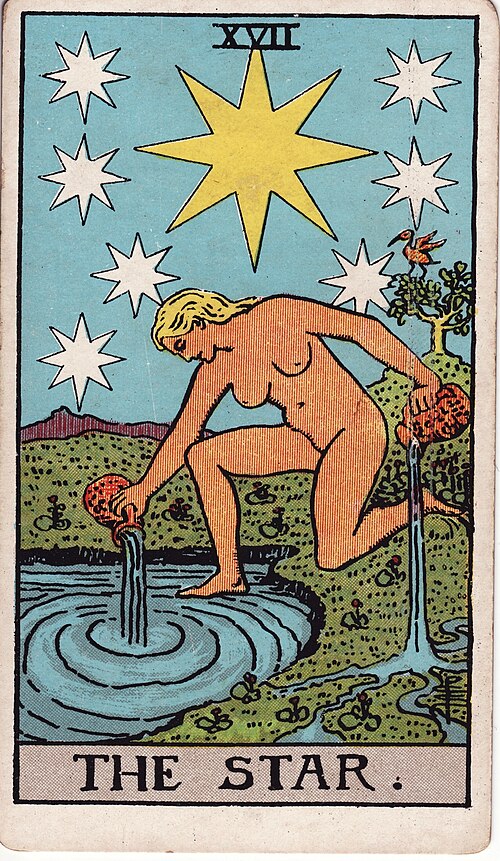
The RWS image shows a nude woman kneeling beside a pool or stream. One foot rests in the water and the other is on the land. She pours from two vessels: one stream returns to the pool, while the other flows onto the ground in several visible rivulets. Behind her are low hills, green land, and a tree with a bird perched on it. The sky is blue and contains one large, bright eight-pointed star surrounded by seven smaller stars. The palette is cool blue with yellow stars and green earth, a marked visual change from the violent darkness of The Tower.
The image gives several directions at once. Water moves both back into the pool and outward across the ground, joining inner feeling with practical surroundings. The figure's posture is low and unarmored, but it is active rather than passive: she kneels, pours, and participates in the landscape. The bird and tree add a living focal point at the edge of the scene, while the distant hills keep the horizon open. These details support traditional associations with renewal and inspiration, but they do not prove a supernatural message or a promised outcome.
The deck is known as Rider-Waite-Smith because A. E. Waite guided the project and Pamela Colman Smith made the artwork; William Rider is associated with publication around 1909–1910. Waite's The Pictorial Key to the Tarot, dated 1911 in the public-domain edition consulted here, is a historical source for period interpretations. The image itself is evidence of composition and symbol placement; later spiritual, psychological, and self-help meanings are separate interpretive layers. This guide keeps those layers distinct and uses the RWS picture first.
Keywords and how they arise
Useful keywords are hope, renewal, receptivity, healing, honesty, orientation, generosity, and perspective. Hope follows the large star and the open sky, but it is grounded by the figure's work with water. Renewal follows the living landscape after the previous card's upheaval. Receptivity and honesty arise from the unarmored, kneeling posture; generosity comes from pouring into both pool and soil. Orientation describes the star as a point of reference rather than a fixed destination. These keywords do not mean that every Star is easy: their practical test is whether a small, repeatable action supports the future being imagined.
Upright meaning
Upright, The Star can describe renewed trust in a process, a return of creative or emotional capacity, and the ability to act from a clear ideal without pretending that all problems are solved. Its strength is sustainable openness. After disappointment, it may encourage rest, truthful naming of needs, and a modest plan that reconnects inspiration to daily care. The card can also point to visibility and authenticity: showing up without unnecessary armor while keeping appropriate boundaries.
The risk of excess is idealizing a person or future, giving away more than can be replenished, or using beautiful language to avoid a practical repair. The action is to turn hope into a measurable experiment: choose one resource to restore, one honest conversation to have, or one creative practice to repeat. Upright does not guarantee success, reconciliation, health, or recognition. It suggests a quality of attention that can make responsible action possible.
Reversed meaning
Reversed The Star is not automatically a bad omen. It may show blockage when discouragement prevents a person from recognizing available support, internalization when hope is private and not yet ready to be shared, excess when idealism becomes escapism or over-giving, delay when recovery is expected on an unrealistic timetable, or direction adjustment when an inspiring goal needs a more grounded route.
A reversed Star can also describe a dimmed sense of meaning, comparison with an imagined perfect life, or disappointment after a promise was treated as certainty. The adjustment is not to force optimism. Check the water and the ground: what is emotionally true, and what practical condition needs attention? Reduce the scale of the promise, protect energy, ask for reliable help, and let evidence revise the plan. A quieter hope may be more durable than an impressive declaration.
Applications by life area
Relationships and emotions: Upright, The Star can support openness, tenderness, repair, and a relationship climate in which people can be seen without performance. It may describe renewed trust after a difficult period, but only consistent behavior can establish trust. Reversed, one person may feel emotionally depleted, idealize the connection, or keep hope private. Do not use the card to infer a third party's feelings. Ask what has been communicated, what support is reciprocal, and what boundary makes vulnerability safer.
Work and study: Upright, the card favors a guiding purpose, creative recovery, mentoring, and steady progress after a setback. It can be a useful prompt to publish a draft, apply for a program, or return to a method that makes learning feel meaningful. Reversed may indicate loss of motivation, comparison, perfectionism, or a plan that lacks milestones. Break inspiration into a schedule, request specific feedback, and measure progress by completed steps rather than applause.
Money and resources: The Star is not a promise of wealth or a financial forecast. Upright, it can highlight rebuilding a resource base, investing time in a sustainable skill, or making a transparent plan after strain. Reversed may show wishful budgeting, generosity beyond capacity, or delayed recovery. Check cash flow, terms, and realistic timelines; obtain qualified advice for major financial choices. Use the card to clarify values and priorities, not to justify risk.
Personal growth: The Star invites a form of self-respect that is neither grandiose nor hidden. Upright, it supports reconnecting with a value, body practice, creative habit, or community that restores perspective. Reversed, the work may be grieving a lost ideal or allowing support without needing to appear fully healed. If the card raises serious mental or physical health concerns, treat the symbolism as a journaling prompt and use appropriate professional care.
The Star in spreads
One-card prompt: Ask, "What small source of renewal can I tend today?" Upright emphasizes available hope, honest openness, and a practical way to replenish. Reversed emphasizes discouragement, private recovery, over-idealization, or a route that needs adjustment. The answer should become an observable action, not a claim that the future is guaranteed.
Three-card situation, action, outcome: In the situation position, The Star shows the value, hope, or recovery process already shaping the question. In the action position, it recommends a modest restorative practice, transparent communication, or a step aligned with the long-term ideal. In the outcome position, it suggests renewed orientation or a clearer relationship to hope, not automatic success. In a past, present, future layout, it can mark an earlier inspiration, current re-centering, or a possible future in which patience and consistent care matter.
Relationship positions: In self, The Star describes the querent's capacity for openness, repair, or idealization. In the other-person position, read it as behavior or a role represented by the spread, never as proof of private thoughts. In interaction, it can emphasize mutual encouragement, a healing atmosphere, or the need to make hope reciprocal. Pair the symbolism with direct conversation and consent rather than using it to bypass the other person's stated position.
Decision positions: In opportunity, The Star may point to a values-aligned opening, supportive community, or chance to restore a neglected capacity. In risk, it warns against fantasy, overexposure, savior roles, or giving without limits. In advice, it favors transparent intentions, patient practice, and a realistic milestone. In obstacle, it may show cynicism, comparison, depleted resources, or an ideal that is too vague to guide action. In outcome, it suggests orientation and renewed possibility; the result still depends on conditions and choices.
Combination reading example
Instructional example, not a real case: The Tower, The Star, and The Moon show how adjacent cards modify one another. The Tower can identify a rupture or exposed assumption; The Star offers recovery, perspective, and a reason to keep tending the future; The Moon then asks the reader to test fear, ambiguity, and projection rather than assuming that hope has removed uncertainty. This is not a prediction of a crisis followed by a mystical rescue. It is a reading sequence from disruption, to orientation, to careful work with what remains unclear.
Misreadings, traditions, and responsible use
A common misreading is treating The Star as a guaranteed wish, soulmate signal, cure, or public success. Another is reducing it to vague positivity and ignoring the water, soil, effort, and limits shown in the picture. Some schools use reversals; others keep cards upright and let position, image, and combination carry the tension. Marseille and other traditions may use different designs, titles, numbering conventions, or symbolic emphases. Even RWS-inspired reproductions vary, so describe the deck in front of you before applying a memorized keyword.
Tarot is a cultural, symbolic-reading, and self-reflection tool, not a scientifically validated predictive system. Do not use The Star to read a third party's mind or to replace medical, legal, financial, educational, or mental-health guidance. Hope should increase agency rather than dependence. For serious concerns, consult appropriate qualified or emergency resources, preserve privacy, and treat the reading as one optional perspective among evidence, communication, and real-world support.
Journal prompts and learning links
- Journal prompts: What kind of hope is supported by evidence rather than wishful thinking? Where am I giving energy, and what replenishes it? What ideal needs a smaller, measurable next step? What changed when I described the water, land, stars, and posture before naming a meaning?
Suggested learning links: read The Tower at /tarot-card-the-tower, then continue to The Moon at /tarot-card-the-moon as the next RWS card in the series. For foundations, see /tarot-for-beginners, /major-arcana-guide, /tarot-upright-and-reversed, /three-card-tarot-spreads, /tarot-how-to-ask, /tarot-journal-review, and /ethics-and-boundaries. These guides support method, reflection, and boundaries without replacing this card-specific analysis.