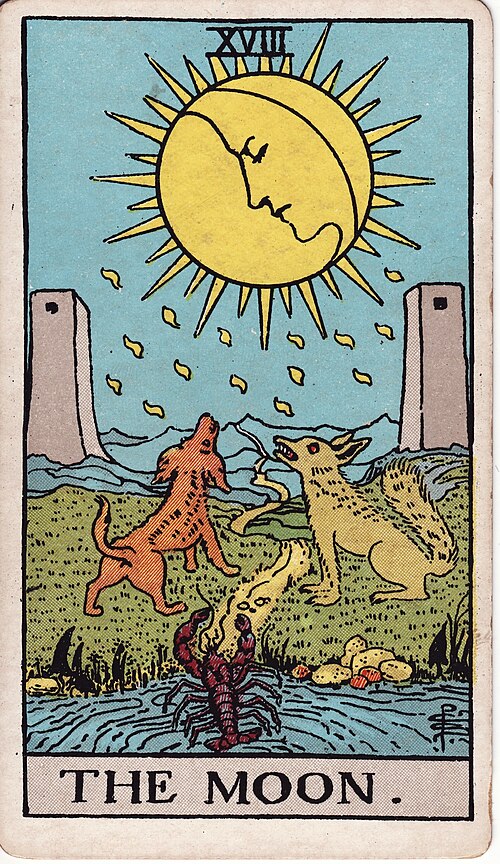
The Moon in the RWS sequence
The Moon is Major Arcana XVIII, the nineteenth card in the 78-card sequence, with The Fool numbered 0. It follows The Star and comes before The Sun. In a Rider-Waite-Smith reading, it often marks a passage through incomplete information: feelings, images, memories, hopes, and fears may be active before a situation is easy to name. The card is not proof of deception, danger, or a fixed future. It is a symbolic prompt to slow down, test impressions, and notice what remains uncertain.
The deck commonly called RWS was first published by William Rider & Son in 1909, with A. E. Waite's instructions and Pamela Colman Smith's illustrations. Waite's traditional associations are one historical layer; the visible picture and the question provide others. This article distinguishes observable imagery, traditional interpretation, and modern editorial synthesis so that a card meaning remains a method for reflection rather than a claim that tarot prediction is scientifically validated.
RWS visual details
The card shows a dark blue night scene. A large golden Moon hangs above the landscape, with a face in profile and alternating straight and wavy rays. Drops descend from it toward the ground. Below, a dog on one side and a wolf on the other lift their heads and howl. In the foreground, a crayfish rises from a pool. Two gray towers stand apart in the middle distance, and a pale, winding path runs between them toward distant mountains. The dog, wolf, and crayfish face the Moon and the path rather than one another, creating a scene of alertness and transition.
The strong contrasts matter. Cool blues and the night sky limit ordinary visibility, while the yellow Moon supplies reflected rather than daylight illumination. The paired animals suggest a tension between domesticated habit and wild instinct without requiring them to stand for two literal people. The crayfish emerging from water gives the scene a movement from a submerged place into awareness. The towers frame a route, but they do not reveal where it ends. These are visual observations; the meanings below are interpretive uses built from that structure and from tarot tradition.
Keywords and how they arise
A concise keyword set for The Moon is uncertainty, intuition, projection, imagination, fear, ambiguity, and liminality. Uncertainty follows from the night and the incomplete view. Intuition and imagination follow from the Moon's reflected light, dreamlike landscape, and water. Projection and fear arise when the mind tries to complete a scene it cannot fully see, as the animals react to the light and the unknown. Ambiguity and liminality describe the path between the water and the mountains, where the subject is moving but has not reached a clear destination. These words are lenses, not a list of guaranteed events.
- Use uncertainty to ask what evidence is missing
- intuition to notice a signal worth investigating
- projection to separate observation from story
- imagination to explore possibilities
- fear to identify a nervous-system response without treating it as proof
- ambiguity to keep more than one explanation open
- and liminality to describe a transition that is real even before its outcome is known.
The Moon upright meaning
Upright, The Moon describes a situation in which direct clarity is limited and emotional or unconscious material is influential. Its strength is sensitivity: you may detect a pattern, creative possibility, or uncomfortable feeling before you can explain it. It can support dreamwork, artistic exploration, careful listening, and honest attention to mixed signals. Its risk is treating every impression as fact. Fear, wishful thinking, rumor, and old memory can dress themselves in the language of intuition.
A practical upright response is to proceed in small, reversible steps. Write down what you actually observed, what you inferred, and what you still need to verify. Ask a clarifying question, check a source, sleep on a major choice, or create a time to review new information. The card does not demand paralysis; it asks for a pace that allows perception and evidence to catch up with emotion. Its potential is not perfect certainty but more honest navigation.
The Moon reversed meaning
Reversed, The Moon can show the same theme turned inward, delayed, intensified, or beginning to resolve. A blockage may appear as avoidance of an obvious question, distrust of every source, or inability to distinguish fear from data. Internalization can make private dreams, shame, or anxiety louder than the external situation. Excess can look like suspicion, compulsive checking, fantasy, or emotional flooding. Delay may mean that clarity is arriving gradually rather than on demand.
- For blockage, name the single fact or conversation being avoided. For internalization, journal the feeling before assigning it to another person. For excess, limit speculation and return to observable behavior or documented information. For delay, set a review date instead of forcing a premature conclusion. For direction adjustment, choose the next modest test that can confirm, revise, or disprove your current story. Reversed is not automatically negative: it can also describe fog lifting, a hidden assumption becoming visible, or a fear losing its authority.
Applications by life area
The Moon is especially useful when a question contains uncertainty, but the area of life changes what responsible interpretation requires. A symbolic reading should open a conversation with reality, not replace it.
- Relationships and emotions: Read the card as a prompt to examine mixed signals, unspoken feelings, attachment fears, or stories you may be telling yourself. Speak from your experience and ask the other person directly
- do not use the card to claim access to a third party's mind or intentions. Emotional work can include naming triggers and allowing time before reacting.
- Work and study: Look for an unclear brief, unreliable assumption, missing context, or creative idea that needs a test. Confirm deadlines, definitions, and sources. If studying, break a confusing subject into smaller questions rather than concluding that confusion means inability.
- Money and resources: Treat uncertainty as a reason to inspect budgets, terms, fees, and risk. The card may symbolize irregular information or anxiety about security, but it cannot provide investment-return, lending, or purchasing advice. Use qualified financial information and a written plan.
- Personal growth: Explore dreams, habits, fears, and inherited narratives while keeping a distinction between symbolic insight and factual diagnosis. A small grounding routine, honest conversation, or journal review can turn a vague feeling into a workable question.
The Moon in spreads and positions
The position changes the emphasis. Do not paste one fixed definition into every layout. First identify the question, then observe whether the card describes a condition, an action, a relationship dynamic, an obstacle, or an outcome.
- One-card prompt: What is unclear, and what is one reliable way to learn more? The card emphasizes the quality of your attention rather than a yes-or-no verdict.
- Three-card situation, action, outcome: In situation, The Moon describes the uncertainty or emotional atmosphere already shaping the issue. In action, it recommends checking assumptions, listening carefully, or moving by a small experiment. In outcome, it suggests that the result may remain partly ambiguous or that understanding will arrive through the process, so define what evidence would count as progress.
- Relationship spread: In self, examine your feelings, projections, and communication needs. In the other person position, read the card cautiously as the information available about the interaction, not a diagnosis of their private mind. In interaction, it may show a feedback loop of silence, fear, imagination, or indirect communication
- clarification becomes the practical emphasis.
- Decision spread: In opportunity, The Moon can point to a creative opening or an unresolved factor worth researching. In risk, it highlights blind spots, wishful thinking, or unclear terms. In advice, it favors postponing irreversible action until a specific question is answered, while still taking a safe exploratory step.
- Obstacle, advice, outcome: As obstacle, it shows confusion, avoidance, or emotional noise. As advice, it asks for grounding, verification, and patience with incomplete information. As outcome, it does not promise failure
- it indicates a need to evaluate the result carefully and avoid declaring certainty too early.
Instructional combination example
Instructional example, not a real case: The Star beside The Moon combines a visible thread of hope with uncertainty about how to follow it. The Star can make The Moon's imagination constructive, while The Moon reminds The Star not to mistake inspiration for evidence. If The Moon is followed by The Sun, the sequence can be read as a movement from partial, reflected light toward clearer disclosure or confidence, but the reader should still identify the real-world action that produces clarity. Adjacent cards modify emphasis; they do not create a guaranteed forecast.
Common misreadings and school differences
A common mistake is reducing The Moon to lies, madness, or a sinister hidden enemy. Another is treating intuition as infallible or assuming every unusual feeling is an occult message. The image supports uncertainty, instinct, and imagination, but the surrounding cards and the question determine whether those themes are creative, relational, practical, or internal. Some modern decks change the animals, landscape, lunar face, or color emphasis, and some readers use astrological or esoteric correspondences that are not universal. Marseille and RWS traditions also differ in imagery and in the numbering of Strength and Justice: RWS places Strength at VIII and Justice at XI, while many Marseille sequences reverse those positions. This series uses RWS numbering and primary image analysis.
Waite's Pictorial Key to the Tarot, published in the early twentieth century, is a historical source for traditional associations, not a scientific validation of divination. The RWS deck's authorship, publication history, and visual details should be kept separate from later popular keywords. Read this article as cultural and symbolic study, or as a structured self-reflection tool.
Responsible use and journal prompts
Do not use The Moon to diagnose mental or physical health, decide legal matters, replace professional financial guidance, identify a hidden criminal, or guarantee what another person will do. For high-stakes questions, consult qualified professionals and use ordinary evidence. A reading can help you frame a question, identify assumptions, and choose a low-risk action; it cannot remove uncertainty or transfer responsibility for a decision.
- What did I directly observe, and what story did I add to explain it?
- Which fear is asking for care, and which fact would help me test it?
- Where can I take a small, reversible step instead of demanding total certainty?
Suggested learning links
- Previous card: The Star — tarot-card-the-star.
- Next card: The Sun — tarot-card-the-sun.
- Foundations: Tarot for Beginners — tarot-for-beginners
- Upright and Reversed Tarot — tarot-upright-and-reversed
- Three-Card Tarot Spreads — three-card-tarot-spreads
- Tarot Journal and Review — tarot-journal-review
- Major Arcana Guide — major-arcana-guide.
- Historical reference: A. E. Waite, The Pictorial Key to the Tarot — sacred-texts.com/tarot/pkt/index.htm. Use it as a primary historical text and compare its language with the RWS image and modern editorial practice.