Card identity and sequence
The Lovers is Major Arcana VI in the Rider-Waite-Smith (RWS) tarot and position 7 of 78 when The Fool is counted as the first card. Its group places a human relationship, a value choice, or a moment of alignment inside the larger journey of the Major Arcana. The card is not limited to romance. It can describe how desire, consent, principles, and consequences meet when a person must choose with awareness rather than drift. In this series, RWS is the reference order and image tradition.
What the RWS image shows
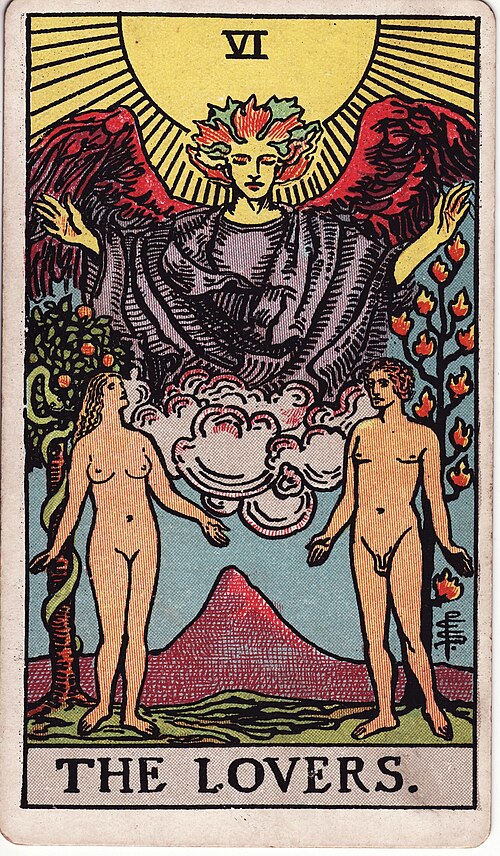
The card visibly presents two unclothed human figures in a garden beneath a bright sun. The man stands on the left and looks toward the woman; the woman stands on the right and turns her attention upward toward a large winged figure above them. The angel extends its arms over the pair. Behind the man is a tree with many visible flames, while behind the woman is a tree with a serpent winding around it. Green ground, a distant gray mountain, blue sky, and warm yellow light give the scene an open but exposed quality. The figures face one another rather than hiding, so vulnerability and mutual recognition are part of the image. The RWS scene is an image to observe first, not proof of a fixed romantic outcome.
A useful historical distinction is that A. E. Waite wrote the card descriptions in The Pictorial Key to the Tarot, published in 1911, while Pamela Colman Smith illustrated the deck associated with the RWS name. Waite's prose is a historical source for one occult interpretation, not a universal rule for every deck or reader. The visible garden, gaze pattern, trees, serpent, angel, and sun support the image analysis here; later associations should be labeled as tradition or editorial synthesis.
Keywords that follow from the image
Useful keywords are choice, alignment, attraction, reciprocity, values, vulnerability, and commitment. Choice follows from the card's place between the teaching and direction themes of the surrounding sequence, and from the pair's exposed meeting. Alignment follows from the figures standing in one shared scene beneath a single overhead presence. Attraction and reciprocity arise from their mutual orientation, while values and commitment ask what makes a relationship or decision durable after the first feeling. Vulnerability comes directly from the lack of clothing and protective walls. These are interpretive handles, not an unexplained list of guaranteed events.
Upright meaning: connection with conscious choice
Upright, The Lovers can show a meaningful bond, honest conversation, shared values, or a decision that deserves full participation. Its strength is integration: feeling and thought are invited into the same choice, and attraction can become an agreement rather than a projection. The card may encourage naming what each person wants, checking consent, comparing principles, and accepting the consequences of a chosen path. Its risk is excess. Idealization, dependence, moral certainty, or the wish to be completed by another person can make an apparently beautiful connection less free. A practical action is to state the decision in plain language, identify who is affected, ask what is freely chosen, and test whether behavior matches the stated value.
Reversed meaning: when connection or choice loses clarity
Reversed, The Lovers does not automatically mean a breakup or betrayal. It may show blockage in communication, an internal conflict between desire and principle, or a choice being made to satisfy pressure rather than consent. Internalization can look like private longing, shame, or values that have not yet been spoken. Excess can appear as obsession, people-pleasing, repeated comparison, or treating chemistry as evidence. Delay may indicate that information, boundaries, or readiness is incomplete. Direction adjustment asks the reader to slow down, separate a genuine preference from fear of loss, and renegotiate the terms of participation. If the card is reversed in an otherwise supportive spread, it can simply suggest that alignment is developing inwardly before it becomes visible.
Applications in ordinary life
In relationships and emotions, upright The Lovers favors reciprocal disclosure and a conversation about shared expectations; reversed, it asks whether silence, projection, or unequal investment is distorting the bond. In work and study, upright can indicate a partnership, a values-based choice, or a useful synthesis of two approaches; reversed may point to divided priorities, unclear roles, or a decision postponed because standards conflict. For money and resources, the card is about agreements and values rather than a promise of profit: read terms carefully, separate joint and personal obligations, and avoid spending to prove affection. In personal growth, it invites integration of competing parts of the self and practice in choosing without outsourcing responsibility.
The Lovers in spreads and positions
For a one-card prompt, ask, “What value or relationship requires an honest choice from me today?” The card then emphasizes the quality of participation, not a yes-or-no prediction. In a past-present-future spread, it can describe an earlier bond or value lesson, the present choice that exposes priorities, or a future need to honor a commitment; the position determines the time emphasis. In a situation-action-outcome spread, it may define the relational or ethical tension, recommend direct conversation and consent, then show the likely shape of an outcome if the chosen action is followed. In relationship positions, Self describes your needs, boundaries, and willingness to be accountable; Other Person describes the role or perspective that the spread assigns, never a verified report of private thoughts; Interaction describes the pattern created between both sides. In a decision spread, Opportunity highlights a path of alignment, Risk warns of idealization or compromised values, and Advice recommends clarifying terms before choosing. In obstacle, advice, and outcome positions, the card changes from the conflict itself, to the practice that restores agency, to the kind of result shaped by mutual responsibility. A reversed card in any position modifies the emphasis toward blockage, inward processing, excess, delay, or a needed change of direction.
Instructional combination example
Instructional example, not a real case: The Hierophant, The Lovers, and The Chariot appear in sequence. The Hierophant can frame the choice through teaching, vows, or inherited standards; The Lovers then asks whether those standards are genuinely shared rather than merely obeyed; The Chariot turns the decision into a chosen direction requiring discipline. Together they do not guarantee marriage or victory. They teach a reader to move from received values, through conscious agreement, toward accountable action.
Common misreadings, traditions, and responsible use
A common misreading treats The Lovers as an automatic soulmate card or as evidence that a third party has a particular feeling. The image can support intimacy, but its central work is conscious relationship to choice and values. Marseille and RWS traditions differ in imagery: Marseille versions commonly show a central person between two figures with a cupid-like figure above, while the RWS card uses the garden scene and a large winged presence. The traditions also commonly reverse the numbering of Strength and Justice: RWS places Strength at VIII and Justice at XI, while many Marseille sequences place Justice at VIII and Strength at XI. Titles, colors, and symbolic emphasis also vary across decks. Use tarot as cultural symbolism and self-reflection, not scientifically validated prediction. Do not use this card to read a third party's mind, guarantee a relationship, or replace medical, legal, financial, or safety advice.
Tarot journal prompts
- 1. Which value am I choosing in practice, and which value am I only describing? 2. Where do attraction and consent agree, and where do I need a clearer conversation? 3. What would a freely chosen commitment look like in one observable action?
Suggested learning links
Continue backward to The Hierophant (tarot-card-the-hierophant) for the card's teaching and tradition context, and forward to The Chariot (tarot-card-the-chariot) for the movement that follows a decision. For foundations, see Tarot for Beginners (tarot-for-beginners), The Major Arcana Guide (major-arcana-guide), Tarot Upright and Reversed (tarot-upright-and-reversed), and Three-Card Tarot Spreads (three-card-tarot-spreads). These resources provide method and vocabulary without replacing the card-specific image analysis.