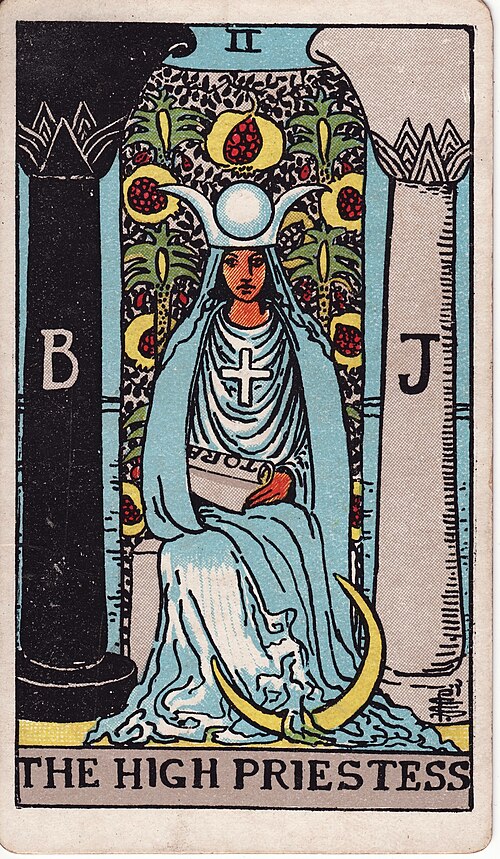
The High Priestess is Major Arcana II in the Rider-Waite-Smith (RWS) tradition and position 3 in the 78-card sequence, after The Fool and The Magician. She often slows a reading down. Her image does not show a public performance or a visible conquest; it shows a figure at a threshold, holding knowledge that is only partly exposed. In a tarot reading, that can point to discernment, privacy, intuition, timing, or information that needs careful handling. It is a symbolic framework for reflection, not scientifically validated proof of hidden facts or a guaranteed prediction.
Place in the RWS sequence and tradition
The RWS deck was first published by William Rider & Son in 1909 from A. E. Waite’s instructions and Pamela Colman Smith’s illustrations. Waite’s Pictorial Key to the Tarot is a historical source for the card’s symbolism, while modern readers use the image in many psychological, spiritual, artistic, and practical ways. RWS and Marseille traditions differ in some imagery and in the numbering of Strength and Justice: RWS places Strength at VIII and Justice at XI, while Marseille commonly places Justice at VIII and Strength at XI. This series follows RWS numbering and gives the RWS image priority.
What the RWS image shows
A seated woman faces the viewer between two upright pillars: a dark pillar on the viewer’s left and a light pillar on the viewer’s right. A patterned veil hangs behind her, with palm-like forms and pomegranate shapes. She wears a blue robe and a crown-like headdress, and a large cross is visible on her chest. A crescent moon appears near her feet. She holds a scroll across her lap; its writing is partly covered by her robe. The composition is frontal and balanced, with the figure looking outward while the veil blocks a complete view of what lies behind it.
These are observations before they are interpretations. Waite associated the pillars, veil, scroll, moon, and cross with religious and esoteric ideas, but a contemporary reader does not have to treat every historical association as a fact about the future. The visual structure itself gives a reliable starting point: two sides, a guarded passage, partially visible text, a still central figure, and symbols of reflection and cycles.
Keywords derived from the image
- Stillness and receptivity follow from the seated pose and the absence of dramatic action. Discernment follows from the partly covered scroll and the threshold-like veil: the question is not only what is known, but what is ready to be known. Hidden context follows from the barrier behind the figure. Intuition and cycles follow from the moon, while duality and balance follow from the paired pillars. Privacy is an editorial and practical extension of the guarded setting, not a claim that the card exposes someone else’s secrets.
Upright meaning: pause, perceive, then respond
Upright, The High Priestess often describes a situation in which observation is more useful than immediate display. Core dynamics include waiting for context, noticing patterns, listening to subtle reactions, and allowing an answer to mature. Its strengths can be patience, confidentiality, careful research, emotional literacy, and the ability to hold two possibilities without forcing a premature choice. In a noisy situation, the card can recommend a quiet review of what has actually been said, what has not been said, and which assumptions are filling the gap.
The risk is not simply passivity. Too much silence can become avoidance, secrecy, withholding, or a habit of expecting others to guess what you need. An upright card is not a guarantee of a favorable result. Its practical action is proportionate: pause before committing, verify important information, write down your observations, ask one precise question, protect confidential material, and set a date to reassess. Use intuition as a prompt for inquiry, not as a substitute for evidence or direct communication.
Reversed meaning: when inner knowledge becomes blocked or overprotected
Reversed, the same theme may be blocked, internalized, excessive, delayed, or redirected. Blockage can look like confusion because too much relevant context is unavailable. Internalization can mean the reader already senses a concern but has not translated it into words. Excess can become suspicion, secrecy, compulsive checking, or retreat from a conversation that requires a clear boundary. Delay may be useful when facts are missing, but it can also become indefinite postponement. Direction adjustment asks: should you gather evidence, speak plainly, change the question, or stop treating an anxious feeling as a conclusion?
A reversed High Priestess is not automatically negative. It may indicate that private processing is appropriate, that a sensitive matter needs stronger confidentiality, or that a familiar interpretive habit should be questioned. The corrective action is to distinguish signal from fear: name what is observable, identify what is inferred, seek consent before discussing another person, and choose a small next step. If the card appears in a position about timing, the delay may concern readiness rather than fate.
Applications by life area
In relationships and emotions, upright The High Priestess supports listening, emotional boundaries, and respect for what a partner is not yet ready to share. It can describe a quiet bond, but it does not prove what another person thinks or feels. Reversed, it may show unspoken resentment, mixed signals, privacy that has become distance, or a need to ask directly rather than interpret silence. The useful action is a calm conversation with room for a no.
In work and study, the card favors research, observation, confidential preparation, and learning from primary material before presenting a conclusion. It can be a reminder to read the brief carefully and notice institutional context. Reversed, check whether information is being withheld, whether perfectionism is delaying submission, or whether you are studying indefinitely to avoid being evaluated. Convert notes into a question, draft, experiment, or scheduled review.
For money and resources, The High Priestess favors due diligence, reading terms, separating facts from hopes, and keeping a private budget while information is incomplete. It does not predict profit or authorize an investment. Reversed, hidden fees, unclear obligations, procrastination, or fear-based secrecy deserve attention. Use ordinary financial records and qualified advice for consequential decisions; let the card define a checklist, not a return.
For personal growth, the card invites a practice of noticing: journaling, meditation, quiet walks, dream recording, or reviewing a decision after emotion settles. Its lesson is not to become inaccessible. Growth includes learning when an inner impression is ready to be tested in the outer world. Reversed, ask whether spiritual language is helping you reflect or helping you avoid accountability.
The High Priestess in spreads and positions
One-card prompt: “What deserves patient attention before I act?” Upright emphasizes observation and a clean question; reversed emphasizes the specific blockage, fear, or missing fact that prevents clarity. Do not read either orientation as a fixed yes or no.
In a three-card past, present, future spread, The High Priestess in the past can show a private realization or an unresolved silence that still shapes the present. In the present, it asks for a slower pace and better information. In the future, it suggests a period in which discernment and timing matter, not a guaranteed secret revelation. In a situation, action, outcome spread, it frames the situation as partly understood, recommends research or measured listening as the action, and makes the outcome dependent on how well uncertainty is handled.
In relationship positions for self, other person, and interaction, The High Priestess for self asks whether you are protecting a real boundary or hiding behind ambiguity. For the other person, it can describe limited access to their perspective, not their inner thoughts. For the interaction, it highlights subtext, pacing, trust, or the need for a direct question. Consent and observable behavior remain more reliable than a card for understanding another person.
In decision positions, the opportunity is the chance to learn, wait, or choose with better context. The risk is indecision, secrecy, or making a private impression carry more weight than evidence. Advice is to define what must be known, who can answer it, and when you will decide. In obstacle, advice, and outcome positions, the obstacle may be silence or incomplete information; advice is to clarify and protect boundaries; the outcome shows the quality of the process rather than a predetermined event.
Instructional combination reading
Instructional example, not a real case: In a three-card sequence of The Magician, The High Priestess, and The Empress, The Magician’s visible initiative meets the High Priestess’s pause before becoming The Empress’s tangible growth. Read together, the cards modify one another: action should be informed by listening, and private insight should eventually become something nourishing and usable. If The High Priestess is reversed, the same sequence may warn that secrecy or delay is interrupting a promising idea.
Common misreadings, deck differences, and responsible use
A common misreading is treating The High Priestess as a supernatural guarantee that a hidden fact will be revealed. Another is reducing her to “the other woman,” a passive feminine stereotype, or an instruction never to speak. Historical occult correspondences vary, and some decks change the pillars, clothing, religious references, or moon symbolism. Marseille and other traditions may use different designs and sequence conventions. State the deck and method before interpreting.
Use this card for cultural learning, symbolic reading, and self-reflection. Do not use it to read a third party’s mind, make a medical or legal decision, predict an investment return, or tell someone that an outcome is unavoidable. For high-stakes questions, pair reflection with evidence, consent, professional guidance, and a realistic alternative plan.
Journal prompts and next links
- What do I directly observe, and what am I inferring? Which unanswered question would most improve my decision? Where would a clear boundary protect both privacy and honesty? What small action would test my impression without forcing a conclusion?
For sequence study, compare The High Priestess with the previous card, The Magician, at tarot-card-the-magician, and the next card, The Empress, at tarot-card-the-empress. Build method from the site’s tarot-for-beginners, tarot-upright-and-reversed, three-card-tarot-spreads, tarot-journal-review, and ethics-and-boundaries articles. These links supply foundations; this article applies them to one card rather than repeating their full explanations.