Identity, sequence, and method
The Hierophant is Major Arcana V, the sixth card in the 78-card Rider-Waite-Smith sequence. He follows The Emperor and precedes The Lovers, moving from personal or civic order toward shared teaching, ritual, values, and affiliation. The RWS sequence is used for this series. Marseille decks commonly place Justice at VIII and Strength at XI, while RWS places Strength at VIII and Justice at XI; they also differ in titles, arrangements, and details of imagery. RWS is therefore a declared framework, not a claim that every tarot school must number the cards identically.
The card is often discussed through a mix of historical, occult, religious, and modern self-reflection language. The RWS deck was published by William Rider & Son in 1909, with A. E. Waite credited for the conception and Pamela Colman Smith for the illustrations. Waite's The Pictorial Key to the Tarot offers a period reference, while later traditions add meanings that should be labeled as later or school-specific rather than presented as settled historical fact.
What the RWS image shows
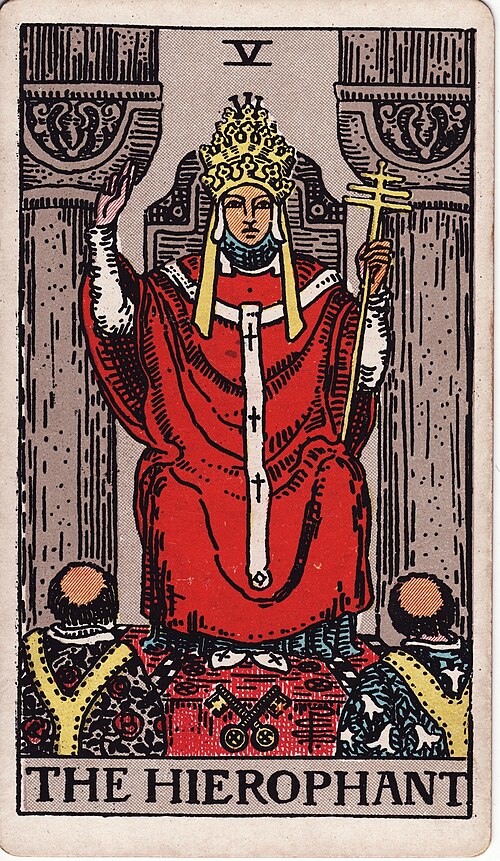
A central, seated religious teacher faces the viewer between two tall gray pillars. He wears a layered ceremonial costume with strong red and pale tones, a triple crown, and a raised right hand whose fingers form a blessing gesture. His other hand holds a staff or cross with multiple bars. Two smaller acolytes kneel below him, turned toward the central figure, and two crossed keys lie on the patterned floor between them. The pillars frame the teacher, the kneeling figures direct attention upward, and the keys create a visual bridge across the lower foreground. Unlike The Emperor's open mountain landscape, this scene is enclosed and instructional: its main action is transmission from a recognized center to attentive learners.
Keywords derived from the image
Useful keywords are teaching, tradition, initiation, shared values, ritual, interpretation, community, and discernment. Teaching follows the seated central figure and the two students; tradition follows the crown, staff, formal costume, and repeated ceremonial geometry; shared values and ritual follow the public gesture and arranged setting; interpretation follows the keys and the act of receiving a system. Community is present because the image includes teacher and learners rather than an isolated seeker. Discernment is essential because receiving a tradition does not remove the student's responsibility to test whether its guidance is relevant, ethical, and understood.
Upright Hierophant meaning
Upright, The Hierophant highlights learning within a structure: find a trustworthy teacher, name the tradition being used, follow a sound process, or make values explicit before acting. Its strengths include mentorship, continuity, shared language, ethical commitment, ceremony, and the patience to learn foundations before improvising. In a group, it may favor a clear agreement or a practice that helps people cooperate. The risk of excess is conformity: obeying a rule because it is old, confusing credentials with wisdom, or using doctrine to silence honest questions. A practical action is to identify the source, ask what its rules are for, and choose a learning or community setting where questions and consent are allowed. Upright indicates a framework, not a guaranteed blessing.
Reversed Hierophant meaning
Reversed does not automatically mean negative. As blockage, the card can show that a rigid doctrine, gatekeeper, or unclear tradition prevents useful learning. As internalization, it may indicate private doubt, an inner teacher, or values being worked through away from public approval. As excess, it can describe dogma, empty ritual, borrowed authority, spiritual bypassing, or pressure to belong. As delay, it may show waiting for permission, credentials, initiation, or consensus before taking a modest and responsible step. As direction adjustment, it asks whether the method should be adapted, whether a different teacher is needed, or whether a personal practice can coexist with a communal one. Reversed can therefore support thoughtful dissent as well as reveal harmful rebellion without a plan.
Applications by life area
In relationships and emotions, The Hierophant can point to shared values, commitment language, family or cultural expectations, counseling, or a relationship becoming more public and defined. It does not prove that another person is committed or reveal what they privately believe. Reversed, examine pressure to perform a role, mismatched expectations, or a taboo that blocks an honest conversation. Ask which agreements are freely chosen and which are merely inherited.
For work and study, the card favors a curriculum, apprenticeship, certification path, peer community, supervisor, or established method. It can be especially useful when the problem is not motivation but lack of a reliable sequence. Reversed, look for gatekeeping, stale instruction, credential anxiety, or copying a method without understanding its assumptions. Compare sources, keep notes, and ask for feedback that demonstrates competence rather than simple compliance.
For money and resources, read The Hierophant through institutions, contracts, shared financial norms, education, and recurring obligations. It is not a promise of wealth and should not replace professional financial advice. Upright, it favors reviewing terms and learning the system before committing; reversed, it warns against opaque fees, authority-based sales pressure, or buying belonging through a group. Keep records and seek independent review for high-stakes choices.
For personal growth, the question is how a teaching becomes lived practice. Choose one principle, explain it in your own words, and observe whether it improves your conduct. Reversed growth may involve separating genuine values from shame, fear, or borrowed certainty. The goal is neither automatic obedience nor automatic opposition, but an informed relationship with tradition.
The Hierophant in spreads and positions
In a one-card draw, use The Hierophant as the prompt: What teaching, value, or shared agreement would clarify my next step, and how will I check that the source is trustworthy? In a three-card situation, action, outcome spread, the situation position may show the norm or institution shaping the question; action may call for study, consultation, a stated agreement, or a repeatable practice; outcome may show integration into a group or method rather than a fixed event. In a past, present, future spread, it can mark an inherited teaching, a current search for guidance, or a future commitment to a chosen framework.
In relationship positions, The Hierophant for self asks how your values and expectations shape the bond; for the other person, it describes their visible role, stated norms, or relationship to tradition rather than their secret thoughts; for the interaction, it highlights commitment language, social approval, family rules, or a shared ritual. In a decision spread, opportunity may be access to a teacher, institution, or supportive community; risk may be conformity, gatekeeping, or an agreement whose terms are not understood; advice may be to study the method, ask direct questions, and define consent. As obstacle, the card can be a rigid doctrine or waiting for permission; as advice, it favors ethical structure and accountable learning; as outcome, it suggests a shared framework whose value depends on whether it remains alive and voluntary.
Instructional combination reading
Instructional example, not a real case: The Hierophant beside The Emperor combines shared tradition with enforceable structure. In a study question, the pair may favor a syllabus, mentor, and clear standard rather than collecting disconnected tips. If The Lovers sits beside The Hierophant, the emphasis can shift toward choosing values and entering an agreement consciously; the relationship between the cards matters more than a fixed keyword for either one. The combination does not predict a particular institution or relationship.
Common misreadings, deck differences, and responsible use
Do not reduce The Hierophant to marriage, religion, a priest, or automatic approval. In older decks the corresponding figure may be titled The Pope or presented through different visual conventions; RWS's title invites one layer of interpretation but does not erase the card's broader history. Some modern decks replace institutional imagery with community, teaching, or personal ethics, so compare the actual image before importing a meaning. Tarot is a cultural, symbolic-reading, and self-reflection practice, not scientifically validated predictive power. Do not use the card to read a third party's mind or to replace medical, legal, financial, educational, or safety advice. A tradition is not ethical merely because it is established; consent, evidence, and the right to question remain relevant.
Tarot-journal prompts
- 1. Which teaching or value is genuinely guiding this question? 2. What source, mentor, or community deserves verification before I follow it? 3. Where am I waiting for permission when a small responsible choice is available? 4. Which ritual or agreement helps me act with integrity, and which one needs revision?
Suggested learning links
Continue backward to The Emperor (tarot-card-the-emperor) and forward to The Lovers (tarot-card-the-lovers). For foundations, use Tarot for Beginners (tarot-for-beginners), Major Arcana Guide (major-arcana-guide), Upright and Reversed Tarot (tarot-upright-and-reversed), Three-Card Tarot Spreads (three-card-tarot-spreads), and Ethics and Boundaries (ethics-and-boundaries). These links provide general method and responsible-use context; this article applies them to The Hierophant without reproducing the foundational guides.