The Hermit at a glance: identity and sequence
The Hermit is Major Arcana IX in the Rider-Waite-Smith (RWS) tradition and position 10 in this 78-card series. It follows Strength, position 9, and precedes Wheel of Fortune, position 11. The card belongs to the Major Arcana group and concerns deliberate withdrawal, discernment, and the sharing of hard-won perspective. In RWS, Strength is VIII and Justice is XI. Many Marseille traditions place Justice at VIII and Strength at XI, and their imagery is not identical to the RWS designs. This article uses RWS numbering and primary image analysis while presenting tarot as a cultural, symbolic-reading, and self-reflection practice rather than a scientifically validated way to predict events.
What the RWS image visibly shows
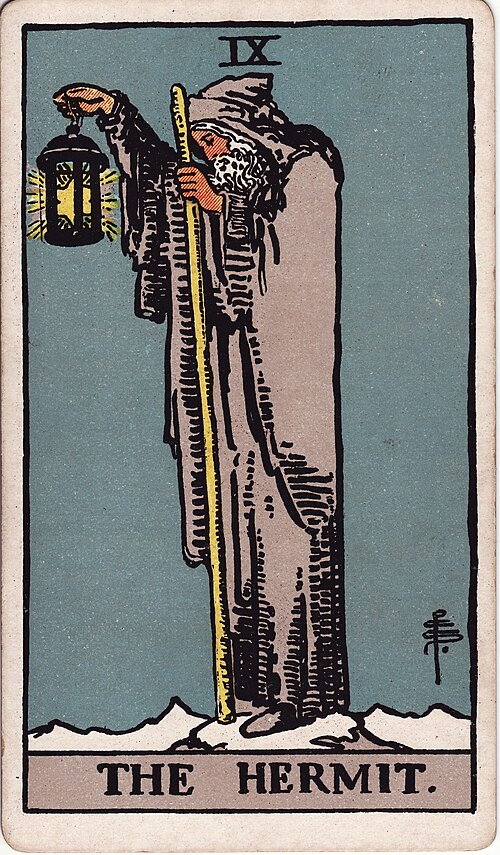
An older, bearded figure stands near the top of a mountain. He wears a gray or muted cloak with a hood and looks downward toward the ground in front of him. One hand holds a staff that reaches to the earth; the other raises a lantern. Inside the lantern is a six-pointed star, visibly contained within a small field of light. The background is sparse and mountainous, with cool gray and blue tones rather than a crowded city or a group of companions. The figure faces toward the open space below and slightly to one side, not toward a throne or an audience. The high ground, staff, lowered gaze, and concentrated light create a composition about careful seeing and orientation.
Keywords and how they arise
Core keywords are solitude, discernment, guidance, patience, study, perspective, and threshold. Solitude follows from the lone figure and the absence of a social scene, but the lantern keeps the image from meaning simple disappearance. Discernment and study arise from the downward, attentive gaze and the deliberate stance on difficult terrain. The staff suggests support, pacing, and contact with what is solid; the lantern suggests a small, portable source of illumination rather than total knowledge. Guidance follows from a light that can be carried and shared, while threshold comes from the figure standing between a high point and the path below. Traditional meanings may add spiritual or philosophical language, but this article keeps those additions distinct from what is visibly shown.
Upright Hermit: core dynamics and practical action
Upright The Hermit favors a purposeful pause, careful research, and a quieter method of finding direction. It can indicate time alone to separate a personal value from social pressure, or a mentor who offers a method rather than a command. Its strength is selective attention: instead of chasing every signal, you identify the question, gather enough evidence, and let an answer mature. The risk of excess is withdrawal that becomes avoidance, superiority, secrecy, or endless preparation. The Hermit does not promise that isolation will solve a problem. Its practical action is to create a bounded period for reflection, consult a reliable source, and return with a clear next step.
- Potential strengths: independent thought
- patient investigation
- sober self-knowledge
- useful mentorship
- and the ability to distinguish a durable principle from a passing reaction.
- Risks of excess: refusing all feedback, treating privacy as invisibility, delaying action until certainty is impossible, or assuming that being alone makes an opinion automatically wiser.
- Practical actions: define the question, set a time limit for research, record what is known and unknown, seek one qualified perspective, and test insight through a modest real-world step.
Reversed Hermit: blockage, internalization, excess, delay, and adjustment
Reversed The Hermit is not automatically negative. It may show the lantern turned inward, a needed retreat that has lasted too long, or guidance that is difficult to access. As blockage, distraction, loneliness, or fear of being seen can interrupt honest reflection. As internalization, the person may be processing a lesson privately; that can be healthy if it leads to integration, but unhelpful if it becomes rumination. As excess, secrecy, cynicism, intellectual superiority, or total self-reliance can cut off useful support. As delay, the search for the perfect answer may replace a timely experiment. Direction adjustment may involve reconnecting with community, asking a precise question, shortening the pause, or accepting that a provisional answer is enough for the next step.
- For blockage, identify whether the problem is lack of information, fear of judgment, or simple exhaustion. Choose the smallest action that creates better evidence.
- For internalization, distinguish restorative solitude from repetitive rumination by asking whether the pause changes your behavior or only repeats the same thought.
- For excess, check whether privacy has become secrecy, expertise has become contempt, or independence has become refusal of appropriate help.
- For delay, set a decision date or experiment. For direction adjustment, move the lantern toward a trustworthy conversation instead of demanding complete certainty alone.
Applications by life area
In relationships and emotions, The Hermit can support a healthy pause, emotional honesty, and respect for each person’s need for space. It may suggest that a relationship needs reflection before a difficult conversation, not that one partner has a right to disappear without explanation. It cannot reveal another person’s private thoughts; use observable communication and explicit consent. In work and study, the card favors concentrated learning, specialist advice, independent projects, editing, and research. Its warning is analysis paralysis or isolating yourself from collaborators. For money and resources, read it as audit, budgeting, due diligence, and choosing a conservative information-gathering process; it is not a promise of a profitable investment or a substitute for financial advice. In personal growth, the card supports a journal, contemplative practice, therapy, or a trusted teacher when these are appropriate. Serious distress, risk, or impairment calls for qualified professional help rather than a card interpretation.
The Hermit in spreads and positions
Position changes emphasis. A one-card prompt asks: What deserves my undivided attention, and what is the next piece of evidence I need? The answer may be a pause with a boundary, not a prediction of being alone. In a three-card past, present, future spread, The Hermit in the past can show a period of study or withdrawal that shaped the question; in the present, it emphasizes the current need for discernment; in the future, it suggests a possible phase of reflection or mentorship if the question supports it, never a fixed guarantee. In a situation, action, outcome spread, it names the context requiring careful review, recommends a bounded investigation, and frames the outcome as clearer orientation rather than automatic certainty.
- Relationship spread: Self emphasizes your use of space, reflection, and communication
- other person describes their visible role or the distance represented in the spread, not their hidden feelings
- interaction asks whether solitude is respected, explained, and eventually brought back into dialogue.
- Decision spread: Opportunity shows a chance to learn, consult, or clarify values
- risk warns of isolation, secrecy, or endless research
- advice recommends a quiet method with a deadline and a reality check.
- Obstacle, advice, outcome: As obstacle, The Hermit can be avoidance disguised as wisdom
- as advice, it asks for disciplined attention and a reliable guide
- as outcome, it suggests perspective or a more intentional pace, not guaranteed resolution.
Instructional combination example
Instructional example, not a real case: Strength followed by The Hermit can describe a sequence in which emotional regulation creates enough safety for honest self-examination. The Hermit followed by Wheel of Fortune can shift a private insight toward changing circumstances, asking the reader to distinguish a useful lesson from a claim of fate. The adjacent card modifies the emphasis: one card supplies context and the other supplies a possible mode of response.
Common misreadings, schools, and deck differences
A common misreading is treating The Hermit as a guaranteed breakup, permanent loneliness, or proof that a person is secretly wise. The image shows one figure with a light and staff, not a social verdict. Another error is using the card to justify avoiding needed medical, legal, financial, or relational conversations. Different decks may depict a younger guide, a woman, another landscape, or a different lantern and star; those changes can alter the visual starting point. Waite’s The Pictorial Key to the Tarot, published in 1911 and credited to Arthur Edward Waite with illustrations by Pamela Colman Smith, describes the RWS Hermit in its own historical and esoteric vocabulary. Later psychological and practical schools may emphasize introspection or mentorship instead. Marseille decks use different numbering conventions from RWS in the Strength and Justice pair and do not share every RWS scene.
Responsible use and journal prompts
Use The Hermit to frame a question that can be investigated: What do I know, what do I need to verify, and which conversation or action follows? Tarot can organize attention and self-reflection, but it cannot establish scientific causation, read a third party’s mind, or guarantee a future. Protect privacy, keep ordinary evidence in view, and seek qualified support for health, legal, financial, or safety decisions.
- What kind of solitude would restore my judgment, and when will I reconnect with others?
- Which source, teacher, or lived experience deserves careful checking before I decide?
- Where am I using research to improve a choice, and where am I using it to postpone one?
Suggested learning links
Continue through the site’s canonical single-card articles and foundational tarot guides. Suggested links are tarot-card-strength (previous card), tarot-card-wheel-of-fortune (next card), tarot-for-beginners, major-arcana-guide, tarot-upright-and-reversed, three-card-tarot-spreads, tarot-how-to-ask, and tarot-journal-review. The Wheel of Fortune article is the next planned card in this fixed series; until it is published, the link functions as a learning-path label rather than a claim that the entry already exists.