The Hanged Man at a Glance
The Hanged Man is Major Arcana XII and the thirteenth card in the 78-card Rider-Waite-Smith sequence, with The Fool numbered 0. Its central theme is a deliberate or necessary pause that changes how a situation is seen. It does not simply mean passivity, punishment, or an unavoidable sacrifice. The card asks what becomes visible when ordinary momentum is interrupted, and whether a pause is being chosen, imposed, or resisted.
This article uses the RWS order and image. The Marseille tradition places Strength and Justice differently and uses different pip-card imagery; in RWS, Strength is VIII and Justice is XI. Those differences matter when comparing a deck or a book. Waite's Pictorial Key to the Tarot, associated with the RWS tradition and illustrated by Pamela Colman Smith, is a historical reference for the interpretive frame, while the practical applications below are modern editorial synthesis. Tarot is treated here as cultural symbolism and a self-reflection practice, not as a scientifically validated form of prediction.
What the RWS Image Shows
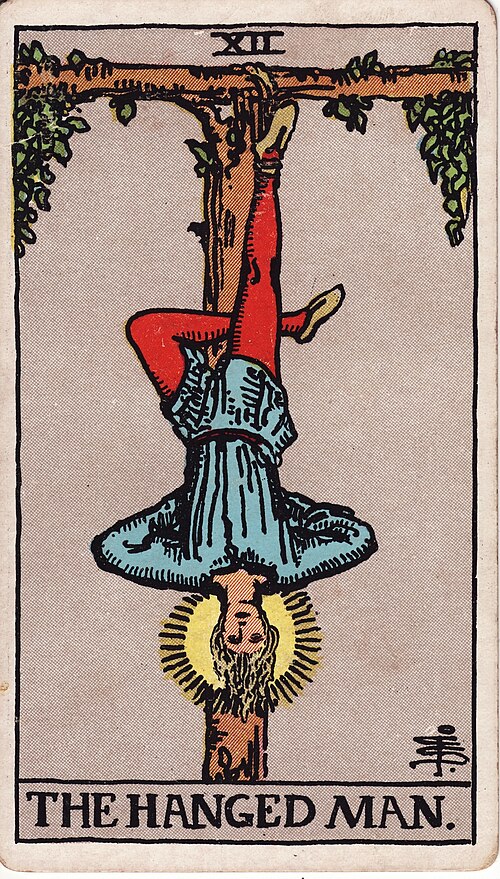
A single figure hangs head downward from one foot, which is bound to a horizontal wooden support between two upright forms. The free leg bends behind the bound leg, creating a clear angular shape rather than a limp fall. His arms are held behind his back, and his face appears composed rather than visibly panicked. A bright halo surrounds his head. The clothing is strongly colored, with a blue tunic and red trousers, while the wood and background are quieter brown, green, and gray tones. The figure's inverted direction makes the world look physically reversed: his head points down and his feet point up.
The image contains no crowd or visible attacker. The suspension itself is the action. The halo, orderly posture, and crossed legs can suggest attention, patience, and a changed frame of reference in traditional reading, but those are interpretations rather than literal facts about the picture. A useful first question is not, "Who is punishing him?" but, "What kind of knowledge becomes available from this unusual position?"
Keywords Derived from Image and Tradition
The concise keyword set is pause, surrender, perspective, suspension, release, and reframing. Pause follows from the figure's lack of forward movement. Surrender describes loosening control rather than proving defeat, because the posture is organized and the expression is calm. Perspective and reframing come directly from the inversion: the same world is being viewed from a different orientation. Suspension names the threshold between an old position and a new one. Release is a useful modern extension when the card asks what attachment must be set down. These keywords are prompts for inquiry, not fixed answers.
- Pause: interrupt automatic momentum. Surrender: stop forcing what cannot yet be forced. Perspective: inspect the situation from an unfamiliar angle. Suspension: tolerate an unfinished interval. Release: loosen an attachment, assumption, or timetable. Reframing: let a changed viewpoint alter the next action.
Upright Meaning: Pause with Purpose
Upright, The Hanged Man often describes a period in which pushing harder is less useful than observing differently. Its strength is the ability to tolerate uncertainty long enough to notice a hidden assumption. It can support patience, empathy, contemplation, creative incubation, and a willingness to trade a short-term preference for a clearer long-term choice. In a practical reading, ask what evidence is missing, whose viewpoint has not been considered, and which response would be wiser after one more round of reflection.
The risk of excess is stagnation disguised as wisdom. Waiting can become avoidance, martyrdom, indecision, or a habit of giving away agency. A healthy upright expression has a purpose and a review point: pause the purchase until the terms are clear, take a night before sending the message, or step back from a role that keeps reproducing the same conflict. It does not require endless suffering or self-erasure. A practical action is to name what is temporarily being paused, what information is needed, and the date on which the decision will be revisited.
Reversed Meaning: Blockage, Internalization, and Direction Adjustment
Reversed does not automatically mean bad news. It can show blockage when a person cannot move because an old interpretation, fear, or obligation is holding the situation in place. It can show internalization when the needed change is psychological rather than visible: a belief must be questioned before circumstances can shift. It can show excess when patience has become self-denial or when someone keeps performing sacrifice to avoid asking for a fair exchange. It can show delay when the pause is real but no review date, evidence, or decision rule has been established.
For direction adjustment, turn the card's question around. Instead of asking only what to surrender, ask what can be reclaimed: a boundary, a conversation, a smaller experiment, or permission to leave an unproductive waiting room. The reversed card may also indicate premature release, when someone abandons a valuable process because its result is not immediate. Distinguish external delay from internal resistance, then choose one modest, testable step. The aim is not to force motion but to restore intentional motion.
Applications by Life Area
In relationships and emotions, upright The Hanged Man can describe listening before reacting, allowing a bond to change form, or recognizing that empathy requires a view beyond one's own story. It does not reveal what another person secretly thinks. Reversed, it may point to emotional limbo, one-sided accommodation, indirect communication, or a need to stop waiting for someone else to decide. Ask for clarity and protect consent rather than treating silence as a promise.
In work and study, upright it favors research, mentorship, a deliberate revision, or a new method after a plateau. A student may need to change the question rather than repeat the same memorization routine. A team may need to suspend a launch to examine an assumption. Reversed, it can show procrastination, unclear ownership, or an endless review cycle. Define the next test, the evidence required, and the point at which a decision will be made.
In money and resources, the card favors a cooling-off period, a second estimate, and examining opportunity cost. It can support delaying a discretionary purchase while protecting essentials. Reversed, it warns against indefinite financial limbo, rescuing others without agreement, or calling an unexamined budget a spiritual lesson. It is not a guarantee of profit or loss; use ordinary financial checks and qualified advice for consequential decisions.
In personal growth, The Hanged Man invites a controlled experiment in viewpoint: journal from another person's perspective, pause a familiar habit for a week, or question an identity built around being needed. The work is not passive suffering. It is learning to tell the difference between chosen spaciousness and a pattern that quietly removes choice.
The Hanged Man in Spreads and Positions
For a one-card prompt, read it as: "What would I notice if I stopped forcing the usual answer?" The card may emphasize a pause, a new angle, or the cost of remaining suspended, depending on the question. In a three-card past, present, future spread, it can show a past sacrifice shaping the present, a current interval of reassessment, or a future need to slow down before acting. In a situation, action, outcome spread, it frames the situation as a perspective problem, recommends observation or release as the action, and makes the outcome conditional on whether the lesson is integrated rather than merely endured.
In relationship positions, The Hanged Man for self can describe the querent's willingness to listen or a tendency to over-accommodate. For the other person, it describes the role their behavior occupies in the question, not their private mind; it may indicate distance, a changed viewpoint, or an unresolved decision. For interaction, it highlights the pattern between people: waiting, suspending judgment, or repeating an unequal exchange. In decision positions, opportunity is the chance to see an overlooked option; risk is indefinite delay or self-sacrifice; advice is to pause with a clear purpose and review point.
As an obstacle, the card can indicate attachment to the old viewpoint, fear of acting without certainty, or a passive role that has become familiar. As advice, it asks for a deliberate reset, not an automatic yes or no. As outcome, it suggests a changed understanding or an open interval rather than a guaranteed event. Always let surrounding cards and the real question decide whether the emphasis is insight, delay, release, or recalibration.
Instructional Combination Reading
Instructional example, not a real case: The Hanged Man beside Death does not have to predict a literal loss. Read together, the suspended viewpoint can prepare a person to release an old arrangement; Death gives the pause a stronger transition theme. If The Hanged Man sits beside The Hermit, the pair may emphasize private study and deliberate solitude. The adjacent card modifies the kind of pause, so do not assign one universal combination meaning.
Common Misreadings, Deck Differences, and Boundaries
A common misreading treats the card as proof that suffering is noble, that a person must wait forever, or that an outside power has sentenced them to helplessness. Another mistakes an inverted body for a promise of literal reversal. Some schools read reversals as blocked, internalized, excessive, delayed, or redirected energy; others do not use reversals at all. Marseille and other historical decks may show different details and may organize meanings through different traditions. State the deck, orientation method, and question before comparing sources.
Use the card to support reflection, communication, and reversible experiments. Do not use it to read a third party's mind, make medical or legal decisions, promise a fate, or replace financial and professional advice. If a pause concerns safety, health, housing, or urgent rights, use qualified real-world support first.
Tarot Journal Prompts
- What am I calling patience that may actually be avoidance? What assumption changes when I describe this situation from another viewpoint? What exactly will I pause, what evidence do I need, and when will I review the choice? What boundary would let me surrender control without surrendering agency?
Suggested Learning Links
Continue backward with Justice (tarot-card-justice) to compare discernment and consequence, then forward with Death (tarot-card-death) to study transition and release. For method, see Tarot for Beginners (tarot-for-beginners), Tarot Upright and Reversed (tarot-upright-and-reversed), Three-Card Tarot Spreads (three-card-tarot-spreads), Tarot Journal Review (tarot-journal-review), and Responsible Mysticism: Freedom, Privacy, and Necessary Boundaries (ethics-and-boundaries). For historical orientation, consult Waite's The Pictorial Key to the Tarot at sacred-texts.com/tarot/pkt/index.htm.