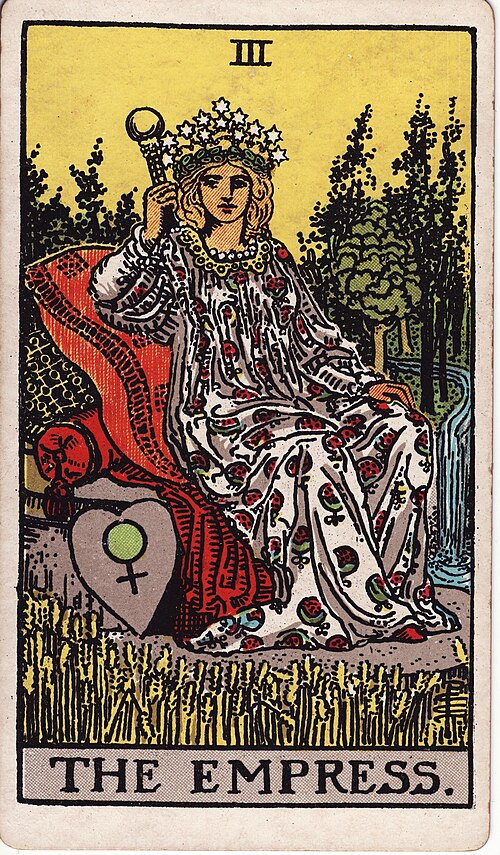
The Empress is Major Arcana III in the Rider-Waite-Smith (RWS) tradition and position 4 in the 78-card sequence, following The High Priestess. Her card turns attention toward growth that can be sensed, supported, and made tangible: bodies, land, creativity, care, pleasure, and material conditions. In a reading, she may ask what is being nourished and what environment will let it develop. Tarot here is a cultural and symbolic tool for reflection, not scientifically validated proof of prediction or a guarantee that abundance will arrive.
Place in the RWS sequence and tradition
The RWS deck was first published by William Rider & Son in 1909 from A. E. Waite’s instructions and Pamela Colman Smith’s illustrations. Waite’s Pictorial Key to the Tarot describes The Empress through visible symbols and theological language; later readers have expanded the card into creative, relational, ecological, and practical interpretations. RWS and Marseille traditions differ in some imagery and in the numbering of Strength and Justice: RWS places Strength at VIII and Justice at XI, while Marseille commonly places Justice at VIII and Strength at XI. This series uses RWS order and gives the RWS image primary weight.
What the RWS image shows
A crowned woman sits in a lush outdoor setting. Twelve stars form her crown or diadem. She wears a patterned white garment, and a necklace with a Venus symbol is visible at her chest. A heart-shaped shield bearing the Venus symbol rests near her. She holds a short scepter topped by a round globe. In the foreground, a field of wheat rises in warm gold tones. Behind her, a stream or waterfall moves through green landscape toward a wooded area. The card’s palette combines soft greens, golds, pale fabric, and earth colors, producing a scene of fertility and shelter rather than conflict.
The image can be read without assuming that every woman, parent, or caregiver is “the Empress.” The visible facts are a seated figure, cultivated land, flowing water, a Venus emblem, stars, a globe, and an abundant landscape. Waite’s historical interpretation connects these features with earthly fecundity and the visible world. Modern readers may also use them to ask about resources, creative output, pleasure, embodiment, and the conditions that make a project sustainable.
Keywords derived from the image
- Nourishment follows from wheat, water, and the protected garden. Creativity follows from the card’s generative landscape and Venus association, but it can mean making, designing, teaching, or cultivating rather than only artistic inspiration. Sensuality follows from attention to the body and the material world. Growth follows from seeds, seasons, and flowing water. Support and abundance describe available conditions, not a promise of unlimited supply. Boundaries remain necessary because a garden needs tending, not just admiration.
Upright meaning: cultivate what can grow
Upright, The Empress describes development through care, consistency, receptivity, and a supportive environment. Core dynamics include creation, fertility in the broad sense, comfort, embodiment, collaboration, and the conversion of an idea into something people can experience. Its strengths include generosity, patience, aesthetic intelligence, practical care, and the ability to notice what a person or project needs. The card can favor making a prototype, feeding a relationship, improving a workspace, resting adequately, or giving a creative process time.
The risk of excess is overgiving, smothering, indulgence, possessiveness, comparison, or confusing visible abundance with genuine health. An upright Empress is not an automatic yes, a pregnancy prediction, or a promise of financial gain. Practical action means identify the living system involved, provide one realistic resource, and set a sustainable rhythm. Ask whether your care is welcomed and whether it leaves room for another person’s agency. Growth is strengthened by limits, maintenance, and honest feedback.
Reversed meaning: blocked, internalized, excessive, or delayed growth
Reversed, The Empress may point to blocked creativity, neglected needs, internalized self-worth, excess comfort, delay in development, or a change in direction. Blockage can appear as a barren routine, depleted energy, a project without support, or a relationship where care does not circulate. Internalization can mean hiding a creative impulse, relying on private reassurance, or treating worth as something that must be earned through usefulness. Excess may show as overconsumption, dependency, rescuing, or blurred boundaries.
Delay is not necessarily failure: a seed may need a different season, method, or container. Direction adjustment asks whether to improve the conditions, reduce the scope, seek help, or stop feeding an arrangement that is draining everyone. Reversed does not automatically mean bad, and upright does not guarantee a positive result. Separate observable resource problems from shame-based stories. A small maintenance task, a candid request, or a revised timeline can restore agency better than forcing a dramatic beginning.
Applications by life area
In relationships and emotions, upright The Empress highlights warmth, affection, shared pleasure, emotional availability, and care that is expressed in concrete ways. It can support a conversation about comfort and reciprocity, but it cannot prove that another person loves or wants something. Reversed, notice overfunctioning, jealousy, neglect, emotional hunger, or the use of caretaking to control closeness. Ask what support is requested, what is freely offered, and what belongs to each person.
In work and study, the card favors creative production, teaching, collaboration, design, and a workspace that supports concentration. It may recommend nurturing an idea through drafts and feedback instead of demanding immediate perfection. Reversed, check for procrastination disguised as preparation, too many commitments, poor working conditions, or a team member carrying invisible labor. Make the next deliverable concrete and protect time for recovery as well as output.
For money and resources, The Empress draws attention to food, housing, tools, supplies, comfort, and the long-term cost of maintenance. Upright, it can suggest investing in the conditions that let work or health-related routines function, but it is not a forecast of profit. Reversed, review impulse spending, unequal contributions, resource depletion, and financial decisions made to appear generous. Use a budget, records, and qualified advice for consequential choices.
For personal growth, the card invites a kinder relationship with the body, creativity, pleasure, nature, and receiving support. Growth can be measured by habits and conditions, not only by dramatic insight. Reversed, ask whether self-care has become avoidance or whether harsh self-denial is being praised as discipline. Choose a practice that is specific, affordable, repeatable, and respectful of physical and emotional limits.
The Empress in spreads and positions
One-card prompt: “What needs nourishment, and what form of care is actually sustainable?” Upright emphasizes available growth and supportive conditions; reversed emphasizes depletion, overcare, blocked creation, or a needed change in the environment. Neither orientation is a fixed yes or no.
In a three-card past, present, future spread, The Empress in the past can show a formative source of care, a creative seed, or a resource pattern that still shapes the question. In the present, she asks what can be cultivated with the resources on hand. In the future, she suggests a period of development if care and boundaries are maintained, not a guaranteed outcome. In a situation, action, outcome spread, the situation is assessed through needs and capacity, the action supplies one practical support, and the outcome reflects how well the system is tended.
In relationship positions for self, other person, and interaction, The Empress for self asks whether you are available to give and receive without losing your identity. For the other person, it describes the role or quality you can observe, not a diagnosis of their feelings. For the interaction, it highlights mutual warmth, physical or domestic context, shared creativity, and reciprocity. If care is one-sided, the same image becomes a prompt to set limits rather than keep proving devotion.
In decision positions, the opportunity is to build something durable, improve conditions, or accept appropriate support. The risk is overextension, comfort that delays action, dependency, or confusing a beautiful option with a viable one. Advice is to assess capacity, maintenance, consent, and the resources required over time. In obstacle, advice, and outcome positions, the obstacle may be depletion or excess; advice is to nourish the essential and remove waste; the outcome shows what the chosen conditions can realistically sustain.
Instructional combination reading
Instructional example, not a real case: In a three-card sequence of The High Priestess, The Empress, and The Emperor, private discernment becomes embodied growth and then meets structure. The Empress softens the High Priestess’s inwardness by asking what insight can be cultivated in daily life; The Emperor modifies her abundance by adding limits, plans, and accountability. If The Empress is reversed, the combination may instead show an idea stalled between silence and overcontrol, calling for a smaller, better-supported experiment.
Common misreadings, deck differences, and responsible use
A common misreading is reducing The Empress to pregnancy, motherhood, a particular gender, or effortless wealth. Fertility here can be creative, ecological, relational, or material, and the card never establishes a medical fact. Some decks change her clothing, landscape, crown, shield, or religious references; Marseille designs and later occult systems also organize imagery differently. Name the deck, honor the question, and let the visible image lead before applying inherited keywords.
Use the card for cultural learning, symbolic reading, and self-reflection. Do not use it to make medical, legal, or investment-return decisions, to predict conception or health, or to declare what a third party secretly feels. Care is not a license to control someone, and abundance is not a moral measure. For high-stakes matters, use evidence, consent, professional advice, and a practical contingency plan.
Journal prompts and next links
- What am I trying to grow, and what observable conditions would support it? Where am I overgiving or withholding necessary care? Which resource needs maintenance before I expand? How can I receive help without surrendering my agency?
For sequence study, compare The Empress with the previous card, The High Priestess, at tarot-card-the-high-priestess, and the next card, The Emperor, at tarot-card-the-emperor. Build method from the site’s tarot-for-beginners, tarot-upright-and-reversed, three-card-tarot-spreads, tarot-journal-review, and ethics-and-boundaries articles. These provide foundations for reading imagery and positions; this article applies that method to The Empress.