Identity, sequence, and method
The Emperor is Major Arcana IV, the fifth card in the 78-card Rider-Waite-Smith sequence. He follows The Empress and precedes The Hierophant, placing structure after generative abundance and before formal teaching or inherited tradition. The RWS sequence is the editorial standard here. Marseille decks commonly place Justice at VIII and Strength at XI, while RWS places Strength at VIII and Justice at XI; the two traditions also differ in titles, arrangements, and some imagery. The number and image are therefore a school choice, not a universal numbering law.
This guide separates what can be seen in the card from traditional interpretation and practical reflection. The RWS deck was published by William Rider & Son in 1909, with A. E. Waite credited for the conception and Pamela Colman Smith for the illustrations. Waite's The Pictorial Key to the Tarot is a useful period reference, but no single later keyword should be treated as the only meaning of the image.
What the RWS image shows
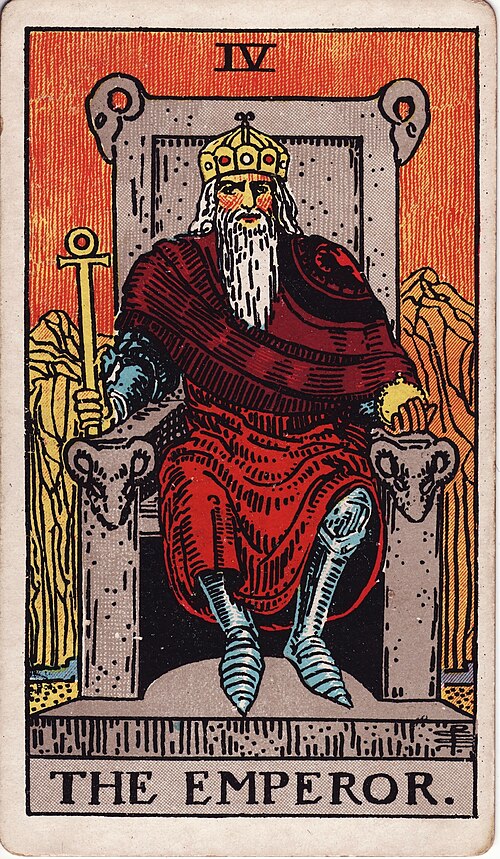
A bearded ruler sits facing the viewer on a stone throne. Ram heads appear on the throne, and his red robe falls over visible armor at the neck and legs. He holds an ankh in one hand and a globe or orb in the other. Behind him are hard, gray-brown mountains, a narrow river, and a warm orange or yellow sky. His hands extend the symbols to either side while his seated body keeps the composition centered; the card shows contained authority rather than movement toward a visible destination. The throne, armor, rock, and mountain background create a firm, angular setting. There is no crowd, battlefield, or office scene, so claims about a particular ruler or event go beyond what the picture itself proves.
Keywords derived from the image
Useful keywords are structure, authority, boundaries, stewardship, order, protection, and accountability. Structure follows the stone throne and mountain setting; authority follows the central seated ruler and his elevated position; boundaries follow the enclosed posture and armor; stewardship follows the orb held as something to govern rather than merely possess. Protection is suggested by armor, while accountability is the necessary companion to power: the image presents control as a responsibility. In excess, the same symbols can describe rigidity, domination, fear of change, or rules maintained after they stop serving their purpose.
Upright Emperor meaning
Upright, The Emperor points to a need for clear form. The core dynamic is turning intention into a workable system: define the scope, name the decision-maker, set a standard, and make the next obligation visible. Its strengths include steadiness, long-term planning, reliable boundaries, disciplined leadership, and the ability to protect limited time or resources. The risk of excess is confusing control with care. A person may use rules to avoid listening, demand obedience instead of consent, or treat vulnerability as incompetence. A practical response is to write the brief, budget, schedule, policy, or boundary that the situation actually needs, then state how it can be reviewed. Upright is not a guarantee of success; it emphasizes conditions that can be managed and tested.
Reversed Emperor meaning
Reversed does not automatically mean failure or evil. It can show blockage when a plan has no authority, scope, or consistent rule; internalization when the person is policing themselves harshly instead of asking for support; excess when command becomes domination, micromanagement, defensiveness, or inflexibility; delay when approval is trapped in a hierarchy or a perfect plan never becomes an action; and direction adjustment when a rigid structure must be redesigned. Ask which part of the Emperor is inverted in this context. The remedy may be a smaller commitment, a shared decision, a clear escalation path, or permission to change the rule. Reversed may also indicate that quiet self-governance is developing before public leadership becomes appropriate.
Applications by life area
In relationships and emotions, the card can emphasize reliability, explicit agreements, and a wish to make a bond safe enough for honest feeling. Its shadow is possessiveness, emotional distance, or one person acting as the unquestioned authority. Rather than asking what another person secretly feels, ask what has been said, agreed, avoided, or enforced. An action might be a calm boundary conversation with a specific request and a way to revisit it.
For work and study, The Emperor favors a syllabus, project charter, milestones, quality criteria, and a realistic chain of responsibility. It can describe a mentor or manager, but it need not identify a literal older man. Reversed, check for excessive gatekeeping, unclear ownership, overplanning, or a learning method that leaves no room for questions. One useful action is to convert a large goal into a dated deliverable and a feedback checkpoint.
For money and resources, focus on accounting, reserves, contracts, maintenance, and the limits of a budget. The card does not promise profit or authorize investment advice. Upright, it supports knowing what is owned, owed, scheduled, or protected; reversed, it can flag avoidance of records, inflexible spending rules, or control by someone who has not earned that role. Use ordinary financial due diligence and qualified advice for consequential decisions.
For personal growth, the lesson is mature self-command without self-punishment. Practice keeping one promise, defining one boundary, or building one repeatable routine. Reversed growth may require replacing an inherited rule with a consciously chosen value. The aim is not to become invulnerable; it is to make power answerable to purpose, consent, and reality.
The Emperor in spreads and positions
In a one-card draw, read The Emperor as a prompt to ask: What needs a clear container, and what responsibility is mine to accept or negotiate? In a three-card situation, action, outcome spread, the card in the situation position may show the existing structure or power arrangement; in action, it favors a boundary, plan, or accountable conversation; in outcome, it suggests a more defined condition, not a guaranteed event. In a past, present, future spread, it may mark an earlier rule, a current demand for order, or a future need to lead carefully.
In relationship positions, The Emperor for self asks how you are using boundaries and responsibility; for the other person, it describes the role or behavior visible in the interaction, not their private mind; for the interaction, it highlights the agreements, hierarchy, or tension around control. In a decision spread, it changes emphasis by position: opportunity may be the chance to build durable structure, risk may be overcontrol or inflexibility, and advice may be to define authority, limits, evidence, and review dates. As obstacle, it can show a locked rule or fear of losing control; as advice, it asks for disciplined stewardship; as outcome, it describes a stabilized arrangement whose quality depends on how fairly it is built.
Instructional combination reading
Instructional example, not a real case: The Emperor beside The Hierophant links personal structure with shared teaching, policy, or tradition. In an opportunity position, the pair may suggest formalizing a practice through a clear method and a trusted standard. If The Empress replaces The Hierophant beside The Emperor, boundaries meet care: the reading may shift toward protecting growth rather than merely enforcing order. The adjacent card modifies the Emperor's emphasis; it does not turn the pair into a fixed prediction.
Common misreadings, deck differences, and responsible use
Do not reduce The Emperor to a powerful man, a father, a boss, or automatic success. Courtly and gendered imagery can be read as a role or function rather than a fixed identity, and different decks may change clothing, emblems, landscape, or the balance between sovereignty and fatherhood. Marseille and RWS readers may use different numbering and visual conventions, so name the deck before comparing meanings. Tarot is a cultural and symbolic reading practice, not scientifically validated predictive power. Do not use this card to read a third party's mind or to replace medical, legal, financial, or safety advice. Treat every interpretation as a prompt for observable choices, consent, and reflection.
Tarot-journal prompts
- 1. Which rule, boundary, or responsibility would make this situation more workable? 2. Where am I practicing stewardship, and where am I trying to control what is not mine? 3. What evidence would show that this structure is helping rather than constraining? 4. Which inherited authority do I want to keep, revise, or release?
Suggested learning links
Continue backward to The Empress (tarot-card-the-empress) and forward to The Hierophant (tarot-card-the-hierophant). For foundations, use Tarot for Beginners (tarot-for-beginners), Major Arcana Guide (major-arcana-guide), Upright and Reversed Tarot (tarot-upright-and-reversed), Three-Card Tarot Spreads (three-card-tarot-spreads), and Ethics and Boundaries (ethics-and-boundaries). These links provide method and context; this article applies them specifically to The Emperor without replacing the foundational lessons.