Card identity and sequence
The Devil is Major Arcana XV in the Rider-Waite-Smith (RWS) system and the sixteenth card in the 78-card sequence, with The Fool numbered 0. As a Major Arcana card, it can describe a high-level pattern involving attachment, power, appetite, shame, fear, or material pressure. It is not a sentence of doom and does not prove that a person, relationship, or institution is evil. Its practical question is: what has gained leverage, and what choices remain available?
This series follows RWS numbering and primary image analysis. RWS and Marseille traditions differ in the numbering of Strength and Justice: RWS places Strength at VIII and Justice at XI, while many Marseille decks place Justice at VIII and Strength at XI. The traditions also differ in line, color, composition, and some imagery, so a meaning learned from one deck should not be presented as a universal property of every Devil card.
What the RWS image shows
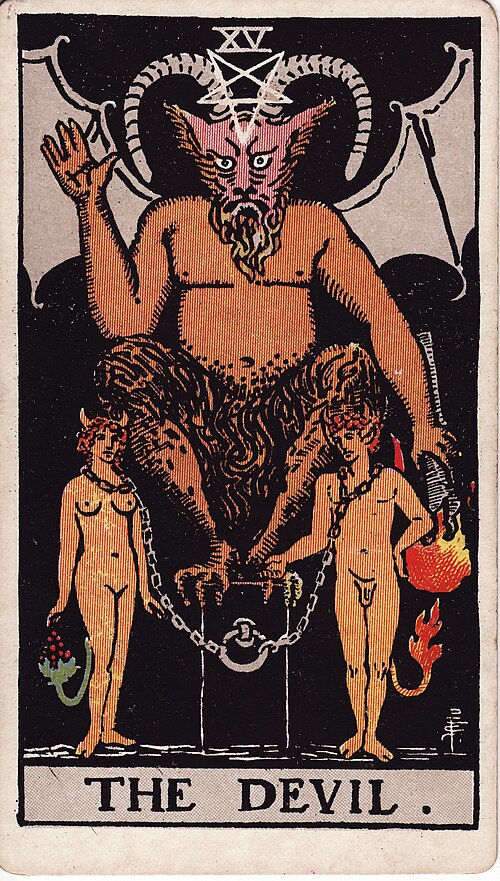
A large horned, winged figure sits or crouches on a dark pedestal. The figure faces forward and raises one hand while holding a lighted torch in the other, which points downward beside the pedestal. A reversed-looking sign is visible on the raised palm. At the base stand two nude human figures, one on each side, each attached to the pedestal by a loose chain around the neck. The pair have tails, horns, and small changes from ordinary human form. One tail ends in flame and the other in fruit. The background is dark, and the ground is heavy and enclosed compared with the open landscapes of many neighboring Major Arcana cards.
The image visibly stages hierarchy, attraction, and constrained choice. The chains are not shown as impossibly tight, yet the figures remain in the arrangement; that detail supports a question about perceived necessity, habit, consent, and the social or emotional cost of leaving. The torch can illuminate or intensify desire, while the pedestal gives the central figure a position of influence. Traditional readers may connect the card with materialism, bondage, taboo, or shadow themes, but those are interpretive lenses rather than literal diagnoses of a person.
Keywords grounded in the image
- Attachment
- compulsion
- appetite
- power
- shame
- dependency
- material pressure
- shadow awareness
- agency.
Attachment follows from the chained pair and the repeated posture of remaining close to the pedestal. Compulsion describes behavior that feels stronger than a stated intention. Appetite comes from the bodily, sexual, and sensory cues without reducing the card to sex. Power and dependency arise from the unequal scale between the central figure and the pair. Shame can appear when a person hides a need or confuses desire with moral failure. Shadow awareness means examining a disowned motive, not labeling oneself or someone else as bad. Agency remains in the loose-chain image and keeps the reading practical.
Upright The Devil meaning
Upright, The Devil brings attention to a force that is persuasive, rewarding, and costly. It may show a habit, contract, status system, relationship dynamic, fear, or coping strategy that has become central. Its strength is uncomfortable honesty: name the payoff, the price, and the conditions that keep the pattern active. The card can also describe ambition, erotic vitality, material focus, or a willingness to confront taboo subjects when those energies are chosen consciously and bounded responsibly.
The risk of excess is surrendering choice while insisting that surrender is inevitable. A person may rationalize a harmful arrangement because it supplies security, pleasure, belonging, or relief. Another risk is moral panic: calling ordinary desire “dark” can prevent a precise conversation about consent, boundaries, and consequences. Practical action begins with a written inventory: What do I receive? What do I give up? Who benefits? What evidence would show that the arrangement is changing?
- Upright actions: name the attachment without euphemism
- check consent and power
- separate need from compulsion
- read the terms of an agreement
- set one boundary and observe the response.
Reversed The Devil meaning
Reversed The Devil does not automatically mean liberation, and it is not automatically negative. It can describe a loosening chain, an internal confrontation with shame, a hidden dependency becoming visible, or a delayed decision to change. It can also show the theme turned inward: the struggle is private, intellectualized, or expressed through self-criticism rather than an obvious external situation.
- Blockage: the pattern is recognized but the payoff still feels indispensable. Internalization: shame, secrecy, or fear keeps the conflict inside. Excess: rebellion becomes compulsive, or “freedom” becomes another identity that avoids responsibility. Delay: withdrawal, repair, or renegotiation is postponed while the cost grows. Direction adjustment: replace an all-or-nothing escape with a safer boundary, support, or staged exit.
In a spread, reversed may ask whether the questioner is projecting bondage onto a situation that needs a clearer fact check. It may also show that a chain has been removed but the learned posture remains. Upright cards can still describe harmful excess or a difficult truth; reversed cards can still mark a constructive release. Let the position, neighboring cards, and real-world evidence decide which layer is most useful.
Applications by life area
Relationships and emotions: The Devil can highlight chemistry, attachment, jealousy, secrecy, unequal power, or a bond maintained by fear of being alone. It may also invite an honest conversation about desire and agreements without shaming either person. Do not use it to declare what a partner secretly thinks or to label someone abusive without evidence. Reversed, examine whether a boundary is taking hold, whether guilt is loosening, or whether a private fear still governs the interaction.
Work and study: The card can describe overwork, status hunger, a manipulative incentive, a workplace dependency, procrastination that supplies short-term relief, or intense focus that produces results at a high cost. Its constructive side is recognizing the real motivator and negotiating terms instead of pretending the system is neutral. Reversed, a learner may be breaking a habit or discovering that avoidance is internal. Define a measurable limit and a support structure.
Money and resources: The Devil often makes material stakes visible: debt, leverage, scarcity fear, consumer compulsion, unequal contracts, or a reward that carries hidden obligations. It can also point to practical ambition when the costs are understood and consented to. Never treat it as proof of financial loss or profit. Read the actual numbers, fees, deadlines, and alternatives; seek qualified financial advice for consequential decisions.
Personal growth: The card asks for a compassionate audit of the self-story around desire. Which need has been denied, dramatized, or outsourced? Which behavior is called “just who I am” even though it can be changed? Growth is not purity. It is the ability to hold appetite, responsibility, and choice in the same frame, then take a step that reduces avoidable harm.
The Devil in tarot spreads
One-card prompt: “What has leverage over my choice in this situation?” Upright, identify the reward and the price without moral theater. Reversed, ask whether the chain is loosening, hidden, or being replaced by a new form of avoidance.
Three-card situation, action, outcome: In the situation position, The Devil names the attachment, incentive, fear, or power structure that needs inspection. In the action position, it recommends a fact check, boundary, renegotiation, or honest naming of the payoff. In the outcome position, it describes the likely pattern if the leverage remains or if the proposed action changes the terms; it does not guarantee catastrophe or release.
Relationship positions: For self, the card shows your attachment, projection, appetite, or fear of loss. For the other person, it is a symbol of the role or behavior you are observing, not a license to read their mind. For the interaction, it highlights chemistry, coercive pressure, mutual reinforcement, taboo, or a negotiation about freedom and responsibility. Ask what is observable and what needs direct conversation.
Decision positions: As opportunity, The Devil can show access to resources, intense motivation, or a deal whose real terms must be understood. As risk, it points to dependency, hidden cost, compromised consent, or short-term reward. As advice, it says to name the leverage, read the fine print, and keep an exit or boundary where possible. The card is especially useful when a choice feels both attractive and expensive.
Obstacle, advice, and outcome positions change the emphasis. As obstacle, it may show denial, shame, a habit, or an incentive that keeps the current pattern in place. As advice, it asks for radical specificity rather than dramatic judgment. As outcome, it shows what the existing attachment is likely to reinforce if no terms change; neighboring cards can indicate whether the next step is negotiation, patience, rupture, or repair.
Instructional combination example
This is instructional, not a real case. Imagine Temperance beside The Devil beside The Tower. Temperance suggests the attachment should first be measured and understood rather than attacked blindly. The Devil names the reward and cost that keep it persuasive. The Tower then raises the possibility that an unstable arrangement may be exposed by a sudden fact or consequence. The combination does not predict an event; it teaches a sequence of proportion, truth-telling, and structural review.
Misreadings, deck differences, and responsible use
The most common misreading is treating The Devil as a literal evil person, guaranteed betrayal, or automatic death, illness, addiction, or disaster card. Another is assuming that every chain represents a relationship that must end immediately. The RWS image allows questions about agency and looseness, but it does not supply a legal or clinical diagnosis. Marseille versions and modern decks may change the figure's posture, symbols, colors, nudity, or surrounding details, and some readers do not use reversals. State the deck and method before interpreting.
Tarot is a cultural, symbolic-reading, and self-reflection tool, not a scientifically validated predictive system. Do not use this card to read a third party's mind, force a relationship decision, or give medical, legal, investment-return, employment, or guaranteed-fate advice. For safety, abuse, addiction, debt, or mental-health concerns, use qualified professional and emergency resources as appropriate. A reading can help formulate a question; it cannot replace consent, evidence, or expert support.
Journal prompts
- What reward and cost are attached to the pattern I am studying?
- Which part is observable fact, and which part is fear or projection?
- What boundary would test whether the arrangement respects my agency?
- After naming the desire without shame, what responsible action becomes possible?
Suggested learning links
Continue backward to Temperance at /tarot-card-temperance and forward to The Tower at /tarot-card-the-tower. For method, use Tarot for Beginners at /tarot-for-beginners, the Upright and Reversed guide at /tarot-upright-and-reversed, How to Ask Tarot Questions at /tarot-how-to-ask, Tarot Journal Review at /tarot-journal-review, and Ethics and Boundaries at /ethics-and-boundaries. These foundational articles support careful interpretation without replacing the card-specific analysis above.