Card identity and sequence
The Chariot is Major Arcana VII in the Rider-Waite-Smith (RWS) tarot and position 8 of 78 when The Fool is counted as the first card. It follows The Lovers, so the sequence moves from conscious choice and alignment toward direction, effort, and public movement. The Chariot is not simply a victory stamp. It asks how a person coordinates competing drives, chooses a route, and remains responsible while moving through pressure. RWS supplies the series order and the primary image reference; other tarot schools may use different emphases.
What the RWS image shows
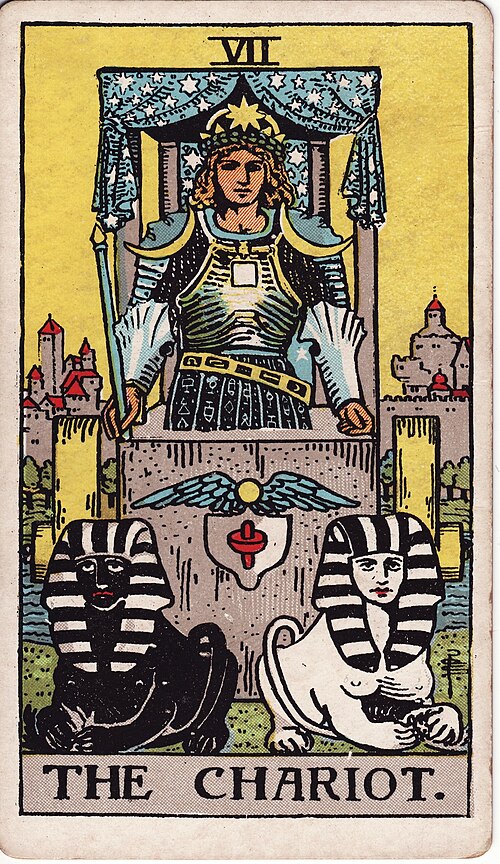
The RWS card shows a front-facing, armored figure standing in a stone chariot before a city. A canopy above the figure is patterned with stars, and the shoulders carry crescent-like emblems often discussed in traditional commentary. The driver holds a short wand and wears a structured breastplate. Two sphinxes, one black and one pale, sit in front of the chariot and face outward in the same general direction, yet they suggest contrasting pulls. The chariot has no obvious reins in the image. Blue armor and drapery, gray stone, dark and light animals, and the open sky create a visual contrast between protection, public visibility, and difficult coordination. The driver looks toward the viewer rather than toward either sphinx, emphasizing composure and self-command.
Waite described The Chariot in The Pictorial Key to the Tarot, published in 1911, a book illustrated by Pamela Colman Smith for the deck tradition now called RWS. His discussion connects the card with conquest, reason, and sphinx symbolism, but historical commentary should not be confused with what every modern deck intends. Here, the image observation is primary: a driver, vehicle, city, canopy, wand, armor, contrasting sphinxes, and forward-facing stance. Interpretive claims about triumph or initiation belong to tradition and editorial synthesis rather than scientific fact.
Keywords that follow from the structure
The main keywords are direction, agency, discipline, momentum, integration, public progress, and controlled tension. Direction follows from the vehicle and the driver's forward stance. Agency comes from the driver occupying the central position, even though the image does not show simple mechanical control. Discipline follows from armor, posture, and the need to coordinate black and pale sphinxes. Momentum is possible but not automatic: a chariot moves only when its forces are brought into a workable relationship. Public progress comes from the city and visible vehicle. Controlled tension names the central problem: opposing drives may coexist without one being erased. These keywords should be tested against the question and position.
Upright meaning: move with coordinated will
Upright, The Chariot can indicate a clear aim, sustained effort, a boundary held under pressure, or progress achieved by coordinating conflicting needs. Its strength is focused agency: the reader can name the destination, select a route, and keep returning to the next practical step. It may support training, travel, a public launch, negotiation, or a period when self-command matters more than comfort. The risk of excess is force without listening. Rushing, defensiveness, competitiveness, micromanagement, or the belief that control alone guarantees success can turn momentum into damage. A useful action is to define one measurable destination, identify the two strongest competing pulls, and create a routine that keeps both reality and values in view.
Reversed meaning: when movement is blocked or misdirected
Reversed, The Chariot does not automatically predict defeat. Blockage may appear as stalled transport, divided priorities, depleted will, or a conflict that prevents coordinated action. Internalization may show as an intense private struggle, rehearsing control without taking a visible step, or trying to master fear before asking for support. Excess can become aggression, rigid self-reliance, domination, or constant motion used to avoid reflection. Delay may be a practical signal that the route, resources, timing, or consent of others has not been checked. Direction adjustment means changing the destination, pace, boundary, or method rather than merely pressing harder. A reversal can therefore be constructive: it may invite rest, repair, delegation, and a more honest definition of progress.
Applications in ordinary life
In relationships and emotions, upright The Chariot can describe a couple or individual setting a shared direction and protecting a boundary; reversed, it can highlight power struggles, emotional suppression, or two people pulling toward incompatible goals. In work and study, upright favors a schedule, exam preparation, a launch, or disciplined advocacy; reversed asks whether overwork, scattered priorities, or a rushed plan is undermining performance. For money and resources, read it as budgeting, transport, project control, or the need to coordinate competing obligations, not as a promise of financial gain. In personal growth, it teaches the difference between agency and coercion: move deliberately, accept feedback, and let a changed plan be a sign of learning rather than personal failure.
The Chariot in spreads and positions
For a one-card prompt, ask, “What direction can I support with one disciplined action today?” The card emphasizes a next step and the quality of control, not a guaranteed arrival. In a past-present-future spread, it may show a past period of struggle that built technique, a present demand for coordination, or a future opportunity to move after conditions are aligned. In a situation-action-outcome spread, it can name the competing forces, recommend a route and repeatable practice, then describe an outcome shaped by follow-through and changing conditions. In relationship positions, Self describes your direction, boundaries, and control habits; Other Person describes the role assigned by the spread, not that person's private mind; Interaction describes how pursuit, resistance, or cooperation is being produced between you. In a decision spread, Opportunity highlights a route that rewards focus, Risk warns of force, haste, or tunnel vision, and Advice asks for a destination, constraints, and a backup plan. In obstacle, advice, and outcome positions, the card identifies what is blocking coordination, what practice restores steering, and what kind of movement may follow. Reversed in any position, it shifts attention toward blockage, inward pressure, excess, delay, or a necessary direction change.
Instructional combination example
Instructional example, not a real case: The Lovers, The Chariot, and Strength appear together as neighboring Major Arcana cards. The Lovers frames a choice through values and consent; The Chariot turns that choice into direction and coordinated effort; Strength modifies the drive by asking for patience, emotional regulation, and humane handling of resistance. The combination does not guarantee victory. It shows a learning sequence from alignment, through movement, toward steadier courage.
Common misreadings, traditions, and responsible use
A common misreading treats The Chariot as a promise that winning is inevitable or that force is always admirable. Its imagery supports directed effort, but the absent reins and contrasting sphinxes also make coordination a question rather than a settled fact. Marseille and RWS decks share a broad chariot motif but differ in drawing details, added occult symbolism, colors, and the amount of emphasis placed on sphinxes, armor, or the driver. The numbering difference between traditions matters for the series: RWS places Strength at VIII and Justice at XI, while many Marseille sequences place Justice at VIII and Strength at XI. Use tarot as cultural symbolism and self-reflection, not scientifically validated prediction. Do not use this card to guarantee travel, employment, investment returns, legal outcomes, or another person's behavior, and do not let a reading replace professional or emergency guidance.
Tarot journal prompts
- 1. What is my actual destination, stated in observable terms? 2. Which two motives are pulling against each other, and what would coordination require? 3. Where would slowing down, delegating, or changing direction improve the plan?
Suggested learning links
Read The Lovers (tarot-card-the-lovers) first for the values and relationship choice that precede directed movement, then continue to Strength (tarot-card-strength) for a different model of power and self-regulation. For foundations, see Tarot for Beginners (tarot-for-beginners), The Major Arcana Guide (major-arcana-guide), Tarot Upright and Reversed (tarot-upright-and-reversed), and Three-Card Tarot Spreads (three-card-tarot-spreads). These links support method, sequence, and responsible use without turning The Chariot into a fixed prediction.