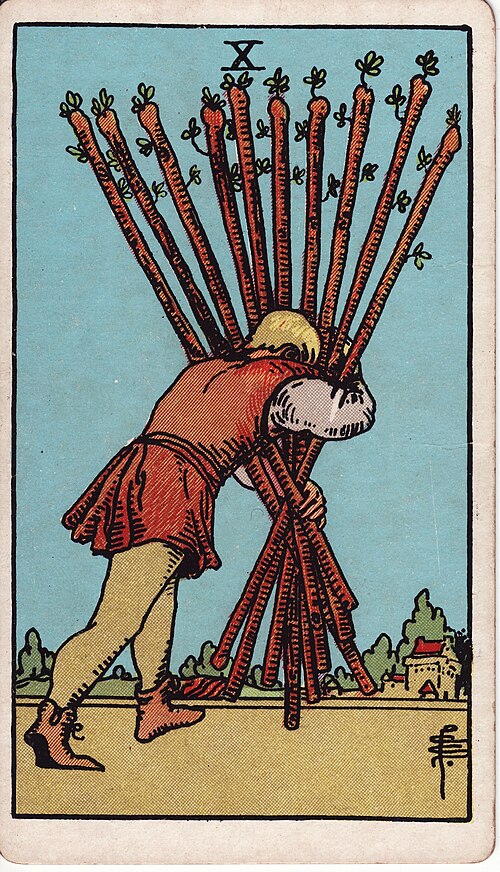
Ten of Wands at a Glance
Card: Ten of Wands. Group: Minor Arcana, Wands suit. RWS rank: Ten. Position: 32 of 78, following the Nine of Wands and preceding the Page of Wands. The card concentrates on a large load of effort, responsibility near completion, and the need to decide whether every burden being carried is necessary.
The Wands suit is commonly used to organize action, drive, creative effort, and competition. The Ten does not predict a workload or prove that a person must keep going. It is a symbolic reading tool for separating meaningful responsibility from accumulated obligation, then choosing a practical way to share, simplify, complete, or release the load.
RWS Image: A Traveler Carrying the Load
The Rider-Waite-Smith image shows a solitary figure bent forward as he carries a bundle of ten long wands across both arms. The bundle rises in front of his upper body and partly hides his face, so his view is restricted. He walks along a low, open landscape toward a distant settlement with visible buildings. The scene uses warm yellow and orange light with green and brown ground, while the horizon and buildings remain farther away than the figure.
The image visibly emphasizes quantity, posture, direction, and obstruction. All ten wands are gathered into one load instead of being arranged as separate tools, and the figure's hands are occupied with carrying rather than steering or greeting. The distant settlement gives the composition a destination, but the blocked view makes the route harder to assess. Traditional readings often connect this structure with responsibility and pressure; a careful modern reading also asks whether the load is self-chosen, shared, temporary, or simply habitual.
Keywords and How They Follow from the Image
- Responsibility: the figure is visibly carrying a substantial bundle. Burden: the quantity and bent posture show effort with a cost. Completion: the traveler is moving toward a settlement rather than standing at the beginning of a route. Overcommitment: one person holds every wand at once, leaving little freedom of movement. Delegation: the bundled load raises the practical question of who else could carry part of it. Release: the covered face and limited view invite a reassessment of what can be put down. These keywords arise from the card's visible arrangement and the Ten's place at the end of the numbered suit sequence, not from a guaranteed forecast.
Upright Ten of Wands Meaning
Upright, the Ten of Wands can describe sustained effort, a demanding responsibility, or the final phase of a project that has become heavier than expected. Its strength is follow-through: the traveler has organized enough energy to move a large load toward a destination. The card can support finishing essential work, honoring a commitment, and acknowledging the real labor behind an outcome.
Its risk is overcommitment. The figure's face is obscured, suggesting that the task can crowd out identity, perspective, rest, and relationships. A person may confuse being needed with being responsible for everything, or may continue carrying duties that should be renegotiated. Practical action begins with a load audit: list each obligation, its deadline, its owner, its real consequence, and the next smallest step. Delegate where possible, renegotiate scope, and protect sleep and recovery rather than treating exhaustion as proof of character.
Reversed Ten of Wands Meaning
Reversed, the Ten of Wands may show blockage when too many tasks prevent prioritization or when shame makes a person refuse help. Internalization can appear as carrying pressure privately, hiding difficulty, or defining worth by output. Excess may be frantic control, martyrdom, resentment, or taking responsibility for other people's choices. Delay can follow when the load is so broad that no single task receives enough attention to finish.
Reversal is not automatically negative. It can mark a useful unloading, a boundary, a transfer of responsibility, or a deliberate pause before a plan becomes unsafe or unsustainable. Direction adjustment means choosing the essential destination, removing a nonessential wand, asking who owns the next step, or changing the route. If the burden has already been released, the card may describe the awkward transition from constant doing to recovery. Upright does not guarantee success, and reversed does not guarantee failure.
Applications in Life Areas
- Relationships and emotions: The card can describe one person carrying the practical or emotional labor for two, or a couple trying to reach a shared goal while communication is crowded out. Discuss specific responsibilities instead of expecting mind-reading. Reversed, resentment or withdrawal may be a signal to redistribute work and say what support is actually needed
- it is not proof of a partner's hidden motives.
- Work and study: Upright, finish the highest-value deliverable and make the workload visible to collaborators, teachers, or managers. A long list is not the same as a priority list. Reversed, reduce scope, break the project into checkpoints, and ask for an extension or accommodation through the proper channel when needed.
- Money and resources: Read the card as a prompt to map recurring obligations, debt, time, tools, and financial responsibilities. It does not promise a payoff or predict loss. Reversed may favor cancelling unnecessary commitments or seeking qualified financial guidance
- do not make an investment or borrowing decision from a card alone.
- Personal growth: Examine the story that says you must carry everything to be worthy or reliable. Growth can be disciplined completion, but it can also be learning to delegate, rest, accept limits, and choose a destination that still fits your values.
Ten of Wands in Tarot Spreads
One-card prompt: “What am I carrying, and which part is truly mine to carry today?” The card emphasizes a load and a destination, but the useful answer depends on your actual commitments. Record the tasks, obligations, and assumptions that the image brings to mind, then verify them against calendars, agreements, and current evidence.
- Three-card past, present, future: In the past, the Ten of Wands can show how obligations accumulated or how a demanding promise was accepted. In the present, it highlights workload, pressure, and the need to prioritize. In the future, it may describe completion after sustained effort or the consequence of carrying too much
- surrounding cards show whether simplification or follow-through is more appropriate.
- Three-card situation, action, outcome: As situation, it frames the matter as crowded with duties or nearing a demanding finish. As action, it recommends naming the essential task, distributing the rest, and setting a limit. As outcome, it can point to a completed responsibility, a changed scope, or the recognition that the original load was not sustainable.
- Relationship positions: For self, the Ten shows your contribution, pressure, or habit of taking over. For the other person, it describes the role their visible responsibilities play in the relationship, not their unspoken thoughts. For interaction, examine the labor pattern: is the pair sharing a goal, competing over control, or leaving one person to carry the whole arrangement?
- Decision positions: In opportunity, the card may show a meaningful project that can be completed if scope and support are realistic. In risk, it warns of hidden workload, poor delegation, and a destination that no longer justifies the cost. In advice, choose the essential wands, negotiate ownership, and do not mistake a full schedule for a sound plan.
- Obstacle, advice, outcome: As obstacle, identify excess commitments, restricted perspective, or fear of disappointing others. As advice, perform a load audit, ask for help, and set a completion or release condition. As outcome, read the card as the result of carrying through or of reaching the limit that forces a redistribution
- it is not an automatic promise of success or collapse.
Instructional Combination Example
Instructional example, not a real case: Nine of Wands beside the Ten of Wands can show a progression from guarding the last stretch to carrying too much of the whole project. The Ten beside the Page of Wands can redirect the emphasis toward a new, smaller experiment after an old responsibility is completed or released. Adjacent cards modify the Ten by showing whether the issue is endurance, load, learning, or a fresh use of energy.
Common Misreadings, School Differences, and Responsible Use
A common misreading is “the Ten of Wands always means success after suffering.” It can instead ask whether the goal, timeline, or division of labor needs revision. Another mistake is turning the figure into a moral lesson about weakness; the visual load may reflect structural conditions, not a personal flaw. Separate observable imagery from traditional interpretation, modern practical application, and editorial synthesis. A. E. Waite's The Pictorial Key to the Tarot is a historical source associated with the 1911 publication context and was illustrated by Pamela Colman Smith; later schools interpret the numbered Wands differently, so later associations should not be presented as settled history.
RWS and Marseille traditions differ in some imagery and in the numbering of Strength and Justice: RWS uses Strength VIII and Justice XI, while Marseille commonly uses Justice VIII and Strength XI. This series follows RWS numbering and gives primary attention to RWS imagery. Some schools do not use reversals, and those that do may read them as blockage, internalization, excess, delay, or direction change. Keep the chosen method consistent and explain it rather than treating card direction as a simple good-or-bad switch.
Tarot is a cultural and symbolic-reading practice that can support self-reflection; it has no scientifically validated power to predict events. Do not use the Ten of Wands as medical, legal, investment-return, or guaranteed-fate advice. Do not use it to read a third party's mind or to pressure someone into carrying work they did not agree to. For high-stakes choices, use documents, budgets, professional guidance, and direct communication alongside any symbolic exercise.
Tarot Journal Prompts
- Which responsibilities are mine by agreement, and which have I accepted from habit or fear?
- What can be delegated, delayed, simplified, or released without abandoning the essential goal?
- How would my next action change if rest and a clear view were treated as resources rather than rewards?
Suggested Learning Links
- Previous card: Nine of Wands, tarot-card-nine-of-wands. Compare its guarded boundary with the Ten's concentrated load.
- Next card: Page of Wands, tarot-card-page-of-wands. Continue the Wands sequence by moving from a completed numbered cycle toward a new mode of learning and action.
- Foundational tarot articles: Wands suit guide, tarot-wands
- Tarot for Beginners, tarot-for-beginners
- Upright and Reversed, tarot-upright-and-reversed
- Three-Card Tarot Spreads, three-card-tarot-spreads
- Tarot Questions, tarot-how-to-ask
- and Tarot Journal Review, tarot-journal-review.