Ten of Swords at a Glance
The Ten of Swords is Minor Arcana, Swords suit, rank ten, and position 60 in this 78-card RWS series. The Swords suit commonly organizes thought, speech, judgment, boundaries, and conflict. Ten marks a completed cycle, so this card concentrates on an ending that is painful, unmistakable, or mentally exhausting. It can describe the end of a story, strategy, argument, role, or expectation. The card is a symbolic framework for reflection, not a prediction of literal death, violence, or unavoidable failure.
RWS Image: What Is Visible
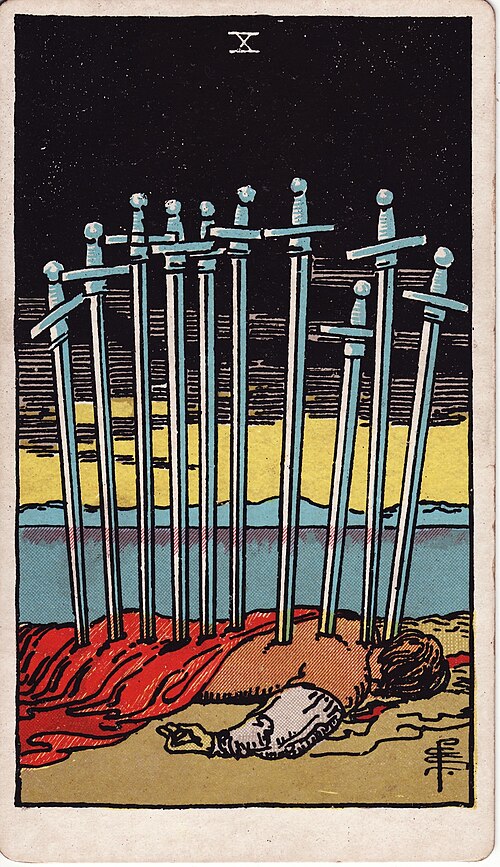
The RWS card shows a prone figure lying face down across the foreground, with ten swords visibly aligned across the back. The figure wears a red garment, and the body is set against dark water, a heavy black sky, distant land, and a narrow yellow horizon. The swords dominate the scene, but the far horizon introduces a small visual contrast: darkness is not the only color in the image. The figure's head and face are turned away from the viewer, so the card does not identify a gender or reveal a literal cause. There is no visible crowd or rescuer; the scene emphasizes aftermath, stillness, and the boundary between an ended condition and what may follow.
The image supports several levels of reading. Observation gives us a body at rest, ten blades, a dark sky, water, distant landscape, and a strip of light. Traditional interpretation adds defeat, ruin, painful completion, and release from a worn-out struggle. Modern reflective practice may use the card to ask what has actually ended, what story must be retired, and what practical recovery can begin. None of these layers should be confused with evidence that a feared event will happen.
Keywords from the Image and Tradition
- Completion follows from the ten-sword structure and the scene's stillness
- painful truth follows from the exposed blades and prone body
- finality refers to the end of a pattern, not automatically to a person
- aftermath follows from the dark water and distant horizon
- release becomes possible when resistance to a finished chapter is reduced
- recovery is suggested by the narrow light beyond the immediate scene, without promising a particular outcome.
Upright Meaning: An Ending That Needs to Be Acknowledged
Upright, the Ten of Swords can show that a strategy, conflict, belief, or chapter has reached its limit. Its difficult strength is clarity: once the ending is acknowledged, energy no longer has to be spent pretending that the same arrangement can continue unchanged. The card may support a clean boundary, an honest post-mortem, a final conversation, or a decision to stop repeating a harmful pattern. It can also describe the felt aftermath of an event that has already happened rather than announcing a new one.
The risk is making finality theatrical or absolute. A setback can be real without proving that the entire future is ruined. Excess may appear as all-or-nothing language, public self-condemnation, revenge fantasies, or reopening a closed conflict to obtain one more explanation. Practical action means naming the ending precisely, protecting immediate needs, preserving relevant records, asking what must be repaired, and allowing the next step to be modest. Upright does not guarantee a positive outcome; it describes a demanding transition that still contains choices.
Reversed Meaning: Recovery, Resistance, or a Delayed Ending
Reversed, the Ten of Swords is not automatically an improvement or a worse omen. It may show blockage when a necessary ending cannot be accepted, internalization when the person carries defeat privately, excess when the language of ruin has become a habit, delay when an old situation is prolonged after its useful life, or direction adjustment when recovery requires a different boundary or plan. It can also describe the first movement away from the lowest point: the event may be over, but the body, emotions, or practical arrangements still need time.
- For blockage, identify the fact that has already changed. For internalization, tell the story to a trusted and appropriate person without exposing someone else's private information. For excess, replace totalizing words with a specific account of what ended. For delay, set a clear closing action or review date. For direction adjustment, move from proving who was right toward rebuilding capacity, safety, and choice. Surrounding cards determine whether the emphasis is resistance, recovery, or unfinished administration.
Applications in Life Areas
In relationships and emotions, upright may mark the end of a relationship pattern, a painful truth about compatibility, or the aftermath of a conflict. It does not establish that another person is malicious, unfaithful, or destined to leave. Reversed may show difficulty accepting a breakup or the slow rebuilding of trust after a rupture. Use the card to clarify boundaries, consent, communication, and what both people can actually choose; do not use it to read a third party's mind.
For work and study, the card can describe a completed project that exposed serious limits, the end of a role, a failed approach, or exhaustion after sustained pressure. Its constructive action is a factual review: record what was learned, close outstanding tasks, seek feedback, and design the next attempt from evidence rather than shame. Reversed may point to repeating a failed method, delaying a necessary change, or beginning a gradual return after burnout; it is not a medical assessment.
For money and resources, the Ten of Swords can symbolize the end of a financial plan, a sunk-cost problem, or the need to stop funding an unsustainable arrangement. It does not guarantee loss, bankruptcy, or recovery. Check actual accounts, obligations, deadlines, and alternatives; seek qualified financial or legal advice when needed. Reversed can show avoidance of a final bill or the administrative work of closing an account, as well as a cautious reset after a setback.
For personal growth, the card asks which identity, promise, or self-story has become too costly to carry. Growth here is not forced optimism. It is honest naming, grief when appropriate, practical rest, and a deliberate decision about what will not be repeated. Tarot can support reflection and journaling, but it cannot replace medical, mental-health, legal, or crisis support.
Reading the Ten of Swords in Spreads
In a one-card prompt, ask: What has ended, what evidence confirms that, and what is the next repairable step? In a three-card past, present, future spread, the past may show the completed cycle or accumulated conflict; the present may describe the aftermath and the need to stop negotiating with an expired pattern; the future indicates a possible direction after the ending, not a guaranteed resurrection or disaster. In a situation, action, outcome spread, it can define the real point of closure, recommend a clean boundary and review, and show the consequences of either accepting or resisting that closure.
In relationship positions, Ten of Swords as self may show grief, exhaustion, or the need to end a personal pattern; as the other person, it should describe the role or condition represented by the position rather than claim access to private feelings; as interaction, it may show a bond organized around an old injury or a conversation that has reached a limit. In decision positions, as opportunity it can offer release from an unsustainable arrangement; as risk it warns against treating one painful result as a verdict on every future option; as advice it recommends clear closure, documentation, support, and a realistic recovery plan.
As obstacle, the card can show attachment to a finished story, fear of starting again, or exhaustion that narrows choices. As advice, it asks for precise closure before new construction. As outcome, it emphasizes a chapter's completion or the consequences of continuing past a clear limit; surrounding cards and real-world actions determine whether the emphasis becomes relief, grief, or further delay.
Instructional Combination Reading
Instructional example, not a real case: Nine of Swords beside the Ten of Swords can show private worry becoming a recognized endpoint, so the reader should separate mental anticipation from the actual conclusion and then plan the aftermath. Ten of Swords beside the Page of Swords can shift the emphasis from closure toward careful fact-finding and a new question. The adjacent card modifies how the ending is handled; it does not erase the Ten's finality or turn the pair into a guaranteed prediction.
Common Misreadings, Schools, and Responsible Use
The most harmful misreading treats this card as a literal death card or as proof that catastrophe is inevitable. Other errors include assuming that every ending is failure, that the prone figure describes a fixed victim identity, or that a dramatic image justifies a dramatic real-world decision. Read the question, position, surrounding cards, observable facts, and available choices together. If a reading raises fear, pause rather than escalating the spread.
Some readers use reversals and others do not; a reversal may indicate blockage, inner experience, excess, delay, or redirection rather than a simple opposite. This series follows RWS order and primary image analysis. RWS and Marseille traditions differ in some imagery and in the numbering of Strength and Justice: RWS places Strength at VIII and Justice at XI, while Marseille commonly places Justice at VIII and Strength at XI. Marseille-style numbered Swords cards often use pip arrangements instead of the RWS illustrated scene. A. E. Waite's 1911 The Pictorial Key to the Tarot credits Pamela Colman Smith for the illustrations and remains an influential historical source, but tarot has no scientifically validated predictive power.
Let the Ten of Swords mark a question about closure and recovery, not a verdict about someone's life or future.
Tarot Journal Prompts
- What has actually ended, and what am I still treating as undecided? Which part of this story is evidence, and which part is an absolute conclusion? What boundary, record, conversation, or rest would support recovery? What new question becomes possible after I stop repeating the old one?
Suggested Learning Links
Continue with the previous card, Nine of Swords (tarot-card-nine-of-swords), and the next card, Page of Swords (tarot-card-page-of-swords). For foundations, see Tarot for Beginners (tarot-for-beginners), Tarot Upright and Reversed (tarot-upright-and-reversed), Three-Card Tarot Spreads (three-card-tarot-spreads), Tarot Swords (tarot-swords), Tarot Journal and Review (tarot-journal-review), and Ethics and Boundaries (ethics-and-boundaries). These resources support cultural learning and self-reflection, not professional advice or guaranteed outcomes.