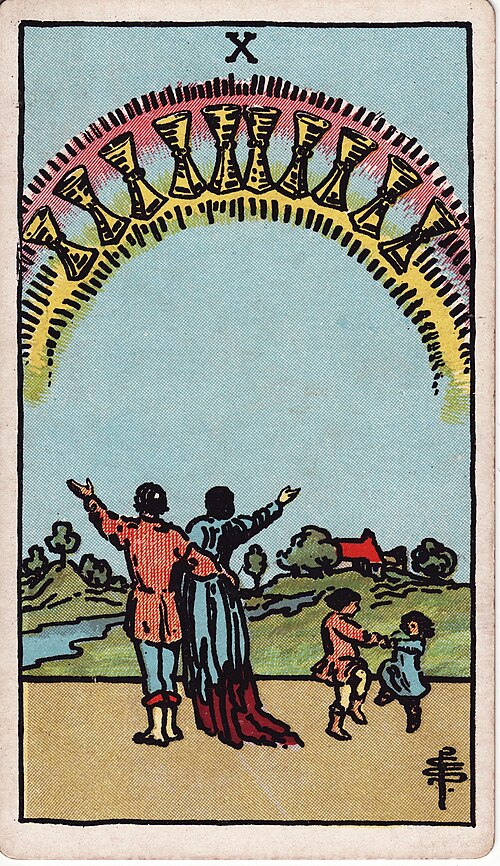
Ten of Cups at a glance
The Ten of Cups is Minor Arcana, Cups, rank ten, and position 46 in this 78-card RWS sequence. It follows the Nine of Cups and precedes the Page of Cups. Its visual language often supports belonging, shared emotional security, and a durable sense of home, but the card is not a guarantee of marriage, family formation, or permanent happiness. The question and spread position determine whether the emphasis is connection, a shared value, or an ideal that needs honest testing.
This series uses the Rider-Waite-Smith tradition, abbreviated RWS, for its order and primary image analysis. RWS and Marseille traditions differ in some imagery and in the numbering of Strength and Justice. Marseille pip cards also use a different visual grammar for many numbered Minor Arcana cards, so a Ten of Cups reading from Marseille should not be treated as an exact copy of the RWS scene.
What the RWS image shows
In the foreground, two adults stand with their arms raised toward a broad rainbow. Ten cups appear along the rainbow's arc. Nearby, two children move together in the green landscape. A house and trees sit farther back, with a river or stream crossing the scene. The figures turn outward toward the rainbow and landscape rather than presenting a private display to the viewer. Bright rainbow colors, open sky, water, and the domestic setting create a visual movement from emotion to shared environment.
The image visibly contains a pair, children, a home, water, vegetation, and an arc of cups, but it does not establish the legal status of the adults or the future of the household. Traditional tarot often extends the picture into family happiness, harmony, and emotional completion. Those extensions belong to interpretation. They can be useful prompts about belonging and shared values without becoming factual claims about a person's relationship or fate.
Keywords derived from the image
The concise keyword set is belonging, shared joy, emotional security, family or community, continuity, and idealization. Belonging follows from the figures facing a common sky and landscape. Shared joy comes from the raised arms and the children participating in the scene. Emotional security is suggested by the home and settled environment. Family or community is a contextual use of the multiple figures, not a fixed prediction. Continuity follows from the rainbow's enclosing arc and the ten-card endpoint. Idealization is the necessary shadow keyword because a beautiful picture can hide unresolved conditions outside the frame.
Upright Ten of Cups meanings
Upright, the Ten of Cups emphasizes a shared emotional field: people, values, and routines that allow connection to be experienced over time. Its strength is mutual recognition rather than solitary achievement. It can invite a celebration of chosen family, repaired trust, community support, or a home life aligned with stated values. As a practical action, name what belonging means in this situation, ask who needs to be included, and turn a hopeful image into ordinary habits such as listening, reliability, and shared care.
The risk of excess is emotional conformity, pressure to perform happiness, or using an ideal family picture to silence conflict. An upright card can still warn against assuming that a pleasant surface equals safety. Check consent, boundaries, and the actual behavior of the people involved. The card may describe an aspiration or a resource rather than an outcome. Let evidence and conversation decide whether the apparent harmony is reciprocal.
Reversed Ten of Cups meanings
Reversed, the Ten of Cups can show blockage around belonging, difficulty expressing a shared vision, or a household pattern in which people live close together but feel emotionally separate. Internalization may appear as private grief, an unspoken standard of happiness, or a need to protect one's real feelings from group pressure. Excess can become idealized family mythology, forced positivity, or dependence on external approval. Delay may arise while a community repairs trust or while different definitions of home are negotiated.
Direction adjustment means moving from the image of perfect harmony toward a specific, honest agreement. Ask what can be repaired, what cannot be controlled, and what form of connection is realistic now. Reversed does not automatically mean breakup, estrangement, or failure. It may simply release a borrowed ideal so that a more inclusive and truthful form of belonging can develop. Upright does not guarantee permanence either; both orientations need context.
Applications in ordinary life
In relationships and emotions, upright Ten of Cups can support shared values, emotional generosity, reconciliation work, or the feeling that a relationship fits into a wider network of care. It does not prove that another person is committed or reveal a third party's private thoughts. Reversed may point to family pressure, incompatible visions of home, suppressed conflict, or a gap between public image and private experience. Use direct conversation and observable conduct before drawing conclusions.
For work and study, the card can describe a supportive team, a learning environment where people celebrate one another, or a long-term goal connected to community impact. Its risk is prioritizing group approval over individual responsibility. Reversed may show a fractured team, unclear shared standards, or a course of study chosen to satisfy others. Clarify roles, feedback channels, and the outcome you personally want to build.
For money and resources, the Ten of Cups can highlight shared household planning, resources used to create stability, or values-based choices that benefit a community. It is not a promise of wealth, inheritance, or financial security. Reversed may flag hidden obligations, family spending pressure, or an attractive lifestyle that exceeds the available budget. Use transparent agreements, written numbers, and qualified financial advice for consequential decisions.
For personal growth, the card asks you to define home and belonging for yourself rather than inheriting a picture of what happiness should look like. Upright growth may involve receiving support and offering dependable care. Reversed growth may involve grieving an ideal, setting a boundary with group expectations, or building a chosen community gradually. If relationship or family distress is serious, seek appropriate professional support rather than treating tarot as a substitute.
The Ten of Cups in spreads
In a one-card reading, ask, "What kind of belonging would be honest and sustainable here?" In a three-card past, present, future spread, the past position can show family patterns or an earlier shared dream; the present position can reveal the community or emotional agreement currently available; the future position suggests a possible direction if people act with care, not a fixed happy ending. In a situation, action, outcome spread, it may name the shared value, recommend a conversation or ritual of connection, or describe a result whose stability still depends on behavior.
In relationship positions, Ten of Cups as self may show your longing for belonging, your capacity for mutual care, or your attachment to an ideal. As the other person, it describes how that person functions in the question's symbolic field, not their unspoken feelings; ask them rather than guessing. As interaction, it examines whether the bond creates a shared emotional home or merely a pleasing public image. In decision positions, opportunity is a chance to build aligned support, risk is idealization or group pressure, and advice is to make shared values explicit.
As obstacle, the card can show fear of disappointing family, a rigid definition of normal happiness, or the belief that conflict invalidates connection. As advice, it recommends inclusive communication, dependable care, and a concrete shared practice. As outcome, it can describe a sense of belonging or emotional integration when the surrounding cards and real actions support it. The position changes emphasis; the card never overrides consent, evidence, or free choice.
Instructional combination example
Instructional example, not a real case: Nine of Cups beside the Ten of Cups can move from private satisfaction to a question about how pleasure is shared with others. The Nine may show a personal wish or completed milestone, while the Ten asks whether that result fits a wider network of care. If the Ten is beside the Page of Cups, a new emotional message or vulnerable gesture may begin a longer process of belonging. Adjacent cards refine one another; they do not guarantee an event.
Misreadings, deck differences, and responsible use
A common misreading is calling the Ten of Cups a guaranteed wedding, pregnancy, perfect family, or permanent end to conflict. The image can support those themes symbolically, but it cannot establish them. Waite's Pictorial Key to the Tarot is a historical interpretive source; the 1911 source record identifies Arthur Edward Waite as author and Pamela Colman Smith as illustrator. This article separates historical tradition from visible imagery and modern editorial synthesis. Marseille and other decks may replace the illustrated scene with different visual cues. RWS and Marseille also number Strength and Justice differently, so the series order here remains explicitly RWS.
Use tarot as a cultural, symbolic-reading, and self-reflection tool. Do not use it to read a third party's mind or to make medical, legal, investment-return, or guaranteed-fate claims. For decisions with serious consequences, use evidence, informed consent, qualified advice, and the ability to revise the plan. A comforting card should not be used to ignore risk, and an unsettling card should not be used to create fear or dependence.
Tarot journal prompts
- 1. What does home or belonging mean to me when I remove other people's expectations? 2. Which shared value is visible in this situation, and which agreement still needs to be spoken aloud? 3. Where might a beautiful ideal be hiding a practical boundary or unresolved need?
Suggested learning links
Continue backward with Nine of Cups at tarot-card-nine-of-cups and forward with Page of Cups at tarot-card-page-of-cups. For foundations, see tarot-cups, tarot-for-beginners, tarot-upright-and-reversed, three-card-tarot-spreads, tarot-how-to-ask, tarot-journal-review, and ethics-and-boundaries. For primary-source comparison, consult The Pictorial Key to the Tarot at https://sacred-texts.com/tarot/pkt/index.htm.