Card identity and sequence
Temperance is Major Arcana XIV in the Rider-Waite-Smith (RWS) system and the fifteenth card in the 78-card sequence, with The Fool numbered 0. It belongs to the Major Arcana, so its theme often describes a central pattern, threshold, or way of integrating experience rather than a small isolated event. The card does not promise perfect calm. It asks how different materials, needs, time scales, or viewpoints can be brought into workable proportion.
This series uses RWS numbering and primary image analysis. RWS and Marseille traditions differ notably in the numbering of Strength and Justice: RWS places Strength at VIII and Justice at XI, while many Marseille decks reverse those positions, and the imagery also differs. That distinction matters when studying the sequence; it does not make one tradition universally correct.
What the RWS image shows
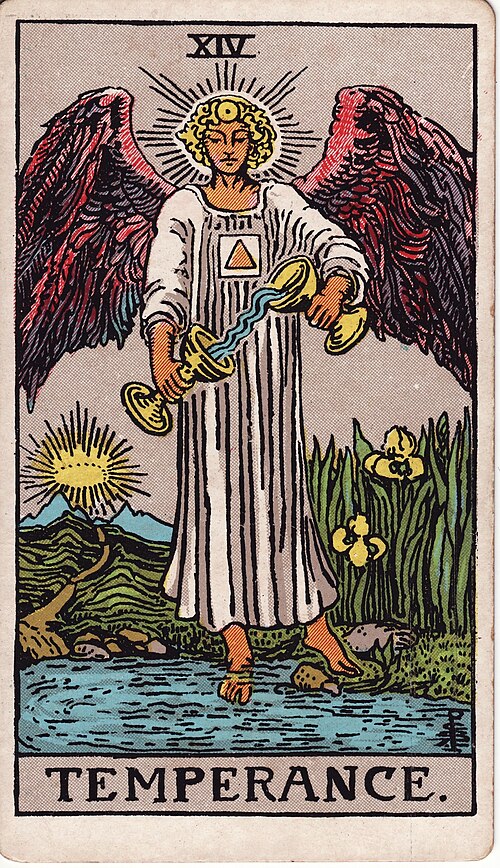
A winged figure stands near a pool or stream, with one foot on solid ground and the other in the water. The figure faces the viewer, and the head is turned slightly toward the work of pouring. Two cups are held at chest height, with liquid shown moving between them. The robe is light, marked by a red triangle inside a square, and the wings are red. Irises grow near the water. Behind the figure, a path travels through the landscape toward distant mountains and a bright shape near the horizon; a low bank and green ground separate the foreground from the route ahead.
These observations support a reading of exchange, translation, and participation in more than one condition at once. Land and water place stability beside feeling and movement. The cups make the process visible: something is being transferred, measured, and blended rather than hoarded. The long path gives the scene direction, but the figure is not rushing. Traditional readers may add elemental, astrological, or alchemical correspondences, yet those are interpretive frameworks rather than extra objects literally depicted in the card.
Keywords grounded in the image
- Integration
- moderation
- patience
- proportion
- exchange
- healing as restoration
- adaptation
- steady flow.
Integration follows from the figure joining land and water and from the two cups sharing one stream. Moderation follows from controlled pouring rather than either cup being abandoned. Patience comes from the quiet stance and distant path: the work is gradual. Proportion describes the need to adjust amounts and timing. Exchange and adaptation arise from moving material between containers and changing context without losing continuity. In a reflective reading, “healing” should mean restoring balance or function in a broad, non-medical sense, not a promise about a health outcome.
Upright Temperance meaning
Upright Temperance describes a middle process: combine what can cooperate, separate what cannot, and test the mixture in real conditions. Its strength is not passivity but regulated movement. It can show emotional composure, diplomatic timing, sustainable habits, careful collaboration, and the ability to translate between people or systems. It may also point to recovery after disruption, provided recovery is understood as a practical process rather than a guaranteed result.
The risk of excess is becoming so committed to balance that nothing is chosen, named, or completed. “Keeping the peace” can hide avoidance, and constant adjustment can become self-erasure. In practical terms, Temperance recommends a small repeatable experiment: revise the schedule, clarify the boundary, blend two skills, reduce an unnecessary input, or ask for a workable compromise. Record what changes instead of assuming that a calm intention has already produced a result.
- Upright actions: slow the pace enough to notice proportions
- combine resources deliberately
- set a sustainable routine
- translate each side's needs
- review the mixture after a defined interval.
Reversed Temperance meaning
Reversed Temperance does not automatically mean failure or danger. It may show that the theme is blocked, internalized, delayed, exaggerated, or asking for a change of direction. The key question is not “Is this card bad?” but “Where has the flow lost a workable channel?” Compare the card with the question and position before choosing a meaning.
- Blockage: the parts are kept separate, or a needed conversation cannot yet happen. Internalization: the person is privately recalibrating and is not ready to show the process. Excess: compromise has become over-accommodation, dilution, escapism, or endless tweaking. Delay: timing, capacity, or missing information prevents a stable blend. Direction adjustment: stop forcing a mixture that is incompatible and choose a clearer proportion or route.
A reversed card can therefore be a useful pause. It may ask for fewer simultaneous changes, a firmer boundary, or a return to basic measurements. If a plan has repeatedly stalled, adjust the direction rather than adding more effort to the same method. Upright Temperance is not a guarantee of a positive outcome either; a balanced process can still reveal that the chosen goal is unsuitable.
Applications by life area
Relationships and emotions: Temperance favors honest pacing, emotional regulation, and mutual adjustment. It can describe a relationship learning how to blend different routines or communication styles. It does not reveal what another person secretly feels. Ask what has actually been said, what each person can offer, and which compromise preserves both people's dignity. Reversed, notice resentment from one-sided accommodation, avoidance disguised as calm, or a conversation repeatedly postponed.
Work and study: The card supports combining disciplines, coordinating a team, editing a process, or building a study rhythm that can survive a busy week. Its strength is consistency over dramatic bursts. The excess is over-editing, indecision, or trying to satisfy incompatible instructions without clarification. A useful action is to define the minimum viable routine, the handoff between tasks, and the date for reviewing what works.
Money and resources: Read Temperance as budgeting, allocation, and sustainable use rather than sudden financial luck. It may encourage separating essential and optional spending, smoothing irregular costs, or combining resources with explicit terms. Reversed, look for leakage, vague agreements, delayed payments, or a plan that depends on optimistic estimates. Do not treat the card as investment, lending, or financial advice; verify figures and use qualified help when needed.
Personal growth: Temperance invites the learner to hold conviction and curiosity together. Practice can mean journaling after a reading, comparing image evidence with traditional meanings, or replacing an all-or-nothing rule with a measured trial. Growth is not the elimination of conflict; it is learning how to respond without letting one impulse govern the whole system.
Temperance in tarot spreads
One-card prompt: “What needs to be brought into better proportion today?” Upright, the card emphasizes one manageable adjustment and patient follow-through. Reversed, it asks whether the issue is overload, avoidance, or a blend that should not be forced.
Three-card situation, action, outcome: In the situation position, Temperance describes the current mixture of needs, people, or timelines. In the action position, it recommends measured coordination, gradual testing, or a careful bridge between sides. In the outcome position, it suggests a more workable rhythm if the process is maintained, not a fixed promise that everything will resolve.
Relationship positions: For self, Temperance shows how you are regulating, compromising, or withholding. For the other person, it describes the role or pace you are observing, not their private mind. For the interaction, it highlights the quality of exchange: mutual blending, uneven adjustment, silence, or the need for a clearer boundary.
Decision positions: As opportunity, Temperance can show a chance to combine strengths, negotiate terms, or choose a sustainable pace. As risk, it warns of dilution, indefinite compromise, or incompatible ingredients. As advice, it favors a small reversible test, explicit measures, and a review point rather than a dramatic leap.
Obstacle, advice, and outcome positions change the emphasis again. As obstacle, the card can indicate too much smoothing and too little decision. As advice, it asks for proportion, timing, and translation. As outcome, it describes the likely quality of the process if the current pattern continues; it should be read with neighboring cards and observable circumstances.
Instructional combination example
This is instructional, not a real case. Imagine Death beside Temperance beside The Devil. Death can frame Temperance as the gradual integration that follows an ending or major change. The Devil then tests whether the new balance is genuine or still organized around compulsion, fear, or an unexamined attachment. Temperance does not cancel either neighbor; it supplies the method of noticing what is changing and what keeps pulling the process back.
Misreadings, deck differences, and responsible use
A common misreading is reducing Temperance to “be patient” while ignoring what must be measured or changed. Another is treating the angel as proof of supernatural protection or the cups as a literal promise of reconciliation. Marseille Temperance may share the broad theme of mixing while differing in composition, line, color, and emphasis; modern RWS-inspired decks also alter gender, skin tone, clothing, symbols, and landscape. Start with the deck in hand, then state which tradition supplies the interpretation.
Tarot here is a cultural and symbolic-reading practice for reflection, not a scientifically validated predictive method. Use a spread to clarify options and actions, not to read a third party's mind or make guaranteed claims about love, health, law, employment, or investment returns. For medical, legal, financial, or safety decisions, consult appropriate qualified professionals. Keep consent and privacy central, and let real evidence outrank a card.
Journal prompts
- Where am I mixing two needs successfully, and what observable sign would show that the balance is working?
- What compromise has become self-erasure or avoidance?
- Which small experiment could clarify the right pace without locking me into a promise?
- What did the image show before I added a traditional keyword?
Suggested learning links
Continue backward to Death at /tarot-card-death and forward to The Devil at /tarot-card-the-devil. For method, use Tarot for Beginners at /tarot-for-beginners, the Upright and Reversed guide at /tarot-upright-and-reversed, Three-Card Tarot Spreads at /three-card-tarot-spreads, Tarot Journal Review at /tarot-journal-review, and Ethics and Boundaries at /ethics-and-boundaries. These links provide foundations without replacing the card-specific image analysis above.