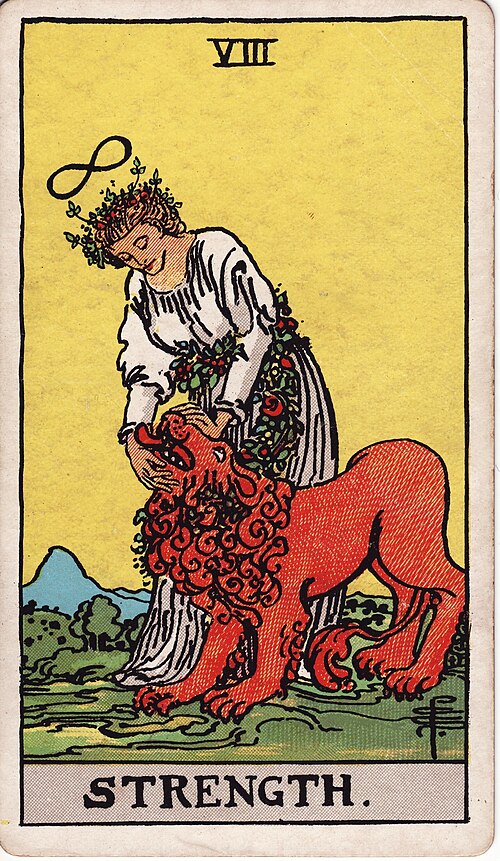
Strength at a glance: identity and sequence
Strength is Major Arcana VIII in the Rider-Waite-Smith (RWS) tradition and position 9 in this 78-card series: The Fool is position 1, so the numbered Major Arcana begin after it. The card belongs to the Major Arcana group and emphasizes a way of meeting powerful feeling rather than a guaranteed victory. In the RWS order, Strength is VIII and Justice is XI. Many Marseille traditions use the reverse placement, Justice VIII and Strength XI, and the images also differ. This guide uses the RWS numbering and the RWS image for primary analysis. It treats tarot as a cultural and symbolic language for reflection, not a scientifically validated prediction system.
What the RWS image visibly shows
A woman in a light-colored dress bends over a lion and gently holds its open jaws. Her body faces the animal rather than fleeing from it, while the lion turns toward her. A wreath of red roses circles her head and another floral garland crosses her waist. An infinity symbol appears above her head. The scene sits in a green landscape beneath a pale sky, with distant blue-gray hills and no wall or weapon separating the pair. The lion supplies visible movement, teeth, hair, and animal force; the woman supplies a calm, deliberate human presence. The image does not show a battle trophy or a defeated corpse. Its structure invites attention to contact, patience, and the manner in which force is handled.
Keywords and how they arise
Core keywords are composure, courage, compassion, regulation, desire, patience, and resilient influence. Composure follows from the woman’s steady posture beside an animal that could injure her. Courage is not the absence of danger; it is the choice to remain present. Compassion and regulation arise because the lion is approached through touch and relationship rather than a blade. The infinity sign supports a reading of sustained practice and a repeating exchange between instinct and conscious choice. The flowers soften the scene, so influence need not mean domination. In traditional interpretation, Strength or Fortitude names an inner quality that can hold intensity without being ruled by it; this does not require treating the card as proof of a person’s personality.
Upright Strength: core dynamics and practical action
Upright Strength points to quiet power, emotional steadiness, and the patient use of influence. Its strength can be physical, but the RWS image gives more weight to self-command and a humane relationship with instinct. At its best, the card helps someone stay engaged with a difficult conversation, fear, ambition, anger, or attraction long enough to respond deliberately. Its risk is excess: composure can become suppression, kindness can become appeasement, and resilience can turn into carrying more than one person should carry. An upright card is not a promise that everything will go well. It describes a useful stance and asks whether that stance is supported by reality.
- Potential strengths: courage without theatrics
- emotional regulation
- patient persistence
- a persuasive rather than coercive presence
- and the ability to protect what matters without escalating conflict.
- Risks of excess: swallowing anger until it leaks out, confusing endurance with consent, trying to tame another person, or demanding constant calm from yourself when rest and help are needed.
- Practical actions: name the feeling before acting, lower the speed of a tense exchange, set one clear boundary, repeat a small practice, and measure progress by behavior rather than by dramatic certainty.
Reversed Strength: blockage, internalization, excess, delay, and adjustment
Reversed Strength does not automatically mean weakness or a negative result. It may show that the card’s energy is blocked, turned inward, exaggerated, delayed, or asking to change direction. As blockage, fear or shame may make a person avoid the very conversation that would clarify the situation. As internalization, the lion can represent an intense feeling being processed privately, with no visible action yet. As excess, self-control can become rigidity, people-pleasing, overwork, or an attempt to manage someone else’s reactions. As delay, confidence may need rebuilding through small evidence rather than a forced leap. Direction adjustment may mean choosing support, a firmer boundary, a softer tone, or a pause instead of pushing harder.
- For a blockage, ask what feeling is being avoided and what safe, specific expression would release pressure. For internalization, distinguish useful reflection from isolation and rumination.
- For excess, check whether patience is masking resentment, whether compassion has erased a limit, or whether control is being used where consent is required.
- For delay, reduce the task to a repeatable step. For direction adjustment, replace conquest with regulation: change the conditions, seek support, or renegotiate the goal.
Applications by life area
In relationships and emotions, Strength favors honest tenderness, repair, and boundaries that do not humiliate either person. It can describe attraction held with care, or the work of staying present while feelings settle. It cannot reveal what a third party secretly thinks; ask about observable communication and your own choices instead. In work and study, the card supports sustained practice, constructive feedback, conflict de-escalation, and leadership that earns cooperation. Its warning is burnout from being the endlessly calm one. For money and resources, read it as disciplined spending, patient negotiation, and resisting panic or impulse; it is not a guarantee of profit or financial safety. In personal growth, Strength invites you to work with instinct, not to declare war on it. Therapy, coaching, medical care, or other qualified support may be appropriate when emotional or physical distress is serious.
Strength in spreads and positions
The same card changes emphasis according to the question and its position. A one-card prompt asks: What quality can help me meet this situation without abandoning my values? It may suggest a regulating action rather than an event prediction. In a three-card past, present, future spread, Strength in the past can show a learned pattern of endurance; in the present, it highlights the current emotional or relational practice; in the future, it suggests a possible direction if the needed practice is continued, not a fixed outcome. In a situation, action, outcome spread, Strength first describes the pressure, then recommends a measured response, and finally asks whether the result reflects durable balance.
- Relationship spread: Self emphasizes how you are handling feeling and boundaries
- other person describes the role or behavior visible in the spread, not their hidden mind
- interaction shows whether tenderness, pressure, avoidance, or mutual regulation is shaping the exchange.
- Decision spread: Opportunity shows where calm influence or patient practice could help
- risk flags suppression, over-control, or carrying an unequal burden
- advice recommends a clear, compassionate action with a boundary.
- Obstacle, advice, outcome: As obstacle, Strength can be forced composure or fear of intensity
- as advice, it asks for steady conduct and humane limits
- as outcome, it indicates a more workable relationship to the pressure, not guaranteed success.
Instructional combination example
Instructional example, not a real case: The Chariot followed by Strength can shift a reading from visible drive and directional control toward the emotional regulation needed to steer that drive well. Strength followed by The Hermit can move from managing intensity in relationship with the world to quiet examination of what the experience is teaching. Adjacent cards modify one another; neither pairing should be treated as a fixed prediction or a universal sentence.
Common misreadings, schools, and deck differences
A common misreading is reducing Strength to physical power, guaranteed victory, or a mandate to tolerate mistreatment. Another is assuming the woman has permanently conquered the lion; the visible image shows an active encounter, not proof that instinct has vanished. Some modern decks change the figure, animal, palette, or title, while Golden Dawn-influenced systems may add correspondences that are not visibly established by the card itself. Waite’s The Pictorial Key to the Tarot, published in 1911 and credited to Arthur Edward Waite with illustrations by Pamela Colman Smith, is one historical source for the RWS discussion, but later readers have developed other emphases. Marseille numbering commonly places Justice at VIII and Strength at XI, so record the deck before comparing meanings.
Responsible use and journal prompts
Use Strength for questions that preserve agency: how can I respond, what boundary needs practice, or what evidence would show improvement? Do not use it to diagnose health, settle legal matters, make investment-return promises, or guarantee another person’s behavior. A card can support reflection and conversation; it cannot replace professional advice, consent, safety planning, or ordinary evidence.
- Where am I calling suppression “strength,” and what honest expression would be safer or more constructive?
- Which small, repeatable action would show patient courage this week?
- What boundary lets compassion remain mutual rather than becoming self-erasure?
Suggested learning links
Continue the sequence through the site’s canonical single-card articles and foundational guides. Suggested links are tarot-card-the-chariot (previous card), tarot-card-the-hermit (next card), tarot-for-beginners, major-arcana-guide, tarot-upright-and-reversed, three-card-tarot-spreads, tarot-how-to-ask, and tarot-journal-review. The Hermit article is the next planned card in this series and will deepen the movement from regulated strength to reflective guidance.