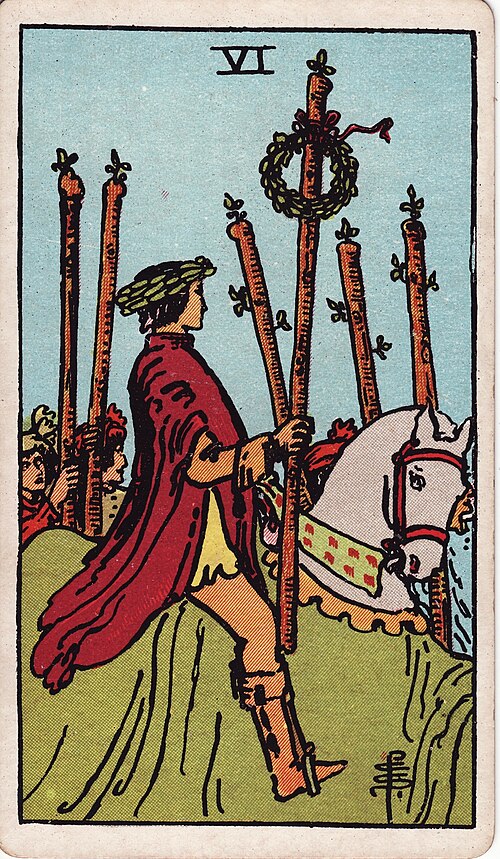
Six of Wands at a glance
The Six of Wands is Minor Arcana, suit of Wands, rank Six, and sequence position 28 in this RWS series. It follows the Five of Wands and comes before the Seven of Wands. Its central dynamic is visible progress after effort: a person or project receives attention, carries a message forward, or gains confidence from a result. Recognition can be deserved and useful, but it can also become dependence on applause. The card describes a current pattern of acknowledgment and direction; it does not guarantee permanent victory, status, or public approval.
RWS visual language
A rider sits on a white horse moving toward the left side of the card. The rider wears a red garment and a green wreath or laurel crown, and holds a tall wand decorated with a leafy wreath. Additional upright wands rise around the lower part of the scene, suggesting supporters or a procession without requiring us to identify every unseen person. The sky is light, and the landscape is open and green rather than enclosed or stormy. The horse and rider occupy the visual center and travel in a clear direction, while the repeated wands connect personal movement with public attention. These are observable image cues. Traditional interpretations often extend them into victory, acclaim, news, or leadership; a modern practical reading also asks what evidence supports the recognition and what responsibility follows it.
Keywords and how they follow from the card
The concise keyword set is recognition, progress, confidence, leadership, and visibility. Recognition follows from the wreaths and central rider. Progress follows from the moving horse and open route. Confidence follows from the upright posture and clear direction, though confidence is not the same as infallibility. Leadership follows from one figure occupying the front of a group, but the surrounding wands remind us that support and context matter. Visibility follows from the public-looking procession. These keywords are interpretive handles, not a promise that an audience will approve.
- Recognition and acclaim
- progress after effort
- visible leadership
- confidence under attention
- responsibility to supporters.
Upright meaning
Upright, the Six of Wands suggests that effort has become legible to other people or that a result is ready to be shared. Its strengths are morale, clear communication, the ability to represent a group, and the confidence to keep moving after a challenge. In work or creative study, it can support presenting a finished stage, accepting fair credit, or using feedback to build the next milestone. Its risks of excess are vanity, overpromising, confusing popularity with quality, and treating collaborators as background. Practical action is to document what was achieved, acknowledge contributions, state the next measurable step, and remain open to correction. If the question concerns an outcome, read the card as favorable visibility or momentum rather than an unconditional guarantee.
- Strengths: morale, communication, representation, and earned confidence. Risks: applause-seeking, inflated claims, entitlement, and neglect of the team. Action: verify the result, share credit, and set the next milestone.
Reversed meaning
Reversed does not automatically cancel progress or turn the card into failure. It can show recognition that is delayed, private, uneven, or difficult to trust. Blockage may be an absent audience, unclear evidence, or a project that cannot yet communicate its value. Internalization can appear as self-doubt after praise, fear of being exposed, or a need to approve your own work before seeking external approval. Excess may be performance for its own sake, dependence on status, exaggerated claims, or taking credit from others. Delay can mean an announcement, promotion, result, or public response arrives later than expected. Direction adjustment is to return to substance: check facts, repair trust, ask for specific feedback, and choose a pace that the evidence can support. Sometimes the reversal means stepping out of the spotlight so the work can mature.
- Blockage: achievement is hard to show or verify. Internalization: praise does not become confidence. Excess: image outruns substance. Delay: recognition or news is late. Adjustment: rebuild evidence, share credit, and let results lead.
Relationships, emotions, work, resources, and growth
In relationships and emotions, upright can describe appreciation, public support, a partner celebrating a milestone, or the confidence to express affection clearly. It can also ask whether one person is performing success for an audience. Reversed may indicate validation hunger, embarrassment, hidden insecurity, or recognition that is not being communicated; it does not reveal another person’s private feelings. In work and study, the card favors a presentation, assessment, promotion discussion, portfolio, or milestone, provided claims are backed by evidence and credit is shared. For money and resources, it may point to improved visibility, a successful sales message, or a resource opportunity, but never guarantees investment returns or future income. Check contracts, budgets, and actual performance. For personal growth, practice receiving praise without making it your identity, and convert encouragement into a repeatable habit. Confidence becomes durable when it survives a quiet day.
Spreads and position changes
For a one-card prompt, ask, “What progress is visible, and what responsibility comes with being seen?” The emphasis is on evidence and stewardship rather than a simple yes. In a three-card situation, action, outcome spread, Six of Wands in Situation describes current recognition or momentum; in Action it recommends communicating a result, accepting appropriate leadership, or celebrating without exaggeration; in Outcome it suggests acknowledgment or forward movement whose durability depends on follow-through. In a past, present, future spread, it can show an earlier win, present visibility, or a future result that becomes public. In relationship positions, Self can show how you seek or offer appreciation, Other Person describes the role that person presents in the situation rather than their hidden mind, and Interaction shows whether recognition is mutual or competitive. In a decision spread, Opportunity can be a platform or chance to represent others, Risk can be ego, publicity without substance, or dependence on approval, and Advice can be to verify claims and share credit. In Obstacle, the card may show pride or fear of exposure; in Advice, it favors clear evidence and generous acknowledgment; in Outcome, it points to the kind of recognition created by current conduct. The position changes the emphasis, not the reality of the question.
Instructional combination example
Instructional example, not a real case: Five of Wands beside the Six of Wands can describe competition becoming visible progress when effort is organized and a result can be demonstrated. The Five supplies testing and friction; the Six supplies public direction and recognition. Six of Wands beside Seven of Wands can modify acclaim with the need to defend standards or boundaries. The adjacent card may show what recognition requires, but it does not convert symbolism into a guaranteed event.
Misreadings, traditions, and responsible use
A common misreading is “the Six of Wands guarantees winning” or “a wreath means celebrity.” The RWS picture supports a public movement and symbols of distinction, but the scale and permanence of recognition depend on the question and surrounding cards. Marseille-style pip cards often provide less narrative scene, so readers may emphasize number, suit, and combination differently. RWS and Marseille traditions also differ in the numbering of Strength and Justice: RWS places Strength at VIII and Justice at XI, while Marseille commonly reverses those positions; imagery and interpretive systems vary as well. This series uses RWS numbering and image analysis. Tarot is a cultural, symbolic-reading, and self-reflection tool, not scientifically validated predictive power. Do not use the card to read a third party’s mind, promise a medical or legal result, or make investment-return decisions. For consequential choices, use evidence, consent, qualified professional advice, and your own judgment.
Journal prompts and learning links
Journal prompts: What evidence supports the recognition I want or have received? Whose effort needs to be acknowledged? Where could confidence become performance? What next step would make this progress repeatable? Suggested learning links are the previous card, Five of Wands, at tarot-card-five-of-wands; the next card, Seven of Wands, at tarot-card-seven-of-wands; and the foundational guides Tarot for Beginners at tarot-for-beginners, Tarot Wands at tarot-wands, Upright and Reversed Tarot at tarot-upright-and-reversed, How to Ask Tarot Questions at tarot-how-to-ask, and Tarot Journal Review at tarot-journal-review. These links add method and context without replacing this card’s individual meaning.