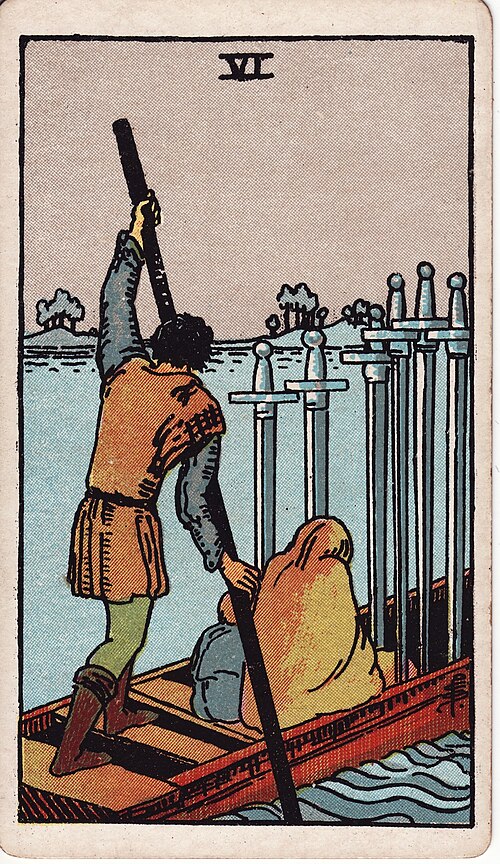
Six of Swords at a glance
The Six of Swords is a Minor Arcana card in the Swords suit, rank Six, and position 56 in the 78-card sequence. In the RWS order it follows the Five of Swords and precedes the Seven of Swords. Swords organize thought, language, judgment, boundaries, and mental strain; the number six introduces movement toward a more workable balance after the disruption of five. The card can describe transition and recovery, but it does not promise an easy journey or a particular destination.
RWS visual details and source layers
The RWS image shows a boat on water. A standing ferryman guides it while a cloaked passenger sits with a smaller figure. Six upright swords are set into the boat, their blades pointing upward. The water appears more unsettled on one side and calmer toward the distant shore on the other. A gray sky, muted blue water, brown boat, and far green or brown land create a quiet, transitional atmosphere. The swords remain present during the crossing, so movement does not mean that every thought, grief, or problem has already been resolved.
Arthur Edward Waite's 1911 The Pictorial Key to the Tarot identifies Waite as author and Pamela Colman Smith as illustrator. This article separates visible RWS details from traditional interpretation and modern reflective practice. The ferryman, passenger, and change in water are image-based prompts; they are not evidence that a specific trip, rescue, or future event must occur.
Keywords and how the image supports them
The main keywords are transition, passage, recovery, distance, guidance, acceptance, mental clarity, and carried knowledge. Transition and passage follow the boat's visible movement between shores. Recovery follows the contrast between rougher and calmer water, while distance follows the act of leaving one setting for another. Guidance arises from the ferryman's role, but it does not require surrendering judgment. The six swords explain carried knowledge: the traveler brings difficult thoughts and lessons along rather than erasing them.
- Transition: identify what is ending and what is beginning. Passage: read the card as a process, not an instant result. Recovery: look for a calmer operating condition without claiming complete healing. Guidance: accept useful support while retaining agency. Distance: create space from noise or conflict. Carried knowledge: use experience as information rather than letting it become permanent baggage.
Upright Six of Swords meanings
Upright, the Six of Swords often describes a deliberate move away from mental turbulence toward a more manageable situation. It can be physical travel, a change of team, a new study method, a boundary that creates distance, or an internal shift in how a difficult experience is understood. Its strengths are planning, continuity, acceptance of help, and the ability to keep moving without pretending the past never happened. The ferryman suggests practical skill or support, while the passenger suggests that receiving help can be part of progress.
The risk is emotional detachment or avoidance. A person may leave the argument but carry every sword into the next setting, or call escape recovery without addressing an essential issue. Practical action is to name the destination in workable terms, arrange transport or support, sort what must be carried, and set a review point. Move at a pace that respects resources and consent. Upright does not guarantee a smooth outcome; it describes a direction that still contains uncertainty.
Reversed Six of Swords meanings
Reversed does not automatically mean failure. As blockage, it can show being unable to leave a draining pattern, lacking a safe route, or trying to move without enough practical support. As internalization, it may describe a private transition, grief processed quietly, or a change of viewpoint that others cannot yet see. As excess, it can become escape, denial, over-planning, emotional withdrawal, or carrying every old fear into a new environment. As delay, travel, relocation, a conversation, or recovery may be slowed by logistics or unresolved feelings.
Direction adjustment may mean revisiting the route, asking for assistance, reducing the load, or accepting that a return to an unfinished issue is part of progress. If the card represents a quiet inner crossing, give the process time rather than forcing a public explanation. If the question involves danger, displacement, or mental health, symbolism cannot replace a safety plan or qualified professional support. Reversed may show that the desired movement is real but not yet properly resourced.
Applications in relationships, work, resources, and growth
In relationships and emotions, the Six of Swords can indicate a calmer conversation after conflict, a period of distance, a change in relationship terms, or two people moving through a difficult phase with support. It does not prove that another person will return, stay, or feel a particular way. Describe observable agreements and choices. Emotionally, notice whether distance creates perspective or simply postpones needed communication.
For work and study, the card supports changing a workflow, leaving a hostile environment, transferring knowledge, moving to a new course, or using a mentor's guidance. Make the transition concrete with dates, documents, transport, training, and a handover. Reversed, check whether indecision, incomplete preparation, or fear of unfamiliar material is extending the delay.
For money and resources, it can point to planned relocation costs, debt or budget restructuring, transport, staged spending, or carrying resources from one phase to another. Treat it as a prompt to calculate the route and contingencies, not as a guarantee of financial improvement or investment advice. In personal growth, study how you carry experience: keep the lesson, question the fear, and decide which burdens no longer belong in the next chapter.
Six of Swords in spreads and positions
In a one-card reading, ask: What is the next manageable step away from mental turbulence, and what support does it require? The card may emphasize a route, a change of perspective, a period of distance, or the need to accept guidance. In a three-card past, present, future spread, the past can show the strain that made movement necessary, the present the route and available support, and the future the condition toward which the process is heading; it is not a fixed prediction. In a situation, action, outcome spread, the situation is a transition, the action is planning and carrying only what is useful, and the outcome is an emerging but not guaranteed calmer arrangement.
In relationship positions, Self describes how you are moving, grieving, or creating distance; Other Person describes the role or behavior represented by that position rather than hidden thoughts; Interaction describes whether the connection is traveling together, separating, or negotiating a new distance. In a decision spread, Opportunity can be a change of setting or mental frame, Risk can be avoidance, travel strain, or unexamined baggage, and Advice can be to plan the route and secure support. In obstacle, advice, and outcome positions, the obstacle may be fear of leaving or inadequate preparation, the advice may be a staged transition with clear communication, and the outcome describes the direction produced by those choices.
Instructional combination reading
Instructional example, not a real case: Five of Swords followed by Six of Swords can describe leaving a win-lose argument rather than extending it. Four of Swords beside Six of Swords can make rest and preparation prerequisites for movement. Six of Swords beside Seven of Swords may ask whether the route is thoughtful strategy or avoidance. Adjacent cards refine the kind of transition being discussed; they do not promise safe travel or erase the need for practical planning.
Common misreadings, deck differences, and responsible use
A common misreading treats the Six of Swords as a guaranteed move, permanent escape, literal exile, or proof that someone is secretly leaving. Another assumes that the boat means instant healing. The visible scene supports passage, distance, and carried difficulty, while the question and surrounding cards determine whether the movement is physical, relational, intellectual, or emotional. Pip-based Marseille readings may give less narrative weight to the RWS boat scene, and other decks can alter the passengers, water, direction, and colors. RWS and Marseille traditions also differ in the numbering of Strength and Justice and in some imagery; this series uses RWS numbering and primary image analysis.
Use tarot as a cultural, symbolic-reading, and self-reflection tool rather than a scientifically validated predictive system. Do not use this card to decide medical care, legal action, financial returns, employment choices, or the fate of a third party. For relocation, travel, conflict, grief, or safety concerns, combine reflection with evidence, logistics, consent, and qualified help. The card can support a question; it cannot carry responsibility for the answer.
- Journal prompts: What am I leaving, and what am I still carrying with me? Which form of support would make this transition more realistic? Is distance creating perspective, or postponing a necessary conversation? What lesson can I keep without turning it into a permanent burden?
Suggested learning links
Continue to the previous card, Five of Swords, at tarot-card-five-of-swords, and the next card, Seven of Swords, at tarot-card-seven-of-swords. For foundations, see Tarot for Beginners at tarot-for-beginners, the Swords suit guide at tarot-swords, the upright and reversed method at tarot-upright-and-reversed, Three-Card Tarot Spreads at three-card-tarot-spreads, and Tarot Journal Review at tarot-journal-review. These links provide method and context without replacing this card's individual reading.