Six of Pentacles at a Glance
The Six of Pentacles is a Minor Arcana card in the Pentacles suit, rank six, and position 70 in this 78-card RWS series. Its central question is how resources move between people: who gives, who receives, who decides the terms, and whether the exchange supports dignity. The card can describe generosity, fair compensation, mentoring, or practical assistance, but also unequal power, conditional giving, and dependence. It is a symbolic framework for reflection, not a promise of wealth or rescue.
This series uses the Rider-Waite-Smith order and primary image analysis. RWS places Strength at VIII and Justice at XI, while many Marseille traditions reverse those numbers and use different imagery. Across decks, the giver, scales, coins, and surrounding scene may change, so interpret the actual card before applying inherited keywords.
What the RWS Image Shows
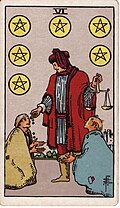
A well-dressed standing figure occupies the center of the scene. One hand extends downward toward a kneeling figure, while the other holds a balance scale. Two figures kneel or crouch near the giver with their hands extended. Six gold pentacles are visible in the composition, reinforcing the suit and rank. The standing figure's elevated posture contrasts with the recipients' lower positions, making the direction of resources and power visible.
Red, blue, purple, gray, and gold clothing distinguish the figures and the coins. The giver faces toward the recipients rather than away from them; the scales introduce a second action alongside the hand-to-hand distribution. The image shows an exchange, but it does not tell us whether the terms are fair, whether the recipients have equal need, or what happens afterward. Those questions belong to interpretation and real-world inquiry, not to visual fact.
A. E. Waite's The Pictorial Key to the Tarot, published in 1911 and illustrated by Pamela Colman Smith, remains an important public-domain reference for the RWS tradition. Its traditional charity emphasis is useful context, but no single book controls every deck or modern practice. The practical synthesis here follows the visible contrast between giving, receiving, weighing, and social position.
Keywords and Why They Fit
- Giving and receiving: the central hand-to-hand action makes resource movement explicit. Fairness and discernment: the scales ask how amount, need, and terms are assessed. Reciprocity: the scene raises the question of whether exchange continues in both directions. Stewardship: the giver allocates a limited, countable resource. Power asymmetry: one person stands while two people kneel. Conditional support: the image shows a transaction, but not whether the gift is free of strings. These keywords come from posture, objects, number, and traditional suit practice rather than an unexplained list.
The Six of Pentacles is therefore less about being simply rich or poor than about the structure of access. The same card can support generosity in an advice position and warn about control in an obstacle position. Ask who has choice, who bears the cost, and whether the arrangement can be named openly.
Upright Six of Pentacles Meaning
Upright, the Six of Pentacles often describes practical generosity, timely assistance, fair exchange, scholarships, mentoring, compensation, or a resource being redistributed. Its strength is responsiveness: identify a real need, offer what is sustainable, and make the terms clear. It can also represent receiving without shame, provided the arrangement respects consent and dignity.
Its risk of excess is paternalism or performance. Giving may become a way to control the recipient, purchase loyalty, display virtue, or avoid addressing an unfair system. A practical action is to ask what the other party actually needs, document agreements, distinguish gift from loan, pay fairly for labor, and set a limit that does not create resentment. Generosity is not automatically ethical simply because it is generous.
Reversed Six of Pentacles Meaning
Reversed, the Six of Pentacles can show a blocked exchange, support withheld, private shame about receiving, excessive giving, delayed approval, or a need to renegotiate the direction of resources. It does not automatically mean exploitation or failure. Read whether the problem is lack of access, unclear terms, unequal power, or an internal struggle over dependence and autonomy.
- Blockage: a request, payment, opportunity, or act of care is held back or reaches the wrong place. Internalization: pride, shame, obligation, or fear of owing someone is processed privately. Excess: overgiving, underpaying, rescuing, scorekeeping, or accepting help that removes agency distorts the exchange. Delay: approval, reimbursement, funding, feedback, or a promised favor remains conditional or slow. Direction adjustment: clarify whether the arrangement is a gift, loan, wage, trade, or boundary
- ask for reciprocal terms
- or redirect help toward a sustainable channel.
A constructive reversed reading may invite a smaller and clearer exchange. Receive only what is appropriate, offer without taking over, and verify the terms before agreeing. For significant financial or legal arrangements, use written records and qualified advice rather than symbolic interpretation.
Applications by Life Area
Relationships and emotions: upright, the card can suggest mutual care shown through practical acts, balanced generosity, or learning to accept support. Reversed, look for scorekeeping, emotional debt, rescuing, or fear that receiving removes independence. Do not use it to infer a partner's motives; discuss expectations and consent directly.
Work and study: upright, seek mentorship, fair credit, useful feedback, scholarships, or compensation that matches the work. If you are the person with authority, share information and opportunities without making people perform gratitude. Reversed, check unpaid labor, unequal access, delayed payment, or a supervisor who uses help as leverage.
Money and resources: use the card to review budgets, gifts, loans, wages, shared expenses, charitable giving, and repayment expectations. It is not financial or investment advice. Upright can prompt transparent generosity; reversed can signal that a seemingly helpful arrangement needs documentation, boundaries, or professional review.
Personal growth: practise both generosity and receptivity without turning either into identity. Notice whether help is offered because it is useful or because control feels safer. A mature expression of the card can include asking for assistance, paying a fair share, sharing credit, and releasing the need to keep a perfect score.
Six of Pentacles in Spreads
- One-card prompt: What resource is moving between people, and are the terms clear and dignified? Three-card past, present, future: in the past, identify an established pattern of giving or receiving
- in the present, assess the current balance of access and power
- in the future, read what may develop if terms are clarified, without treating the card as a guaranteed benefactor. Situation, action, outcome: the situation names the exchange, the action sets a fair request or boundary, and the outcome describes the likely practical effect of that adjustment. Relationship self, other person, interaction: Self examines your capacity to give or receive
- Other Person describes their observable role or leverage, not their private thoughts
- Interaction studies reciprocity, obligation, and consent. Decision opportunity, risk, advice: Opportunity may be support, mentoring, or fair collaboration
- Risk may be dependency, strings, or unequal bargaining power
- Advice is to define the terms and preserve agency. Obstacle, advice, outcome: obstacle shows where resources are blocked or misallocated, advice chooses a transparent correction, and outcome shows what becomes more balanced or what still needs negotiation.
Instructional Combination Reading
Instructional example, not a real case: Five of Pentacles followed by Six of Pentacles moves from visible shortage to a question about access and exchange. It can suggest locating a support channel, but the Six asks whether the help is adequate, respectful, and sustainable rather than assuming rescue. Six of Pentacles beside Seven of Pentacles shifts the emphasis toward review: give or receive according to a plan, then evaluate results before increasing the commitment. Adjacent cards refine the conditions; they do not guarantee an outcome.
Common Misreadings, Traditions, and Responsible Use
Do not reduce the Six of Pentacles to charity, wealth, or a guaranteed loan. The scales do not prove that the arrangement is fair; they make fairness a question. Another mistake is treating the standing figure as automatically wise or the kneeling figures as permanently helpless. Roles can change, and support should not erase agency. RWS-based readers often emphasize generosity and social imbalance; Marseille pip-card readers may focus more on the number six, suit pattern, and surrounding cards. Other decks may change the people, objects, or social scene.
Use tarot as cultural study, symbolic interpretation, and self-reflection, not scientifically validated prediction. Do not use it for medical, legal, investment-return, lending, employment, or guaranteed-fate decisions. Do not read a third party's mind or use a card to pressure someone into giving money, affection, or access. For consequential exchanges, rely on consent, written terms, records, and qualified professionals.
Tarot Journal Prompts
- Where in this situation is power concentrated, and what would make the terms clearer? Am I giving from capacity, guilt, control, or a wish to be needed? What kind of help can I receive without surrendering agency? How can I measure whether an exchange is fair over time?
Suggested Learning Links
For sequence context, read back to the independent Five of Pentacles article at tarot-card-five-of-pentacles and continue next to Seven of Pentacles at tarot-card-seven-of-pentacles as that series entry becomes available. For foundations, use Tarot for Beginners at tarot-for-beginners, the Pentacles suit guide at tarot-pentacles, Upright and Reversed Tarot at tarot-upright-and-reversed, How to Ask Tarot Questions at tarot-how-to-ask, Three-Card Tarot Spreads at three-card-tarot-spreads, and Tarot Journal Review at tarot-journal-review. These resources add method without replacing this card-specific analysis.