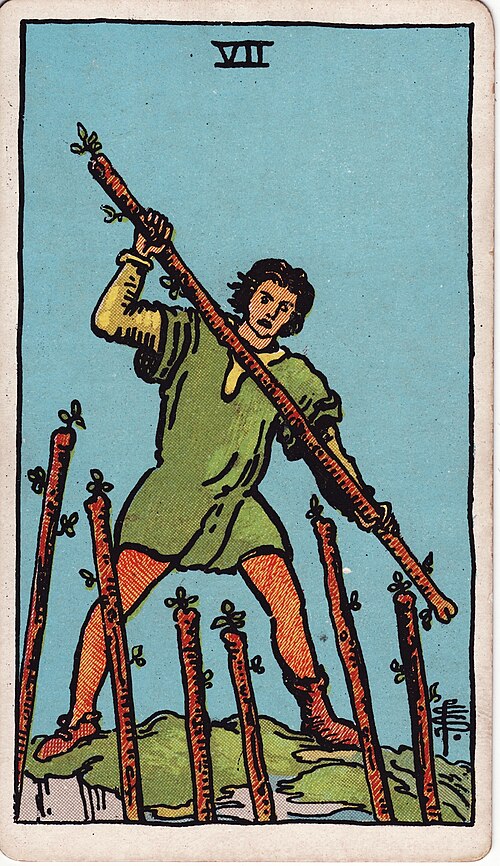
Seven of Wands at a glance
The Seven of Wands is Minor Arcana, suit of Wands, rank Seven, and sequence position 29 in this RWS series. It follows the Six of Wands and comes before the Eight of Wands. Its central dynamic is holding a position while pressure arrives from several directions. The card can describe courage, boundaries, persistence, or a necessary defense of standards. It does not prove that opponents exist, guarantee victory, or tell you to fight every challenge. Read it as a question about what is worth protecting, what evidence supports your stance, and whether your footing is stable enough for the effort.
Historical and deck context
The scene belongs to the Rider-Waite-Smith illustrated tradition associated with A. E. Waite's system and Pamela Colman Smith's illustrations. The 1911 edition of Waite's The Pictorial Key to the Tarot is catalogued under Waite's name and credits Smith for the illustrations. That historical layer is distinct from later keyword tables and modern reflective practice. In this article, observable image details come first, traditional interpretation is identified as tradition, and practical applications are editorial synthesis rather than claims of scientifically validated prediction.
RWS visual language
A single young-looking figure stands on an uneven rise of ground and grips one wand with both hands. Six other wands rise from below toward the figure; no hands or faces are visible behind them, so it is safer to call them approaching staves than to invent named attackers. The figure's attention and body angle face that approach, while the lower-to-upper direction of the staves makes the ground feel contested. Green clothing and reddish-orange lower clothing stand out against a pale blue sky, green hills, and open terrain; brown boots emphasize the problem of footing. The elevated figure, one held wand, and six upward lines create a visual imbalance: one person must respond to many pressures, but height may also provide perspective.
Keywords and how they follow from the card
The concise keyword set is boundaries, courage, persistence, challenge, discernment, and selective engagement. Boundaries follow from one figure marking a position against several rising staves. Courage follows from staying visible rather than abandoning the high ground. Persistence follows from the effort implied by the upward angles and uneven terrain. Challenge is visible in the multiple lines converging on one point. Discernment matters because the picture does not identify the people or motives behind the staves. Selective engagement follows from the practical question: not every pressure deserves the same response. These are interpretive handles, not fixed predictions.
- Boundaries and standards
- courage under pressure
- persistence with limited footing
- discernment about what to answer
- selective engagement instead of automatic conflict.
Upright meaning
Upright, the Seven of Wands suggests a need to maintain a position, defend a principle, or continue a demanding effort after earlier progress. Its strengths include healthy assertiveness, resilience, the ability to name limits, and willingness to protect work that matters. It may support answering fair criticism, negotiating scope, preparing evidence, or saying no to a demand that would weaken the project. Its risks of excess are defensiveness, treating questions as attacks, isolation, stubbornness, and spending energy on every provocation. Practical action is to define the boundary, identify the actual standard, gather evidence, and decide which response is proportionate. A strong stance can include listening, revision, or asking for help; it need not be loud.
- Strengths: resilience, clear limits, advocacy, and sustained effort. Risks: reactivity, siege thinking, rigidity, and unnecessary battles. Action: clarify what is being protected, document why, and choose the smallest effective response.
Reversed meaning
Reversed does not automatically mean defeat or weakness. Blockage may appear as poor footing, unclear authority, a boundary that was never stated, or too many demands arriving at once. Internalization can show anxiety about being challenged, rehearsed arguments that never become a conversation, or the feeling that self-protection must happen alone. Excess can turn courage into suspicion, refusal, exhaustion, or a need to prove oneself repeatedly. Delay may involve postponing a difficult reply, waiting for approval, or holding a position until better evidence arrives. Direction adjustment is to check the premise, distinguish a real threat from ordinary feedback, move the conversation to a clearer setting, and revise the plan when the facts require it. Sometimes the reversal advises a strategic retreat, rest, delegation, or a boundary that is less combative and more precise.
- Blockage: unstable ground or undefined limits. Internalization: private fear of criticism. Excess: defensiveness or burnout. Delay: a response or decision is postponed. Adjustment: verify the pressure, reset the boundary, and conserve effort.
Relationships, emotions, work, resources, and growth
In relationships and emotions, the upright card can describe protecting personal limits, speaking up about a need, or staying steady while a relationship is tested. It can also ask whether self-protection has become a permanent defensive posture. Reversed may point to guardedness, emotional fatigue, fear of disagreement, or a delayed conversation; it cannot reveal another person's hidden motives. In work and study, the card favors defending a proposal, revising an argument, meeting a demanding standard, or protecting focused time. Check whether criticism is useful before treating it as opposition. For money and resources, it can suggest safeguarding a budget, negotiating terms, or resisting pressure to spend beyond a limit; it is not a promise of financial security or investment returns. Review actual figures and seek qualified advice for consequential decisions. For personal growth, practice assertiveness that remains teachable: state the limit, hear the response, and change course when evidence—not fear—requires it.
Spreads and position changes
For a one-card prompt, ask, “What is worth protecting, and what is the most proportionate way to protect it?” The emphasis is on a boundary and its method, not a yes-or-no verdict. In a three-card past, present, future spread, the card may show an earlier test that shaped current vigilance, a present need to hold ground, or a future period requiring preparation; it does not fix the future. In a situation, action, outcome spread, it describes the pressure in the Situation position, recommends a clear and evidence-based defense in Action, and in Outcome shows a result shaped by endurance, flexibility, and the quality of the boundary. In relationship positions, Self describes how you protect or contest space, Other Person describes the role that person presents in the interaction rather than their private mind, and Interaction shows whether the relationship is mutually defended, competitive, or capable of respectful negotiation. In a decision spread, Opportunity may be a chance to advocate or preserve standards, Risk may be needless escalation or exhaustion, and Advice may be to prepare facts and define a stopping point. In Obstacle, the card can show defensiveness or scattered pressure; in Advice, disciplined boundary-setting; in Outcome, the consequences of the stance you actually take.
Instructional combination example
Instructional example, not a real case: Six of Wands beside the Seven of Wands can shift public recognition into the responsibility to defend the quality behind that recognition. The Six supplies visibility; the Seven asks how the result will be maintained under scrutiny. Seven of Wands beside Eight of Wands can modify defense with a need for rapid communication: a boundary may work best when stated promptly and simply. The neighboring card changes emphasis, but it does not establish that a particular person is attacking or that success is guaranteed.
Common misreadings, traditions, and responsible use
A common misreading is “the Seven of Wands means enemies and certain victory.” The RWS image supports a lone position, converging pressure, and effort under unequal conditions; it does not identify enemies, rank their intentions, or promise a winner. Another mistake is to glorify exhaustion as courage. Marseille-style pip cards often show less narrative action, so a Marseille reader may give greater weight to the number seven, the Wands pattern, color, and surrounding cards. Some modern decks change clothing, terrain, or the direction of the action. RWS and Marseille traditions also differ in the numbering of Strength and Justice: RWS places Strength at VIII and Justice at XI, while Marseille commonly reverses those positions; imagery and systems of correspondence differ as well. This series uses RWS numbering and primary image analysis. Tarot is a cultural, symbolic-reading, and self-reflection tool, not a scientifically validated predictive method. Do not use this card to read a third party's mind, diagnose health, decide legal matters, or promise investment returns. Use evidence, consent, qualified professional advice, and your own judgment for high-stakes choices.
Journal prompts and learning links
Journal prompts: What exactly am I protecting, and why does it matter? Which pressure is real, and which pressure is an assumption? Where could I replace defensiveness with a clear request? What evidence would show that my current stance needs revision? Suggested learning links are the previous card, Six of Wands, at tarot-card-six-of-wands; the next card, Eight of Wands, at tarot-card-eight-of-wands; and the foundational guides Tarot for Beginners at tarot-for-beginners, Tarot Wands at tarot-wands, Upright and Reversed Tarot at tarot-upright-and-reversed, How to Ask Tarot Questions at tarot-how-to-ask, Three-Card Tarot Spreads at three-card-tarot-spreads, and Tarot Journal Review at tarot-journal-review. These links add method and suit context without replacing this card's individual reading.