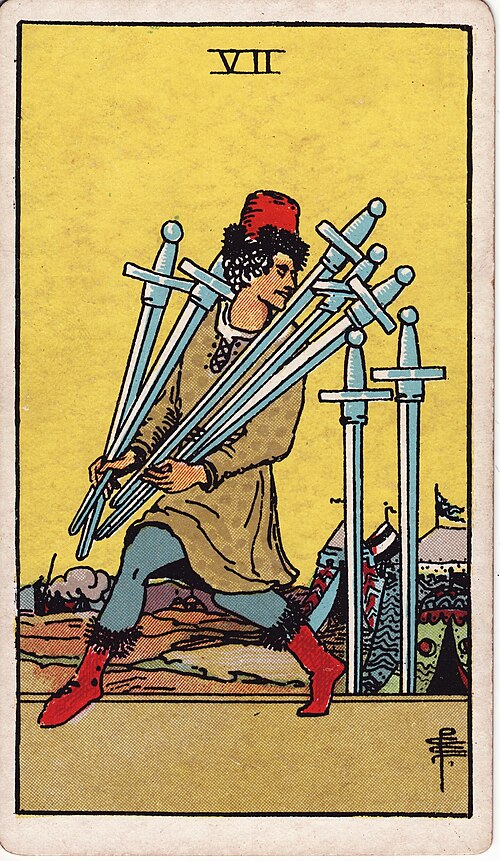
Seven of Swords in the RWS Sequence
The Seven of Swords is Minor Arcana VII of the Swords suit and position 57 in this 78-card RWS sequence. Swords organize questions about thought, language, judgment, conflict, boundaries, and decisions. As the seventh numbered card, it asks how an idea or plan operates when direct force is not the only option. The card can describe strategy, privacy, retreat, or an attempt to avoid accountability; the question and surrounding cards decide which emphasis is useful.
This series follows the Rider-Waite-Smith numbering: Strength is VIII and Justice is XI. Many Marseille-style sequences place Justice at VIII and Strength at XI, and the two traditions also differ in pip-card imagery and some symbolic details. Those differences are meaningful school distinctions, not errors. The analysis here uses the RWS scene and the interpretive tradition associated with A. E. Waite's Pictorial Key, while separating visible evidence from later practical reading methods.
What the RWS Image Shows
A solitary figure moves away from a camp or settlement, carrying five swords gathered in one hand. Two more swords remain upright behind him. His body travels toward one side of the scene while his head turns back, so his movement and attention point in different directions. Warm red and tan clothing stands out against a pale yellow sky and ochre ground; muted blue-gray forms and structures recede in the distance. The image is open rather than enclosed, and the remaining swords are clearly visible rather than erased.
These observable choices create a visual tension between departure and attachment. The figure has taken useful tools but has not taken everything. His backward glance can suggest caution, concern, checking for pursuit, or reluctance to leave the situation fully. Traditional readings often extend this into stealth, cleverness, evasion, or an unfinished obligation. Those are interpretive possibilities, not proof that a person is lying or that a hidden event is occurring. Start with what the composition shows, then test the interpretation against the question and facts.
Keywords from Image and Tradition
- Strategy and independence: one figure chooses a separate route and carries only part of the available equipment, so the keyword follows from selective movement rather than brute confrontation. Privacy and selective disclosure: the turned head and departure can describe information held back until timing or safety improves. Tactical withdrawal: leaving a crowded or adversarial setting may be a deliberate way to preserve energy and options. Accountability and unfinished business: two swords remain in view, reminding the reader that a partial solution can leave consequences, witnesses, or duties behind.
Upright Seven of Swords Meanings
Upright, the Seven of Swords often describes a situation that rewards careful planning, discretion, and a realistic appraisal of what can be carried forward. Its strength is flexible intelligence: identify the essential tools, avoid a needless contest, protect confidential information, and choose an approach that fits the actual conditions. In a relationship, that might mean taking a private pause before a difficult conversation. At work or in study, it might mean preparing a proposal quietly, checking assumptions, or changing tactics after a poor first attempt.
The card's risk is not cleverness itself but cleverness without ethics or completion. Excess can become manipulation, secrecy that damages trust, taking credit for another person's work, avoiding a necessary conversation, or designing a plan so private that nobody can support it. A useful upright action is to define the purpose of privacy and its review point: what must remain confidential, what can be shared, who is affected, and when the plan will be reconsidered. Keep evidence, name responsibilities, and do not confuse a temporary retreat with a finished resolution.
Reversed Seven of Swords Meanings
Reversed, the Seven of Swords does not automatically mean confession, exposure, or moral failure. It may show blockage around strategy: too many moving parts, fear of being seen, or an avoidance plan that no longer works. It can internalize the card as private worry, self-protective rumination, or the feeling that every choice must be made alone. It can also indicate excess, such as secrecy becoming isolation, cleverness becoming self-sabotage, or suspicion expanding beyond the available evidence.
The reversed card may describe delay when a person keeps revising a departure without taking a clear step, or when an unfinished duty repeatedly returns. Direction adjustment asks for a more transparent and proportionate method: share the relevant facts, repair a breach where appropriate, seek advice, document a decision, or leave only after arranging the practical handoff. A constructive reversal can be the gradual release of an old evasive habit. The test is not whether the card feels positive; it is whether the chosen response reduces confusion and restores agency.
Applications by Life Area
- Relationships and emotions: Ask whether privacy is creating safety or distance. The card can support a needed boundary, a calm exit from an unproductive argument, or an honest request for time. Its shadow is withholding, testing someone indirectly, or assuming betrayal without checking. Focus on your choices and observable communication rather than claiming to know another person's thoughts.
- Work and study: Use the card for research, contingency planning, competitive awareness, and an efficient route through a complicated task. Credit sources, follow rules, and distinguish legitimate confidentiality from plagiarism, sabotage, or concealment of material risk. Reversed, simplify the plan and ask for clarification instead of working indefinitely in secret.
- Money and resources: Review what is being moved, withheld, or left exposed. A careful budget, private savings goal, or exit plan may be appropriate, but hidden debt, misleading terms, and impulsive transfers require concrete review. This card is not a prediction of theft and is not investment, tax, or legal advice.
- Personal growth: Notice where independence is a strength and where it has become a refusal of support. Practice naming one fact, one assumption, one responsibility, and one next step. Growth here means using discernment without making secrecy your identity.
Reading the Card in Spreads
In a one-card draw, use the Seven of Swords as a prompt to ask: What is the most ethical and efficient way to handle this situation, and what must not be left unresolved? In a three-card past, present, future spread, the past may show an earlier tactic or departure, the present may reveal what is being carried and what is still behind, and the future may point to a consequence or a revised strategy. In a situation, action, outcome spread, the card in the situation position describes the information gap or competing route; as action it recommends a measured plan; as outcome it suggests that a partial solution will need follow-through rather than guaranteeing escape.
In relationship positions, Seven of Swords for self can emphasize your boundaries, evasions, or need for private processing; for the other person, it should remain a prompt to examine the interaction rather than a claim about their hidden mind; in the interaction position, it can describe indirect communication, different agendas, or a mutually useful pause. In decision positions, opportunity may be a quieter route or a chance to preserve options, risk may be secrecy or an incomplete handoff, and advice may be to use strategy with explicit ethical limits.
For obstacle, advice, and outcome positions, an obstacle reading can show avoidance, divided attention, or the cost of carrying too much alone. Advice shifts the emphasis toward a plan, a boundary, a disclosure, or a clean departure. Outcome describes the likely direction of the current pattern, not fixed fate; the two visible swords left behind may signal remaining work, while a changed context could make the withdrawal wise. Let nearby cards, the question, and real-world feedback refine the emphasis.
Combination Reading: Instructional Example
Instructional example, not a real case: imagine Six of Swords, Seven of Swords, and Eight of Swords in a line. The Six frames movement as transition or recovery; beside it, the Seven makes the transition more tactical, perhaps requiring a private plan or selective disclosure. The Eight then shows how avoidance or limited information could harden into a feeling of confinement. Together they do not prove deception. They suggest checking whether the strategy is protecting a necessary boundary or creating the very isolation that makes the next step feel impossible.
Common Misreadings, Deck Differences, and Responsible Use
A common misreading reduces this card to the thief card and treats every appearance as proof of betrayal. Another assumes that secrecy is always wrong or that an upright card guarantees a successful escape. A reversed card is not automatically a moral correction. In RWS, the scenic numbered image supplies figures and action; in Marseille and other pip-based decks, the Seven of Swords may offer fewer narrative cues, so number, suit, neighboring cards, and the reader's school carry more weight. Some readers do not use reversals at all and instead read blockage from position and combination.
Tarot is best used here as a cultural and symbolic language for reflection, not as scientifically validated prediction. Do not use the Seven of Swords to read a third party's mind, accuse someone, justify surveillance, or replace professional legal, financial, medical, or safety support. When a situation involves coercion, abuse, fraud, or immediate danger, prioritize trusted people, qualified services, documentation, and local resources. Keep the card's suggestion proportional: make a verifiable plan, communicate where needed, and preserve freedom to revise it.
Journal Prompts and Suggested Learning Links
- 1. What am I carrying forward, and what responsibility or conversation remains behind? 2. Which part of my plan needs privacy, and which part needs accountable communication? 3. Where would one small, reversible action test my assumptions? 4. What evidence would show that withdrawal is helping rather than isolating me?
Suggested learning links: read the previous card, Six of Swords (tarot-card-six-of-swords), for transition and passage; continue to the next card, Eight of Swords (tarot-card-eight-of-swords), for perceived restriction and mental framing; and use the Swords suit guide (tarot-swords) for the suit's broader language. The foundational Tarot for Beginners guide (tarot-for-beginners), Upright and Reversed guide (tarot-upright-and-reversed), Three-Card Tarot Spreads guide (three-card-tarot-spreads), and How to Ask Tarot Questions guide (tarot-how-to-ask) provide method without replacing this card's specific image analysis.