Seven of Pentacles at a glance
The Seven of Pentacles is Minor Arcana, Pentacles suit, rank Seven, and position 71 in the 78-card Rider-Waite-Smith (RWS) sequence. It follows the Six of Pentacles and comes before the Eight of Pentacles. Its central question is not simply whether effort will succeed, but whether an investment deserves continued care, revision, or release. Pentacles bring the reading to work, money, the body, time, skills, land, and other tangible conditions. Seven adds a pause for observation: progress may be real while the final result remains unfinished.
This series uses the RWS order and primary image analysis. RWS and Marseille traditions differ in the numbering of Strength and Justice and in some imagery; the RWS places Strength at VIII and Justice at XI, while many Marseille decks reverse those numbers. That difference does not change this card's Minor Arcana number, but it is a useful reminder to name the deck or school being used.
RWS visual analysis
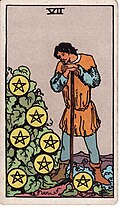
The RWS scene shows one figure in an earthy outdoor setting, leaning on a long staff and turning attention toward a leafy plant. Seven round pentacles are visible among the foliage. The figure is not shown celebrating or harvesting; the posture is quiet, weight-bearing, and observant, with the gaze directed at the plant rather than toward the viewer. Green leaves and stems contrast with the warm gold of the coins, while the clothing and ground use muted, practical colors. The background is a simple cultivated landscape rather than a palace or battlefield.
The image supports a reading about cultivation and evaluation without proving a particular future. The coins are placed within living growth, so material results appear connected to time, care, and conditions rather than being detached prizes. The staff gives the figure support but is not used as a weapon. Traditional interpretations often extend this visual pause into patience, return on effort, and a decision about whether to continue. That is interpretive tradition and editorial synthesis, not a scientifically validated prediction.
Keywords and how they arise
- Assessment follows the figure's attentive pause before the plant
- patience follows the time implied by living growth
- cultivation follows the connection between coins and foliage
- selective investment follows the question of whether more labor is worthwhile
- material progress follows the visible pentacles
- recalibration follows the gap between effort already spent and the harvest still pending. These keywords are prompts for looking at the image and the suit structure, not fixed answers.
Upright Seven of Pentacles meanings
Upright, the card describes a stage in which effort has produced evidence but not completion. Its strength is disciplined review: notice what is growing, measure it honestly, and decide what deserves another season of attention. It can support sustainable work, long-term learning, saving, gardening, recovery routines, and projects whose value becomes clearer gradually. The card favors a realistic time horizon over a quick reward.
Its risk is turning patience into passive waiting or treating past effort as a reason to continue automatically. A person can protect a weak plan because they have already invested in it, or keep measuring without taking the next useful step. A practical upright response is to define a review date, identify observable signs of progress, calculate the remaining cost, and choose between continuing, changing the method, or stopping. The card asks for stewardship, not self-punishment.
Reversed Seven of Pentacles meanings
Reversed, the Seven of Pentacles does not automatically mean failure or loss. It can show a blockage in evaluation: impatience, discouragement, unclear measures, or a plan whose timing does not fit present conditions. The theme may be internalized as worry about whether effort matters, or as comparison with someone else's visible results. It may also describe excess investment, where more time or money is poured into a project without testing its assumptions.
- For blockage, ask what evidence is missing and which decision has been postponed. For internalization, name the private fear beneath the repeated checking and separate it from observable facts. For excess, set a boundary on hours, spending, or emotional labor before continuing. For delay, distinguish a necessary maturation period from avoidable indecision and choose a new review point. For direction adjustment, change the method, scale, audience, or definition of success rather than merely working harder. A reversed card can therefore indicate a useful pause, a hidden preparation phase, or permission to redirect.
Applications in ordinary life
- Relationships and emotions: The card can describe a connection being assessed over time rather than judged by one intense moment. Ask whether care is reciprocal, whether shared plans have visible roots, and whether patience is supporting trust or concealing avoidance. Emotionally, it may invite tolerance for a slow process while still naming unmet needs. It cannot reveal another person's private thoughts
- use it to examine your observations, boundaries, and choices.
- Work and study: This is a strong image for reviewing a portfolio, research project, apprenticeship, garden of skills, or long course of study. Keep what is producing learning, diagnose weak methods, and set a concrete milestone. Its caution is perfectionistic monitoring or staying with a poor system because of sunk effort.
- Money and resources: Read the card as budgeting, staged investment of time or money, and checking whether resources are producing the intended value. It is not a promise of profit or a substitute for financial advice. Compare costs, liquidity, risk, and alternatives
- avoid making a high-stakes decision from the card alone.
- Personal growth: The figure models honest self-observation. Track habits and outcomes without reducing your worth to productivity. The next step may be continued practice, rest that protects the process, or releasing a goal that no longer fits your values.
Seven of Pentacles in spreads
In a one-card reading, use the prompt: What deserves a careful review before I invest more? The answer may emphasize timing, evidence, a resource, or the need to stop confusing waiting with action. In a three-card situation, action, outcome spread, the situation position describes what has already been planted, the action position asks what to tend or revise now, and the outcome position shows the likely direction of the process if those conditions continue. In a past, present, future spread, the card can mark an earlier investment, a present assessment, or a future harvest phase depending on its position.
- In a relationship spread, Self asks how you are tending the connection and what results you are evaluating
- Other Person should be read as the role or observable contribution represented in the spread, not as a claim about private feelings
- Interaction shows whether shared effort is balanced, stalled, or ready for a practical conversation. In a decision spread, Opportunity highlights a worthwhile long-term seed, Risk highlights delay or sunk-cost thinking, and Advice recommends a measured review with limits. In obstacle, advice, outcome positions, the card identifies unclear progress as the obstacle, calls for patient measurement as advice, or describes a result that develops only after sustained care. The position changes the emphasis
- the card does not assign one fixed answer.
Instructional combination example
Instructional example, not a real case: Six of Pentacles beside the Seven of Pentacles can shift the focus from private effort to the fairness of support, wages, or shared resources. The Seven beside the Eight of Pentacles can turn a general waiting period into a specific recommendation to improve technique while reviewing results. If a surrounding card shows urgency, the Seven may describe a necessary checkpoint rather than indefinite delay. Adjacent cards modify the question; they do not erase the Seven's emphasis on evidence and stewardship.
Common misreadings, traditions, and responsible use
A common misreading is calling this card laziness because the figure is not visibly harvesting. The image instead shows a pause with attention and effort already present. Another error is treating it as a guaranteed financial return, or as proof that every long project should continue. In RWS-style illustrated Minor Arcana, the scene supplies narrative details; Marseille pip cards may present the Seven more abstractly, making number, suit, orientation, and surrounding cards more prominent. Modern, esoteric, psychological, and practical schools may also give different weight to elemental or astrological correspondences. State your method and keep interpretations revisable.
Tarot is a cultural and symbolic-reading practice that can support reflection, not a scientifically validated predictive system. Do not use this card as medical, legal, or investment-return advice, and do not let a spread replace professional help, consent, a budget, or direct communication. For high-stakes choices, use verifiable information and qualified guidance. Treat the card as a prompt for agency: decide what you can measure, what you can change, and what boundary protects you.
Tarot journal prompts
- What evidence shows that my current effort is growing, and what evidence challenges that story?
- Where am I waiting wisely, and where am I postponing a decision?
- What resource, method, or boundary would make the next stage more sustainable?
Suggested learning links
For sequence context, continue to the Six of Pentacles article at tarot-card-six-of-pentacles, then compare this card with the Eight of Pentacles at tarot-card-eight-of-pentacles. For foundations, use Tarot for Beginners at tarot-for-beginners, the Pentacles suit guide at tarot-pentacles, Tarot Upright and Reversed at tarot-upright-and-reversed, Three-Card Tarot Spreads at three-card-tarot-spreads, and Tarot Journal Review at tarot-journal-review. These articles provide method and vocabulary without replacing this card's individual reading.