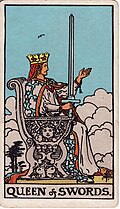
Queen of Swords: identity and tradition
The Queen of Swords is the Queen rank of the Swords suit, a court card in the Minor Arcana and position 63 in the 78-card Rider-Waite-Smith (RWS) sequence. Swords organize questions about thought, language, judgment, boundaries, and conflict; the Queen gives those themes a perceptive, self-possessed, and discerning mode. She may describe a person, a role, a stage of development, or a way to approach a situation. She is not a fixed label for a woman or a prediction about someone else’s private thoughts.
The RWS label refers to the tradition associated with A. E. Waite’s interpretive writing, Pamela Colman Smith’s illustrations, and the Rider publishing house; its authorship and publication history is more nuanced than a single-creator story. Waite’s The Pictorial Key to the Tarot is one historical source for traditional meanings, while the practical reading below also distinguishes visible imagery from later interpretation. RWS and Marseille traditions differ in some imagery and in the numbering of Strength and Justice: RWS uses Strength VIII and Justice XI, while many Marseille-order decks reverse those numbers. This series uses RWS order and primary image analysis.
RWS image: what the card shows
A crowned figure sits on a gray stone throne against an open, cloudy sky. She holds a straight sword upright in her right hand, keeping its line vertical and easy to see, while her other hand extends outward in an apparent gesture of reception, testing, or invitation. Her posture is upright and alert rather than relaxed. Blue-gray and red clothing create a cool, serious impression with a warm accent. Winged or butterfly-like motifs appear on the crown and throne, and the high seat separates her from the low horizon. The sword, direct gaze, elevated seat, moving clouds, and open hand are observable features; the ideas of truth, discernment, and independent judgment are traditional and editorial interpretations of that structure.
Keywords derived from the imagery
- Discernment, because the upright sword separates and clarifies
- honest speech, because the blade is displayed without concealment
- boundaries, because the seated figure controls access to her elevated position
- independence, because she faces the world without needing a companion in the scene
- perspective, because the throne gives her a wider view
- and compassionate truth, because the open hand keeps judgment from becoming mere rejection. These are prompts for interpretation, not a word list of guaranteed outcomes.
Upright Queen of Swords meanings
Upright, the Queen of Swords brings clear observation, precise language, and the courage to name what is actually known. Her strength is not harshness for its own sake; it is the ability to separate evidence from assumption and care from people-pleasing. In a difficult conversation, she favors a direct question, a stated boundary, or a calm account of what happened. In study or work, she supports editing, analysis, standards, research, and decisions based on relevant facts. Her risk is excess: a sharp answer can become contempt, constant testing can become mistrust, and self-protection can turn into emotional distance. A practical action is to write the facts, the interpretation, and the next question in separate lines before responding.
Reversed Queen of Swords meanings
Reversed does not automatically mean a bad person or a failed outcome. It may show a blockage in speaking plainly, or an internalized judgment that has not yet found a safe, constructive form. It can indicate excess through cutting criticism, suspicion, rigid standards, or using intelligence as armor. It may mark delay when a needed conversation is postponed while someone waits for perfect certainty. It can also show the opposite problem: a person knows the truth but cannot yet say it, or is absorbing someone else’s severe voice. Adjust direction by checking the evidence, softening the delivery without diluting the boundary, and choosing a realistic time for the conversation. If the card describes another person, treat it as a prompt to observe behavior rather than a license to diagnose motives.
Applications in life areas
In relationships and emotions, upright Queen of Swords favors honest expectations, emotional self-respect, and conversations that distinguish feeling from accusation. It can describe a relationship needing clearer limits or a person who cares but expresses care through realism. Reversed, defensiveness, unsaid hurt, or an overly prosecutorial tone may block intimacy; pause before assigning motives. In work and study, upright energy supports proofreading, interviewing, critical thinking, fair criteria, and asking for the missing information. Reversed, analysis may become paralysis, hostile feedback, or an argument over wording instead of substance; define the decision and deadline.
For money and resources, use the card for contracts, comparison, budgeting, documentation, and asking qualified questions rather than treating it as a promise of profit or loss. Reversed, review overlooked conditions, emotional spending after a conflict, and delays caused by unclear responsibility; obtain professional advice for consequential financial decisions. In personal growth, the card asks you to develop a mind that can be both exact and humane. Practice saying, “This is what I know, this is what I do not know, and this is what I will do next.”
Queen of Swords in spreads
- One-card prompt: What needs to be named clearly today? The emphasis is on a usable fact or boundary, not a fixed prediction.
- Three-card situation, action, outcome: In the situation position, she identifies the central question or missing distinction
- in action, she recommends a precise conversation, review, or limit
- in outcome, she suggests greater clarity, while reminding you that clarity can require a choice.
- Relationship spread: For self, she shows your standards, defenses, or way of communicating
- for the other person, she describes the observable style the card symbolizes, not their hidden mind
- for interaction, she highlights the quality of the boundary and dialogue between you.
- Decision spread: In opportunity, she points to better information, a candid adviser, or a chance to make a clean choice
- in risk, she warns of coldness, overanalysis, or a sharp exchange
- in advice, she asks for evidence, plain language, and a humane limit.
- Obstacle, advice, outcome: As obstacle, she can be withheld speech or excessive judgment
- as advice, separate facts from stories and say what you need
- as outcome, she suggests a decision that is more defensible, not necessarily more comfortable.
Instructional combination example
Instructional example, not a real case: Queen of Swords beside the Knight of Swords can turn careful discernment into a fast debate. The Queen asks the Knight to support urgency with evidence and a boundary; the Knight asks the Queen not to let caution become indefinite delay. Beside the King of Swords, the Queen may emphasize the human conversation and lived consequence of a formal rule. The neighboring card modifies the emphasis; neither card gives a guaranteed event.
Common misreadings and responsible use
A common misreading is reducing this card to “the cold woman,” a divorced person, or an unavoidable breakup. Court cards can describe any gender, a role, a method, or a developmental phase. Another mistake is treating the sword as proof that the card always means conflict; it can represent careful distinction, language, and protection. Different decks may change clothing, motifs, facial expression, or even the court-card naming system, and Marseille-style pip imagery does not provide the same illustrated scene. Compare the actual deck in hand and state the school being used. Tarot is a cultural and symbolic reading practice for reflection, not scientifically validated prediction. Do not use this card to read a third party’s mind, replace medical, legal, or financial advice, or justify coercion. For serious decisions, use evidence, consent, qualified support, and your own agency.
Tarot-journal prompts
- What fact, feeling, and assumption are currently mixed together in my question?
- Which boundary would protect both honesty and dignity?
- Where am I using analysis to create clarity, and where am I using it to postpone a choice?
Suggested learning links
- Previous card: Knight of Swords Tarot Card (tarot-card-knight-of-swords).
- Next card: King of Swords Tarot Card (tarot-card-king-of-swords).
- Foundational context: Tarot for Beginners (tarot-for-beginners), Tarot Swords (tarot-swords), Upright and Reversed Tarot (tarot-upright-and-reversed), Three-Card Tarot Spreads (three-card-tarot-spreads), and Tarot Journal Review (tarot-journal-review).